Europe27 November, 20253 min read
Macron Announces 10-Month Voluntary Military Service for 18- to 19-Year-Olds to Counter Russian Threat
This article is an automated aggregation of coverage from news outlets. Our editorials offer in-depth analysis curated by the NewsCord team.
Paid, 10‑month voluntary national service for 18‑ to 19‑year‑olds, with military status Introduced to bolster France's defenses amid growing concerns over Russian aggression

7 outlets told this the same way.
Outlets did split on Azerbaijan Bars Hijab in Schools, Sparking Protests in Baku and Arrests →
French voluntary national service
President Emmanuel Macron unveiled a paid, 10-month voluntary national service for 18- and 19-year-olds intended to strengthen France's defence amid concerns about Russia. The program was announced on 27 November 2025 and is described by sources as beginning next summer or in mid-2026. Initial intake is expected to be around 3,000 volunteers, with plans to scale to 10,000 by 2030 and to as many as 50,000 a year by the mid-2030s.
“President Emmanuel Macron on 27 November 2025 announced a paid, 10‑month voluntary national service for 18–19‑year‑olds to bolster France’s defence in the face of growing concern about Russia and shifting international priorities.”
Macron and officials emphasized the scheme would be voluntary, would take place on French soil, and would not be used to send youths to fight in Ukraine. The announcement was presented alongside France's existing armed forces figures, roughly 200,000 active personnel and tens of thousands of reservists, to underline the scheme's role as an augmentation.

Recruits' training and status
Reports vary in emphasis, but several sources agree recruits will wear uniforms, receive pay and be given military status while serving domestically. Evrim Ağacı describes a model of one month of basic training followed by nine months attached to military units 'doing the same duties as regular soldiers' and then entering the reserves while remaining free to pursue education or civilian work.
Latest news from Azerbaijan and RFI similarly note volunteers will have military status, pay and equipment, and that participants could return to civilian life, join the reserves, or continue in the armed forces. The BBC highlights that many recruits are intended for non‑frontline roles and that pay would be at least €800 per month.

France defence funding plans
Funding and force-expansion targets feature prominently and reveal reporting differences. RFI and Evrim Ağacı cite the program cost at around €2 billion, with Evrim Ağacı describing it as 'over €2 billion', and both link it to a wider plan to raise France's annual defence spending to €64 billion by 2027.
Latest reports from Azerbaijan say Macron pledged an extra €6.5 billion over two years and indicate ambitions to grow reservists to about 100,000 by 2030, while Evrim Ağacı gives a range of 80,000–100,000 for reservists by 2030. The BBC highlights fiscal constraints, noting uncertain financing amid a looming debt crisis and an unapproved 2026 budget.
Reactions to French youth service
The political and public reaction is mixed and covered with differing emphases across outlets. BBC highlights a heated domestic debate, noting that an army chief's remark that France must be prepared to 'lose children' in war provoked public outcry and split young opinion about whether service would bring social cohesion or distract from mental-health and economic priorities. Evrim Ağacı similarly reports the controversy over the army chief's warning and quotes Macron seeking to calm concerns by stressing the program is for domestic readiness and not to send youth to Ukraine.
Latest news from Azerbaijan and Morocco World News stress the announcement's location, noting it came from an infantry brigade in the Alps, and describe the rollout as gradual and budget-conscious. RFI also records Macron's explicit ruling out of sending recruits to Ukraine.
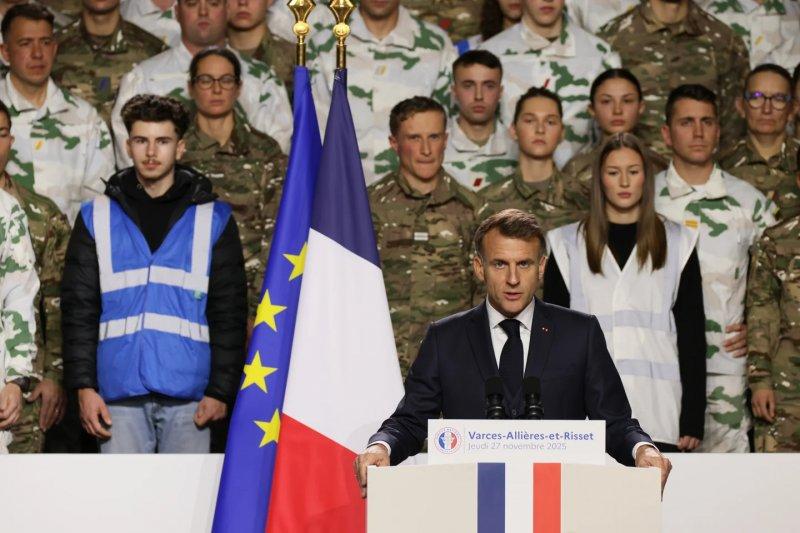
France military service plans
Outlets frame the scheme as part of a broader effort to bolster France's readiness in a Europe reshaped by Russia's invasion of Ukraine. RFI notes France fields about 200,000 active personnel and 40,000 reservists and highlights that other EU countries still maintain mandatory service. The BBC frames the scheme as creating a third tier alongside professional forces and reservists.
“France currently has about 200,000 active personnel and 40,000 reservists, and aims to increase reservists to 100,000 by 2030.”
Several sources explicitly connect the move to Russia's war in Ukraine and to changing threat perceptions across Europe. There are small numeric differences across outlets in current reservist figures and target years, but a consistent narrative emerges. The service is positioned as a strictly domestic, voluntary augmentation to France's military capacity rather than a return to compulsory conscription.
