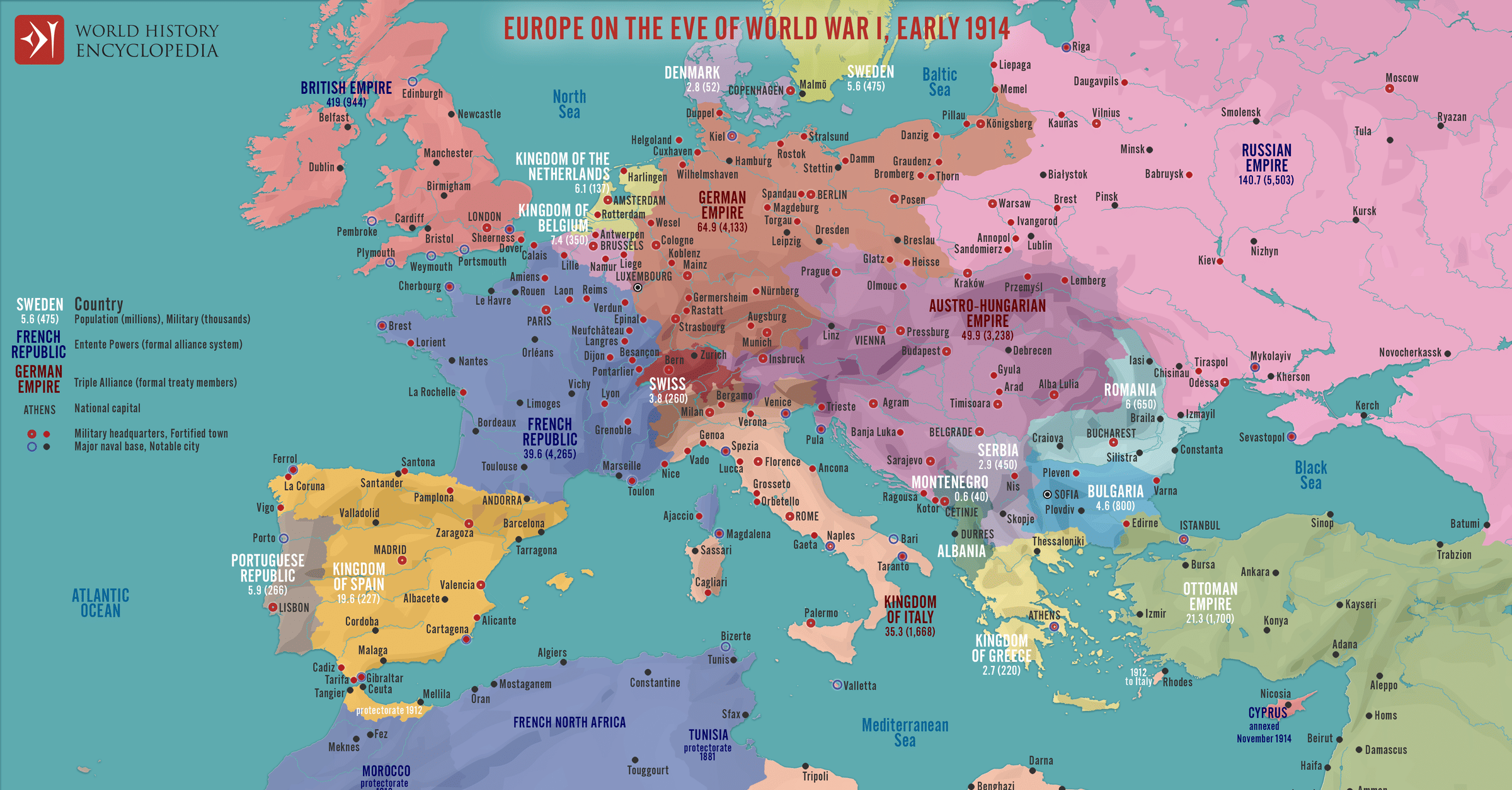
Map of Europe on the Eve of World War I, Early 1914
Key Takeaways
- Europe was divided into two armed blocs: the Triple Alliance and the Triple Entente.
- Long-standing imperial rivalry among Britain, Germany, Russia, and Austria-Hungary.
- Alliance politics reduced diplomatic flexibility and increased prewar risk.
Prewar European Order
On the eve of World War I, Europe faced a volatile mix of alliance politics, imperial rivalry, and rising nationalism.
“Europe on the eve of World War I was defined by a volatile mix of alliance politics, imperial rivalry, and rising nationalism”
The continent was split into two major blocs—the Triple Alliance and the Triple Entente—creating rigid commitments that narrowed diplomatic options.
Long-standing imperial competition among Britain, Germany, Russia, and Austria-Hungary intensified disputes over colonies, trade, and influence.
Nationalist movements within multi-ethnic empires, notably in the Balkans, pressed for autonomy or independence, undermining imperial stability and turning regional crises into global flashpoints.
Militarism and Leadership
That fragile balance was further unsettled by militarism and an arms race preceding 1914.
Leaders such as Wilhelm II (reigned 1888–1918), Franz Joseph I (reigned 1848–1916), and Nicholas II (reigned 1894–1917) oversaw states that expanded conscription, modernized armies, and poured resources into new technologies—from battleships to heavy artillery.
Military planning assumed rapid mobilization and decisive action, making restraint difficult once a crisis began.
By the summer of 1914, Europe had built a system in which a localized conflict could provoke a general war, turning diplomatic tension into an unprecedented, industrial-scale conflict.
War Risk and Prewar Summary
In summary, the article outlines a prewar order where rival blocs, expanding militaries, and a relentless arms race created a volatile environment in which crisis could escalate into general, industrial-scale war.
“Europe on the eve of World War I was defined by a volatile mix of alliance politics, imperial rivalry, and rising nationalism”
More on Europe

Left Leads Paris in First Round as RN and LFI Push Across France
12 sources compared

Muslim group claims responsibility for Amsterdam Jewish school explosion, mayor calls it attack on Jews
23 sources compared

Unknown Attackers Kill French Soldier in Erbil, Macron Says
11 sources compared

Unidentified Attacker Plants Explosive at U.S. Embassy Entrance in Oslo; Oslo Police Investigate Possible Terrorism
12 sources compared