Canada21 January, 20263 min read
Mark Carney Complicates U.S.-Canada Talks With Viral Davos Rebuke of Trump
Mark Carney publicly rebuked Trump's 'Canada lives because of the United States' remark at Davos. President Trump withdrew Carney's invitation to join his Gaza 'Board of Peace'.

41 outlets told this the same way.
Davos diplomatic clash
At the World Economic Forum in Davos, a terse public exchange between U.S. President Donald Trump and former Bank of Canada governor Mark Carney went viral and quickly complicated Canada–U.S. diplomacy.
“At Davos, Trump told attendees that ‘Canada should be grateful’ and that ‘Canada lives because of the United States.’”
Trump told attendees that 'Canada lives because of the United States' and later publicly rescinded an invitation for Carney to join a proposed 'Board of Peace,' prompting Carney to reply in Canada that 'Canada doesn't live because of the United States' and that 'Canada thrives because we are Canadian.'
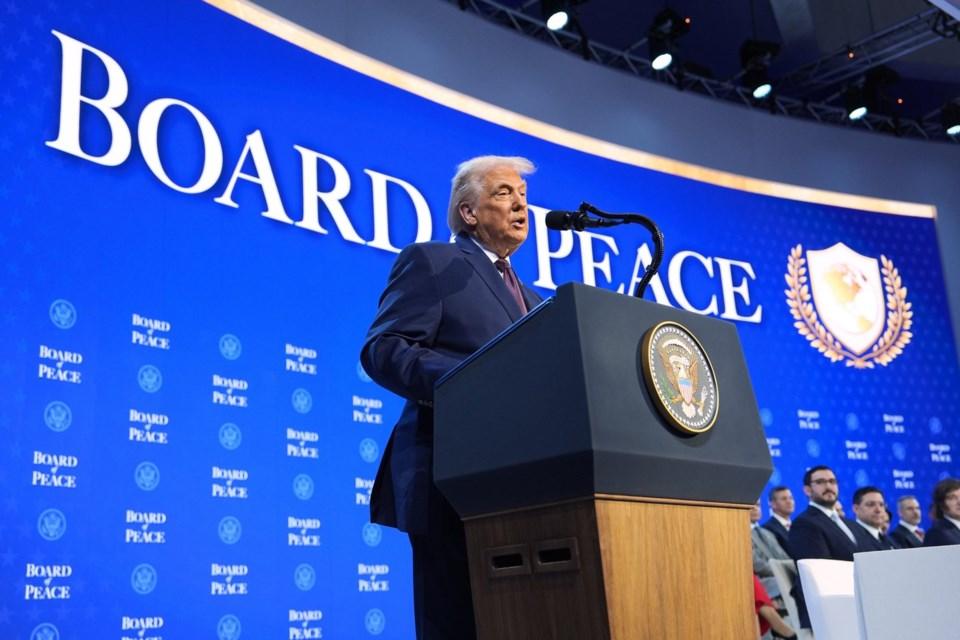
The episode has been framed variously as a diplomatic spat, a signal of deeper rupture in the post‑war order, and a distraction from substantive policy fights over trade and security.
Fraying global order response
Carney used his Davos platform to argue that the old U.S.-led, rules-based international order is fraying and that middle powers must adopt more pragmatic, issue-by-issue coalitions, what some outlets call plurilateralism or value-based realism. He warned of a 'rupture' in the postwar system and urged Canada and other middling states to build a dense web of partnerships and domestic levers (energy, critical minerals, pension funds) to preserve autonomy rather than rely on simple compliance with a single hegemon. Policy outlets and many mainstream papers reported the argument as substantive and consequential, highlighting both the strategic substance of the speech and the political challenge of turning diplomatic theory into actionable policy.
U.S.–Canada diplomatic spat
Trump's retorts extended beyond podium barbs to social media and concrete diplomatic steps. Media reported an altered map he posted covering Canada with a U.S. flag and taunts about making Canada the 51st state.
“President Donald Trump rescinded an invitation for Canada to join his new ‘Board of Peace’ after a public spat at the World Economic Forum in Davos.”
He also publicly withdrew Carney's invitation to the Board of Peace, an initiative he had pitched as part of Gaza ceasefire and reconstruction planning. Coverage linked the spat to broader trade and security rows, noting Canada's heavy trade dependence on the U.S. (more than three-quarters of exports), recent tariff frictions that hit autos and steel and aluminium, and Washington's concerns about Ottawa's engagement with third countries like China.
Reactions to Carney's Davos Speech
Reaction lines diverged sharply.
Senior U.S. officials and some commentators dismissed Carney's intervention as political noise: Associated Press reported U.S. Commerce Secretary Howard Lutnick called Carney's Davos remarks "whining," adding, "Give me a break," while other outlets quoted the same officials describing the move as "political noise."
By contrast, policy analysts and several international outlets treated Carney's speech as a serious intervention - Policy Magazine called it one of the most consequential Canadian foreign-policy interventions in decades and The Guardian and parts of the European press described a broader 'rupture' in the rules-based order that Carney was diagnosing.
That split (officials downplaying the spat, analysts elevating the speech) further complicated Ottawa's task of translating warning into policy.
Reporting errors and policy context
Reporting itself showed fractures as several outlets misidentified Carney’s office or exaggerated his career changes, forcing corrections and highlighting uneven fact‑checking amid the viral rush. Hindustan Times issued a correction that Carney is a former central banker, not prime minister. Straight Arrow News explicitly noted the same factual error.
“Correction first: the article misidentifies Mark Carney as Canada’s prime minister — Carney is a former central banker (former governor of the Bank of Canada and the Bank of England), not the country’s leader.”
Other outlets repeated or amplified the error. At the same time, detailed reporting by Il Sole 24 ORE, the World Economic Forum and defence‑focused outlets placed the episode into a broader policy context. They discussed measures such as doubling defence budgets and diversifying trade and strategic partnerships, showing that coverage ranged from factual slips and social‑media theatre to sober policy debate about how a middle power preserves sovereignty amid great‑power rivalry.