Full Analysis Summary
Turin eviction protests
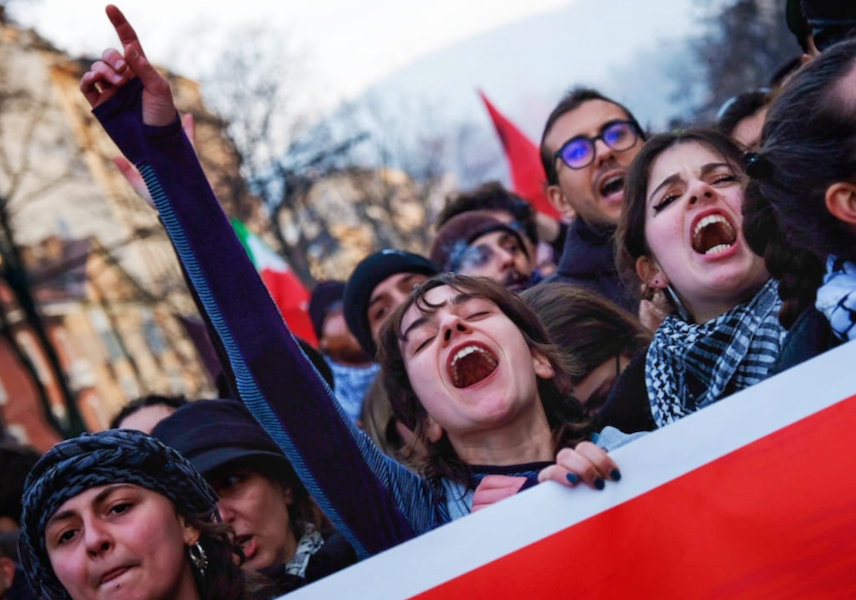
On 31 January an estimated 50,000 people rallied in Turin after the December 18 eviction of the long-standing social centre Askatasuna.
The demonstration staged three converging processions and drew a broad coalition of housing-rights groups, student collectives, trade-union activists, anarchists, No Tav supporters, and pro-Palestine and pro-Kurdistan organizations.
Freedom News reports the marches met in Piazza Vittorio Veneto and advanced toward the former Askatasuna site in Vanchiglia.
It described the demonstration as national in scale and rooted in long-running local activism around the squat founded in 1996.
Anadolu Ajansı placed the event in the context of violent clashes that prompted a response from Prime Minister Giorgia Meloni.
Meloni said the government would meet to assess threats to public order.
Coverage Differences
Tone and focus
Freedom News (Other) emphasizes the protest’s scale, coalition composition and Askatasuna’s history as a hub for grassroots movements, framing the eviction as part of a broader crackdown on dissent; Anadolu Ajansı (West Asian) emphasizes the state response and Meloni’s security framing, focusing on threats to public order and official reactions rather than the protest’s grassroots coalition.
Demonstration Clash Coverage
The demonstration erupted into extended clashes with police as officers used water cannon and tear gas and protesters erected barricades and resisted baton charges; Freedom News says confrontations lasted several hours and that activists and legal observers reported numerous injuries and at least 10 arrests.
By contrast, Anadolu Ajansı highlights the toll on security forces, reporting 108 security personnel injured, and records Prime Minister Meloni's description of the events as organized 'criminal activity,' underscoring her call for new security measures and tougher judicial application.
These accounts together show a stark difference in emphasis: one set of sources centers protesters' grievances and alleged crackdown, while the other foregrounds the injuries to officers and the government's law-and-order response.
Coverage Differences
Contradiction / Emphasis
Freedom News (Other) reports "numerous injuries, some serious, and at least 10 arrests" among protesters and observers, focusing on protester harm and police tactics; Anadolu Ajansı (West Asian) reports "108 security personnel injured" and quotes Meloni labelling the violence "criminal activity," emphasising official casualty figures and criminalisation of the unrest.
Eviction and security response
Prime Minister Giorgia Meloni personally visited injured officers and urged the judiciary to apply existing laws more firmly, arguing past leniency weakened deterrence; she also said the government would examine a proposed security decree to consider new measures.
Anadolu quotes Meloni calling the violence an 'organized criminal activity' and cites authorities' tallies of injured security personnel.
Freedom News records municipal context and notes that government officials framed the eviction as a public-order necessity, while activists say the action was a political crackdown linked to wider protests, including those over Israel’s war in Gaza.
Coverage Differences
Narrative focus
Anadolu Ajansı (West Asian) reports Meloni’s direct statements and the government’s intent to assess a security decree and promote stricter law enforcement; Freedom News (Other) reports that "Government officials framed the eviction as a public‑order necessity, while activists say it forms part of a broader crackdown on dissent," highlighting competing narratives about motive and legitimacy.
Media framing of eviction
Askatasuna’s eviction on 18 December, despite a recent municipal agreement to recognize the building as a "common good," is presented by Freedom News as a flashpoint for wider tensions over housing, public space, and dissent, with the centre described as a "hub for Turin’s autonomous and grassroots movements" since 1996.
Freedom News pieces stress organizers’ slogans for housing, schools, and income and participants’ claim that the eviction is part of a "general war to suppress dissent."
Anadolu’s reporting omits that organising detail and instead foregrounds the security consequences and Meloni’s response.
This difference illustrates how outlet type shapes coverage: one foregrounds movement history and grievances, while the other foregrounds state security and casualty figures.
Coverage Differences
Missed information / Unique focus
Freedom News (Other) includes background on Askatasuna’s founding in 1996, its role as a long‑standing social centre and the municipal agreement to recognise it as a "common good," while Anadolu Ajansı (West Asian) focuses on the immediate security response and does not recount that local organisational history or the municipal agreement in the excerpts provided.
Conflicting protest accounts
The immediate implications are unclear and the sources present competing priorities: Freedom News frames the episode as evidence of a broader clampdown on dissent and a mobilisation around housing and social rights, while Anadolu Ajansı documents a government pushing for stronger enforcement and a technical review of public-order measures.
Both narratives are present in the record - protesters' claims of crackdown and organizers' composition, and the state's account of injured officers and criminal acts - but the tension between these perspectives remains unresolved in the available excerpts.
Readers should therefore note the clear divergence in emphasis and that further reporting would be required to reconcile casualty counts, legal actions and any new security measures.
Coverage Differences
Ambiguity / Conflicting emphasis
The excerpts leave unresolved questions: casualty figures and the attribution of responsibility remain contested between Freedom News (Other), which highlights injuries to activists and arrest counts, and Anadolu Ajansı (West Asian), which highlights injured security personnel and Meloni’s criminalisation of the violence — a factual ambiguity present in the sources.