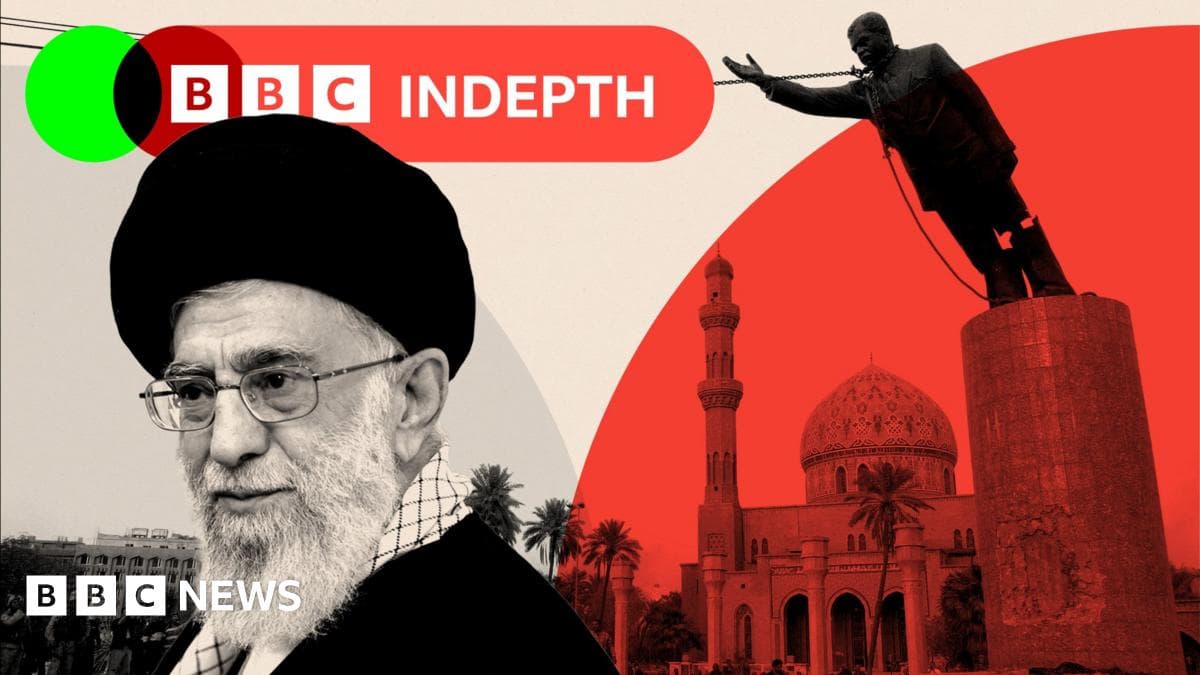
Mission accomplished? The 2003 boast that haunts today's Iran conflict
Key Takeaways
- 9 April 2003 Baghdad statue of Saddam Hussein was pulled down
- Iraqi civilians attempted but failed to dismantle statue without American troops' help
- Metal plaque torn off and marble plinth attacked with a sledgehammer
Iraq's 2003 moment
On 9 April 2003 a statue of Saddam Hussein was pulled down in central Baghdad after Iraqi civilians tried and failed to dismantle it and American troops used an armoured vehicle to topple it, a moment that symbolised regime change.
“On 9 April 2003 a statue of the leader of Iraq, Saddam Hussein, was pulled down in the centre of Baghdad”
US and allied forces had launched their attack on Iraq 20 days earlier, opening with an intense bombing campaign and an attempted decapitation strike using cruise missiles that targeted the Iraqi leader.
Three weeks after the statue fell, President George W Bush stood aboard a US aircraft carrier under a banner saying "Mission Accomplished" — a claim the article says was premature.
The Iraq war left deep scars: it is estimated that 461,000 people died in Iraq from war-related causes between 2003 and 2011 and that the war cost the US $3 trillion (£2.24 trillion), and it reshaped the Middle East while damaging public trust in politicians.
Why Iraq was invaded
The article outlines overlapping motives for invading Iraq in 2003, with regime change at the core and a mix of personal, humanitarian and strategic drivers.
For some in the Bush administration, removing Saddam Hussein answered unfinished business from the 1991 Gulf War and a personal vendetta tied to Bush family history, while others cited Hussein's brutal record, including chemical attacks on Kurdish civilians in the 1980s, as justification.
The 11 September 2001 attacks, which killed 2,977 people (not counting the 19 hijackers) after planes crashed into the Twin Towers, the Pentagon and a field in Pensylvania, changed the political calculus and helped push Iraq to the top of the agenda even though Iraq had no role in those attacks.
Public justification focused on Iraq's supposed weapons of mass destruction, but the article quotes Luis Rueda, head of the CIA's Iraq Operations Group at the time, saying "We would have invaded Iraq if Saddam Hussein had a rubber band and a paperclip."
Parallels with Iran
The article draws parallels and contrasts between 2003 and the US action against Iran, saying today's attack on Iran also emerges from mixed motives: degrading its military, preventing weapons of mass destruction, pursuing regime change and supporting people against a violent regime.
“On 9 April 2003 a statue of the leader of Iraq, Saddam Hussein, was pulled down in the centre of Baghdad”
It links a shift in Washington's calculations to the 7 October 2023 attacks on Israel by Hamas, which led Israel to target Iran and its proxies and opened the way for US action.
The piece emphasises differences with Iraq: there has been no coherent attempt to sell the war to the American public or to seek UN legitimacy, and US President Donald Trump has appeared to veer between different aims.
The article notes that US Defence Secretary Pete Hegseth has insisted Iran is different to Iraq and "will not turn into a 'forever war'."
Allies and consequences
The article examines the role of the UK and allies and warns that a lack of planning and clarity about aims risks repeating Iraq's mistakes.
It recounts Tony Blair's close alignment with President Bush in 2003, including his private note saying he would be with Bush "whatever," and notes the political cost Blair paid when the weapons justifying the war proved false.
It says the US has worked with Israel rather than the UK or other allies in the current strikes, and Prime Minister Sir Keir Starmer initially refused use of UK bases during the original strike before allowing them for "defensive" purposes.
The piece warns that avoiding large ground deployments limits options for genuine regime change, that arming local forces like Kurds has been discussed, and that there appears to be little coherent plan for what comes next, leaving improvised strategy and unpredictable consequences for regional security and domestic politics.
More on USA

Brian Kemp Refuses to Cancel Georgia May 19 Primary After Supreme Court Callais Ruling
10 sources compared

Thousands Join May Day Economic Blackout Against President Donald Trump’s Policies Across U.S.
25 sources compared
Kamala Harris Considers 2028 U.S. Presidential Run After 2024 Loss to Donald Trump
19 sources compared
Donald Trump Threatens Troop Reduction in Germany, Also Targets Italy and Spain
18 sources compared