Full Analysis Summary
Myanmar election controversy
Myanmar's three-stage parliamentary election concluded with the military-backed Union Solidarity and Development Party (USDP) poised to secure a landslide after earlier rounds on 28 December and 11 January gave it overwhelming victories.
Critics at home and abroad denounced the vote as a sham, while the junta insisted it was legitimate.
Junta leader Gen. Min Aung Hlaing inspected a Mandalay polling station and said, 'We recognise the people's vote.'
The vote was widely described as tainted by boycotts, bans on major parties, and severe limits on genuine competition.
Coverage Differences
Tone / legitimacy
The Independent (Western Mainstream) records the junta’s own insistence of legitimacy, quoting the junta leader saying, “We recognise the people's vote.” By contrast, the BBC (Western Mainstream) and the-star.co.ke (African) foreground critics and foreign observers who call the election a “sham,” presenting the ballot as widely condemned rather than accepted. This shows a divergence in emphasis between reporting the junta’s statements and reporting international and domestic condemnation.
Narrative emphasis
The Independent focuses on on-the-ground details such as inspections and local quotes from the junta, whereas BBC and the-star.co.ke prioritise the view of critics and international condemnation, illustrating how the same event is framed either through official statements or through external judgment.
Voting amid civil conflict
Participation was heavily constrained by ongoing conflict and administrative exclusions.
The BBC and the-star.co.ke report that roughly half the country was unable to vote because of the five-year civil war.
The Independent gives more granular turnout accounting, noting earlier rounds on 28 December and 11 January covered 202 townships while 67 townships, mostly under armed-group control, did not participate and voting did not take place in more than a fifth of the country’s 330 townships.
The Independent also reports the effective number of parliamentary seats fell from 664 to 586 because of non-participation.
Coverage Differences
Contradiction / data emphasis
BBC and the-star.co.ke describe large parts of the country — “about half” — being unable to vote, while The Independent quantifies disruption differently, stating voting did not take place in “more than a fifth of the country’s 330 townships” and providing specific township counts (202 covered earlier rounds; 67 townships did not participate). This is a clear discrepancy in scale and detail between sources.
Level of detail
The Independent supplies detailed seat and township counts (e.g., 202 townships covered, 67 excluded, effective seats reduced), whereas BBC and the-star.co.ke emphasise the broader picture of large areas being disenfranchised ("about half"). The difference reflects The Independent’s more granular local accounting versus the broader framing by the BBC and the-star.co.ke.
Narrowed candidate field
The field of contestants was sharply narrowed.
All three sources report that only six parties fielded candidates nationwide and that many popular parties were banned or no longer existed.
The Independent adds that although 57 parties were registered, only six appeared on ballots nationwide.
It also reports that Aung San Suu Kyi’s National League for Democracy (NLD) was dissolved in 2023 after refusing to register under new rules.
Dozens more contested regional seats, but many parties from the 2020 election were absent.
Several opposition groups either refused to run or urged a boycott.
Coverage Differences
Omission / specificity
BBC (Western Mainstream) and The Independent (Western Mainstream) both report that only six parties fielded candidates nationwide; The Independent gives additional specifics about the prior 57 registered parties and the 2023 dissolution of the NLD, while the-star.co.ke (African) stresses that many popular parties were banned and that the campaign was marked by intimidation. This shows The Independent provides party-registration detail that the others summarise or contextualise differently.
Framing of opposition action
The Independent explicitly reports that several opposition groups refused to run or urged a boycott, while BBC and the-star.co.ke frame bans and non-participation in broader terms. The Independent’s account cites dissolution and procedural rules as reasons for absence, giving a legal-administrative angle that complements the other sources’ emphasis on bans and intimidation.
Voting and security concerns
Reports on the conduct of voting and the campaign period present a mixed picture.
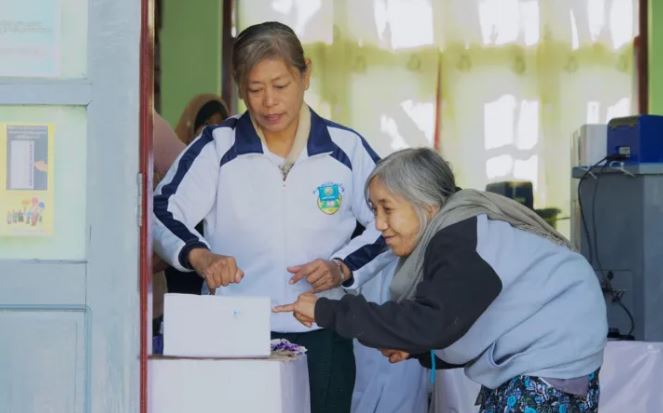
BBC and the-star.co.ke describe orderly voting at some polling stations using new local electronic machines.
They emphasise a campaign atmosphere marked by fear, heavy military and police monitoring, and reluctance to speak openly.
The Independent notes disruptions in earlier rounds and reports attacks that killed at least two officials.
It also stresses that many townships, particularly those under armed-group control, did not participate.
Security presence and monitoring are recurrent themes across the accounts.
Coverage Differences
Tone / micro-vs-macro
BBC and the-star.co.ke include on-the-ground positive observations—"orderly voting at some polling stations" and use of "new electronic machines"—while also stressing fear and monitoring. The Independent focuses more on violence and outright non-participation (including attacks that killed officials), giving a starker security-centered account. This contrast shows micro-level orderly scenes exist alongside macro-level insecurity and exclusion.
Focus on casualties vs optics
The Independent explicitly reports casualties and township exclusions ("attacks that killed at least two officials"), whereas BBC and the-star.co.ke balance those security concerns with descriptions of peaceful voting scenes at selected stations, making the latter sources more ambivalent between local order and broader intimidation.
Election outcome and implications
If confirmed, the expected USDP landslide would return parliamentary control to a military-backed party after the 2020 election saw it hold only about 6% of seats.
All three sources note this dramatic swing and the likely political implication that the military will continue to control the presidency under the constitution.
BBC explicitly reports that under the military-drafted constitution parliament will meet within two months to pick a president, expected to be coup leader Gen. Min Aung Hlaing, effectively continuing the same regime under civilian trappings.
The-star.co.ke highlights the junta's rejection of outside criticism and its claim that the vote was free and fair.
The Independent states final results are expected later this week and documents the lowered effective seat count as a result of non-participation.
Coverage Differences
Projection / consequence framing
BBC (Western Mainstream) directly links the vote result to continuation of the coup leader’s rule — saying parliament will likely pick Gen. Min Aung Hlaing as president and that this would amount to the same regime under civilian trappings — while the-star.co.ke (African) highlights the junta’s defiant posture ("the junta rejects international criticism, insisting the vote was free and fair") and The Independent focuses on procedural details like the timetable for results and seat counts. The differences show BBC foregrounds systemic political consequences; the-star.co.ke foregrounds the junta’s posture; The Independent furnishes procedural specifics.
Certainty vs timing
The Independent provides a timetable for results and quantifies seat changes but stops short of naming a likely president; BBC makes the stronger projection that the coup leader is expected to be chosen, reflecting a more direct interpretation of the constitutional mechanism.