Myanmar Military Junta Holds Sham Post-Coup Election in Only One-Third of Townships as Civil War Rages

Myanmar Military Junta Holds Sham Post-Coup Election in Only One-Third of Townships as Civil War Rages

28 December, 202537 sources compared
Asia

Key Points from 37 News Sources

  1. 1

    Voting held in 102 of 330 townships, about one-third of the country.

  2. 2

    Opposition and international observers widely reject the election as a sham.

  3. 3

    Civil war prevented voting in rebel-held areas, with heavy fighting and mass displacement.

Full Analysis Summary

Myanmar junta election overview

Myanmar's military junta began a tightly controlled three‑phase general election on Dec. 28, with voting held in about one‑third of the country's townships (102 of 330) and further rounds set for Jan. 11 and Jan. 25.

Authorities cancelled polling in dozens of townships because of ongoing conflict and have not given a full date for aggregated results.

The junta and state media presented the exercise as a return to normal politics.

The ballot features more than 4,800 candidates from dozens of parties but is dominated by pro‑military contenders.

The Union Solidarity and Development Party (USDP) is widely seen as the main beneficiary of a vote many international observers say was engineered to entrench military rule.

Coverage Differences

Discrepancy in scope and turnout figures

Some outlets report the first phase covered 102 of 330 townships and highlight cancelled polling in 65 townships (SSBCrack, Al Jazeera), while others give larger or different totals for the areas covered or compile different figures (BBC gives a different townships count). This creates uncertainty about the exact geographic extent reported by each source. The junta’s public framing of the vote as legitimate (Al Jazeera) contrasts with descriptions of the exercise as a sham or theatre by U.N. experts and many Western outlets (SSBCrack, AP).

Post-coup election controversies

The election's credibility is widely contested.

Aung San Suu Kyi and the National League for Democracy were dissolved or barred from contesting.

Suu Kyi remains jailed on a combined 27-year sentence.

Many parties that dominated the pre-coup parliament are absent.

This has prompted widespread claims that the ballot cannot produce a genuine civilian transition.

Rights groups and U.N. officials warned that the environment is one of violence and repression.

Several outlets document mass detentions, civilian deaths and large-scale displacement since the coup, though casualty and displacement figures vary between reports.

Coverage Differences

Contradiction / Variation in casualty and displacement figures

Sources differ markedly on casualty and displacement totals: some reports cite tens of thousands killed (India News Network and Al Jazeera give a much higher figure), while others cite smaller but still grave counts (SSBCrack, livemint, The Straits Times citing UN reports). Those differences reflect differing data sources, timeframes and methods rather than mutually exclusive facts, and should caution readers about precise totals.

Voting conditions and turnout

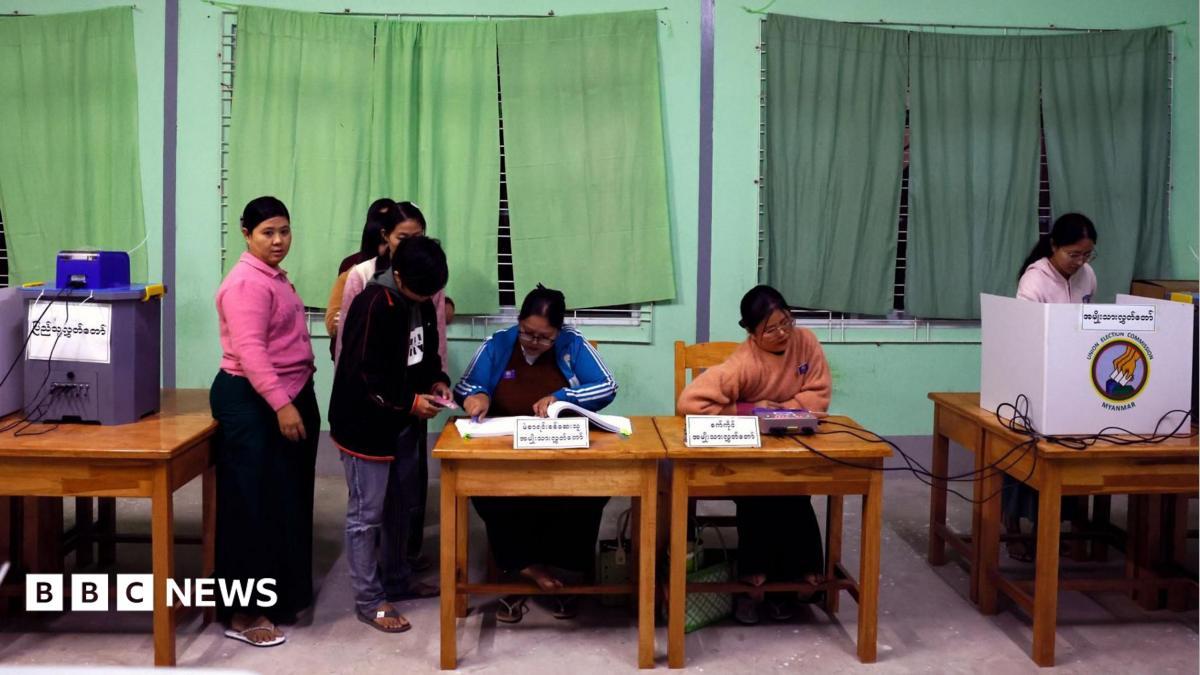
Voting conditions in many polling places were reported as restrictive and intimidating.

New electronic voting machines were used that blocked write-ins and spoiled ballots.

Authorities jailed or prosecuted hundreds for criticizing or disrupting the polls under a new Election Protection law.

Observers reported soldiers or officials pressuring voters.

Turnout appeared low in multiple locations, with specific stations reporting only a few hundred or even a few dozen voters in the first hours of polling.

Coverage Differences

Tone / Emphasis on disruption versus calm

Some outlets emphasise heavy repression and arrests tied to the election law (News18, WION, Outlook India), while others note that, despite tight security and arrests, the first phase saw no major violent incidents reported in some areas (India Today NE, thefederal). This causes divergent impressions of whether the vote proceeded without major incidents or under pervasive coercion.

Global reactions to election

International reactions were sharply divided.

The junta invited observers from countries including Russia, China and India, and state media touted endorsement by some regional delegations.

Western governments, the U.N. and rights groups condemned the election as neither free nor fair and signalled they would not accept the exercise as a legitimate transition.

Some Asian governments and neighbours were described as more willing to engage the junta.

Many international actors urged non-recognition and threatened continued sanctions.

Coverage Differences

Narrative / International alignment

West Asian and some Asian outlets note regional observers and suggest conditional engagement by neighbours (Al Jazeera, livemint), whereas Western mainstream outlets and U.N. statements emphasise non‑recognition, condemnation and sanctions (Associated Press, inews.zoombangla, Tribune India). This contrast shows differing diplomatic calculations and narratives about legitimacy.

Election amid civil war

The election unfolded amid an intensifying civil war that analysts say will shape both immediate results and longer-term stability.

Large parts of the country are controlled or contested by ethnic armed organisations and pro-democracy forces.

Millions are displaced, and air and drone strikes surged in 2025 according to monitoring groups.

Observers warn that the military-drafted constitution and reserved armed-forces seats mean even a pro-USDP legislature would leave real power with the Tatmadaw.

Many analysts expect the ballot to consolidate junta control rather than produce a meaningful return to civilian rule.
Coverage Differences

Narrative emphasis on conflict and political structure

Some sources foreground battlefield developments and rising strikes as central to why the vote cannot be credible (The Straits Times, inews.zoombangla), while others emphasise constitutional mechanics and the junta’s institutional hold (inews.zoombangla, thefederal). A few pieces also note rebel gains that have weakened junta control in places (boldnewsonline), offering a mixed picture of both persistent junta strength and significant resistance pressures.

All 37 Sources Compared

Al Jazeera

Myanmar votes as military holds first election since 2021 coup

Read Original

Al Jazeera

What’s happening in Myanmar’s civil war as military holds elections?

Read Original

AnewZ

Myanmar holds election amid civil war with low voter turnout

Read Original

Associated Press

Myanmar holds first election since military seized power but critics say the vote is a sham

Read Original

BBC

War-torn Myanmar voting in widely criticised 'sham' election

Read Original

boldnewsonline

Myanmar Junta Holds First Elections Since Coup Amid Ongoing Civil War

Read Original

Devdiscourse

Myanmar's Contested Election Amidst Civil Unrest

Read Original

DW

Myanmar's military junta holds controversial election

Read Original

Firstpost

Myanmar’s first post-coup election sees low turnout amid civil war and credibility concerns

Read Original

Folha de S.Paulo

Elections around the world in 2026 test the Trump government, influence in South America and Netanyahu's strength

Read Original

India News Network

Myanmar Holds First Election Since 2021 Military Coup

Read Original

India Today NE

Myanmar holds first general election in five years amid civil war

Read Original

inews.zoombangla

Myanmar Junta Holds First Post-Coup Vote Amid Widespread Conflict and Condemnation

Read Original

livemint

Myanmar sees first election since 2021 military coup, junta-backed party tipped to win: Where is Aung San Suu Kyi?

Read Original

livemint

Myanmar Elections: When will results be announced? — Will Aung San Suu Kyi be released from prison amid military coup?

Read Original

Mid-day

Polls open for military-ruled Myanmar’s first election in five years

Read Original

Myanmar Now

Tightly controlled Myanmar election begins amid low turnout and heavy security

Read Original

News18

Myanmar Junta Holds Elections For First Time Since 2021 Coup Amid Civil War

Read Original

NewsBytes

Myanmar junta holds first election since 2021 coup

Read Original

Newsweek

Myanmar Holds First Election in 5 Years Amid Civil War, Boycott Calls

Read Original

Nikkei Asia

Myanmar voters cast ballots in first general election since 2020

Read Original

NPR

Myanmar is set to hold phased elections. Here's why they're being called a 'sham'

Read Original

Outlook India

Myanmar Military Starts Phased Election Despite Civil War And Political Crackdown

Read Original

Sri Lanka Guardian

Myanmar junta stages election amid war and repression

Read Original

SSBCrack News

Myanmar Holds First General Election Under Military Rule Amid Civil War and Criticism

Read Original

SSBCrack News

Myanmar Holds First General Election Under Military Rule Amid Civil War and Voter Intimidation

Read Original

The Business Standard

Myanmar polls open amid civil war, junta-backed party tipped to win

Read Original

The Business Standard

Myanmar junta's shift from battlefield to ballots faces long odds

Read Original

The Island.lk

Myanmar votes as military holds first election since 2021 coup

Read Original

The Straits Times

Myanmar holds election for first time since 2021 military coup, but some are not voting

Read Original

The Sun Malaysia

Myanmar junta stages election amid civil war and condemnation

Read Original

The Sunday Guardian

Myanmar Elections 2025 LIVE Updates: Voting Begins After 4 Years of Military Rule Amid Civil War

Read Original

The Wire India

Myanmar State Media Lists Indian Observers, New Delhi Says No Official Status

Read Original

thefederal

Myanmar holds first phase of general election amid civil war

Read Original

Times of India

First election since 2021 coup: Myanmar is voting after 5 years amid civil war — why stakes are high

Read Original

Tribune India

Myanmar junta holds first elections since coup amid ongoing civil war

Read Original

WION

Death penalty law, Suu Kyi’s absence: INSIDE Myanmar’s ‘free, fair’ elections amid civil war — Has India sent observers?

Read Original