Full story
Artemis III crew named
NASA named the four astronauts for Artemis III, the next major step in its return-to-the-moon program, with Randy Bresnik as commander, Luca Parmitano as pilot, and Frank Rubio and Andre Douglas as mission specialists.
“- Published NASA has named its crew for its next major Moon mission, Artemis III, though the astronauts will not walk on the Moon or go anywhere near it”
The crew is expected to launch into Earth orbit next year, with the goal of testing two commercially developed lunar landers that are slated to carry astronauts to the surface of the moon during the Artemis IV mission in 2028.
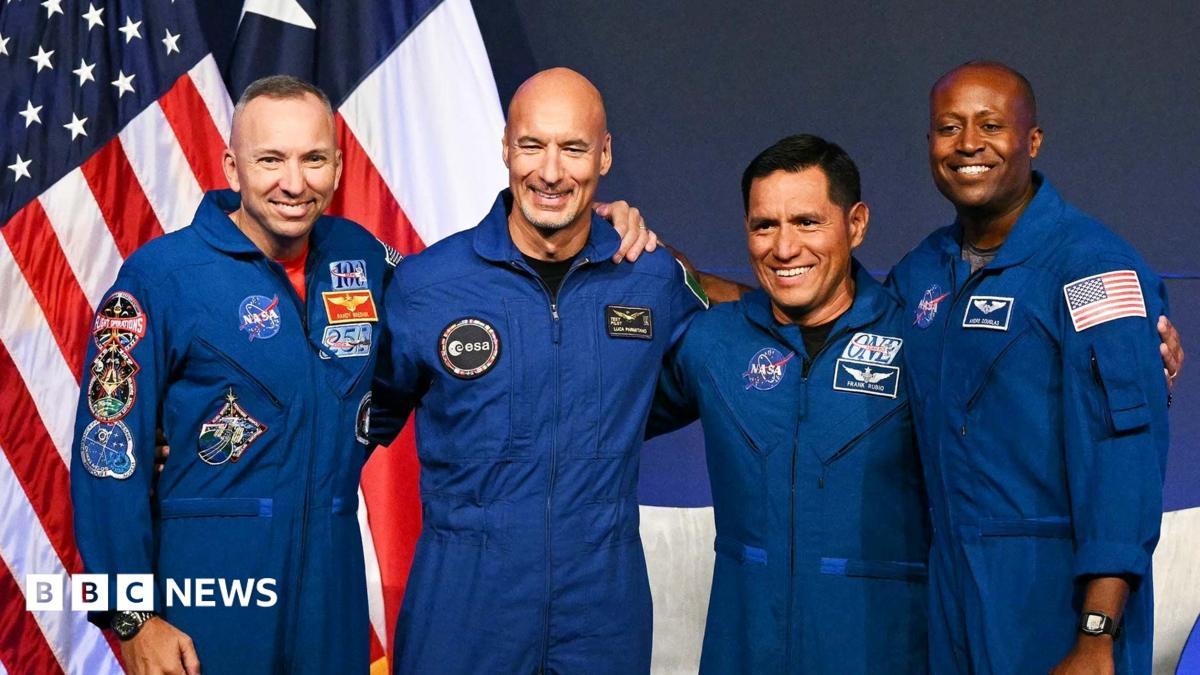
NBC News reported that Bresnik will be the mission’s commander, with Parmitano serving as the pilot, while Douglas and Rubio will be mission specialists, and Bob Hines will train with the crew as a backup member.
Jeremy Parsons, NASA’s Artemis program manager, said during NASA’s announcement on Tuesday, “This test flight will enable us to prove we can carry out highly choreographed operations with our partners across hardware interfaces, software propulsion systems and life support elements with crew in the high-stakes space environment.”
Earth-orbit docking rehearsal
Artemis III will not land on the moon under the current plan, and instead will stay in low-Earth orbit to test rendezvous and docking between Orion and the commercial Human Landing Systems from SpaceX and Blue Origin.
USA Today said the mission will launch no earlier than late 2027, and that NASA will test rendezvous and docking between Orion and the commercial Human Landing Systems (HLS) from SpaceX and Blue Origin.

NPR described Artemis III as “one of the most highly complex missions NASA has undertaken,” while also saying it will demonstrate Orion’s rendezvous and docking capabilities with two commercially designed and built lunar landers in low-Earth orbit.
NPR added that the mission begins with the uncrewed launch of Blue Origin’s Blue Moon lander, which can stay in orbit for 90 days, giving NASA time to launch the crew in the Orion space capsule atop NASA’s SLS rocket from the Kennedy Space Center in Florida.
Program risks and setbacks
The Artemis program’s timeline and hardware progress are being shaped by setbacks, including difficulties identified on the Space Launch System of Artemis II that led to revising the program architecture after fuites d’hélium were discovered at the ICPS, the upper stage.
“NASA introduced the four astronauts of the next Artemis moon program mission on Tuesday, kicking off a year or more of mission-specific training for the Artemis III crew”
Cité de l'espace reported that Lori Glaze, directrice du programme Moon to Mars de la NASA, explained that this component is not accessible on the launch pad, and that the launcher was returned to the vehicle assembly building as the only option to proceed with inspections.
In the Artemis III rollout, CBC said the announcement came after the explosion of Blue Origin’s New Glenn rocket on May 28 in Cape Canaveral, and it quoted Jeremy Parsons saying, “This test flight will enable us to prove we can carry out highly choreographed operations with our partner … with crew in the high-stakes space environment.”
CBC also reported that Blue Origin’s John Couluris said, “We expect to complete the vehicle for Artemis III and be ready for launch in 2027,” linking the company’s next steps to NASA’s schedule for the Earth-orbit test.