Technology and Science20 May, 20262 min read
NASA’s Psyche Completes Mars Flyby, Heads Toward Metal-Rich Asteroid 16 Psyche
This article is an automated aggregation of coverage from news outlets. Our editorials offer in-depth analysis curated by the NewsCord team.
Mars flyby on May 15 approached within 2,864 miles (4,609 km) of Mars. Gravity assist boosted speed and steered trajectory toward the metal-rich asteroid 16 Psyche.

Mars Flyby, Asteroid Ahead
NASA’s Psyche spacecraft completed its close approach of Mars on May 15, coming within 2,864 miles (4,609 kilometers) of the planet’s surface as it used the Red Planet for a gravity assist without using any onboard propellant. The flyby was designed to adjust Psyche’s orbital plane while boosting its speed, sending it on its way toward the metal-rich asteroid 16 Psyche. NASA’s navigation lead Don Han said, “We’ve confirmed that Mars gave the spacecraft a 1,000 mile‑per‑hour boost and shifted its orbital plane by about 1 degree relative to the Sun.”
Han added that the spacecraft is “now on course for arrival at the asteroid Psyche in summer 2029,” after the DSN Doppler signal was monitored in real time during the flyby. The mission is expected to begin its approach sequence to the asteroid in May 2029 and enter orbit in late July 2029, with the closest orbit configuration only 75 km above the surface.

Images, Instruments, Calibration
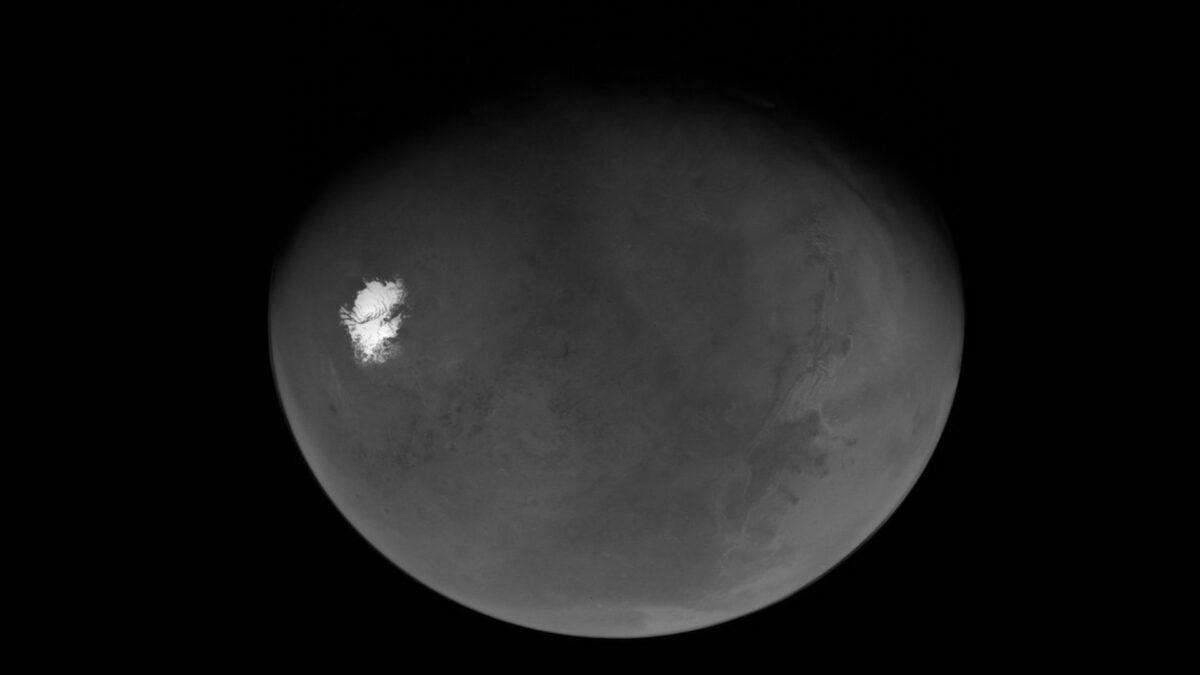
During the flyby, Psyche captured images of Mars including a nearly-full view and a high-resolution look at the double-ring crater Huygens in the southern highlands. Scientific American described the south pole as home to a 430-mile-wide ice cap, while the Psyche multispectral imager also recorded the Syrtis Major region with wind-blown streaks of dust. Jim Bell, the Psyche imager instrument lead at Arizona State University (ASU) in Tempe, said, “This dataset provides unique and important opportunities for us to calibrate and characterize the performance of the cameras.”
Bell also said the team would continue calibration imaging of Mars for the rest of the month as it recedes into the distance. Ars Technica reported that the flyby let ground teams test Psyche’s three science instruments: a multispectral imager, a gamma-ray and neutron spectrometer, and a magnetometer.
What the Flyby Enables
Psyche’s Mars encounter also served as practice for its eventual rendezvous with 16 Psyche, with the spacecraft powering up all of its instruments during the flyby. The mission carries a multispectral imager, a gamma-ray and neutron spectrometer, and a magnetometer, and it will also test a new communication system called Deep Space Optical Communications. Universe Today said DSOC is “a laser space communication system that, if proven effective and reliable, could speed up spacecraft communication with Earth by as much as 100 times.”
NASA’s description of the mission frames the asteroid as a possible metallic core of an ancient planetesimal, offering a “one-of-a-kind window into the interior of rocky planets like Earth.” Gizmodo reported that after the May 15 flyby, the team analyzed radio signals between Psyche and NASA’s Deep Space Network, and that the signals confirmed Psyche is on the right trajectory toward its asteroid target.