Oil Tops $100, Triggers Global Market Crash as Iran Tensions Escalate
Key Takeaways
- Global oil prices surged above $100 amid escalating Iran and Middle East conflict
- Global equity markets plunged, sparking broad sell-offs and heavy index losses.
- Oil shock will raise global inflation and further weaken economic growth.
Immediate market shock
Oil prices surged above $100 a barrel as WTI and Brent climbed to new levels, spurring a sharp sell-off in global markets and prompting renewed fears of a broad economic shock.
“Rising oil prices, triggered by the conflict involving Iran, are pressuring the fragile global economy”
Jakarta Globe reported that “WTI and Brent crude have both climbed above $95 and $100 per barrel, respectively,” and noted that Asian markets “retreated on Friday while oil prices again climbed above $100 per barrel,” while U.S. indices also closed lower, with the S&P 500 down 1.5% and the Nasdaq off 1.8%.

ABP News described the move as a sharp climb driven by risks to maritime trade routes, writing that “Oil prices have climbed sharply, driven by concerns about damaged infrastructure, disrupted logistics and heightened risk to maritime trade routes.”
The New York Times framed the escalation as part of a widening war that is already hitting households and businesses worldwide: “Bombs are exploding in Iran and the Middle East, but the fallout is rattling households and businesses in neighborhoods all over the globe.”
Strait of Hormuz threat
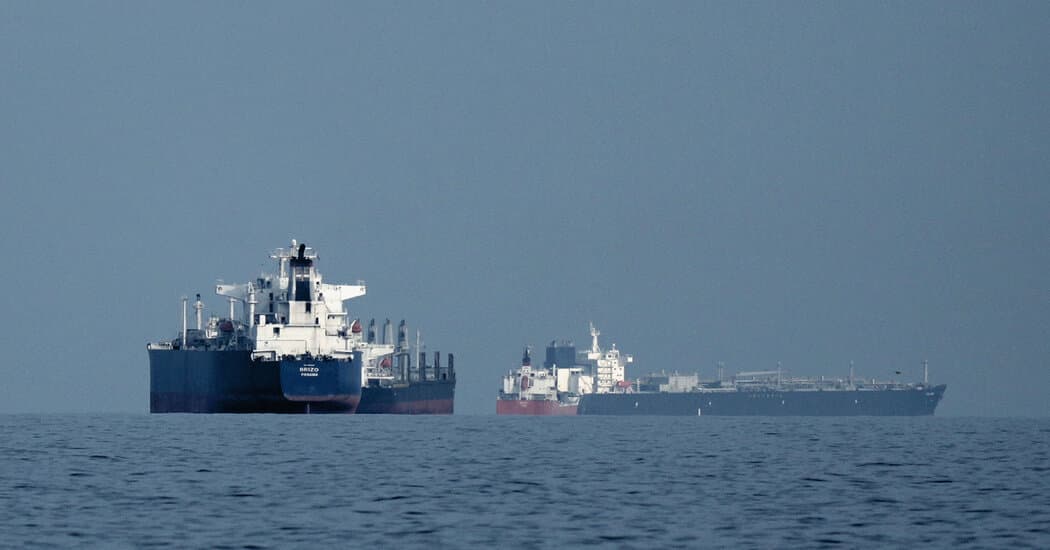
Analysts and officials point to escalating Iran tensions, including explicit threats to close the Strait of Hormuz and attacks on shipping, as the immediate trigger for the oil spike and market panic.
Jakarta Globe said the spike “was triggered by threats from Iran to shut the Strait of Hormuz,” noting that “Roughly 20% of the world’s oil flows through the strait, and attacks on ships in or around the area have already heightened concerns over the scale of supply disruption and persistent shipping bottlenecks,” according to Mizuho Bank analysts.
ABP News similarly linked price moves to damaged infrastructure and disrupted logistics.
The New York Times captured the geopolitical risk with David Goldwyn calling the shutdown scenario “the big one” for the Strait of Hormuz, calling it “the world’s most important choke point for oil.”
Growth and inflation hit
Economists warn the oil shock will subtract from growth and add to inflation, complicating already-tight policy choices for central banks.
“War in theMiddle East Advertisement Supported by Countries already walloped by a breakdown of the international trading order, war in Ukraine and chaotic U”
ABP News cited Gita Gopinath saying crude could average around $75 a barrel in 2026 versus prior expectations of $65, and that the rise could “shave 0.1 to 0.2 percentage points off global economic growth in 2026” while adding “around 0.5 percentage point to global inflation.”
Jakarta Globe echoed that higher crude has revived concerns over global inflation and could push major central banks to remain hawkish, noting that the combination of geopolitical tensions and surging energy prices “has revived concerns over global inflation, which could prompt major central banks, including the US Federal Reserve, to maintain tight or hawkish monetary policies.”
The New York Times illustrated how those macro effects are already trickling down to households and businesses—from higher mortgage rates in Kansas to gas shortages in Hanoi and disruptions to crematory services in India—underscoring immediate social costs beyond headline GDP numbers.
Fiscal strain and markets
The shock is also a stress test for emerging markets and government budgets: analysts warn limited fiscal space, high global debt and falling aid will constrain policy responses.
ABP News warned that “The world does not have the capacity” to respond as before and that policy space “has absolutely depleted” since the pandemic, while citing an IIF report that “global debt reached a record $348 trillion last year.”
ABP additionally noted U.S. aid cuts, writing that “The Trump administration’s shutdown of the US Agency for International Development (USAID) has significantly reduced American foreign assistance commitments,” with U.S. aid falling to $14.7 billion from $31.6 billion a year earlier.
Jakarta Globe highlighted the domestic consequences for Indonesia, saying higher crude “risk exceeding the assumption used in the state budget (APBN) and could increase the government’s energy subsidy burden” and that “If oil prices continue to rise, the government may need to adjust domestic fuel prices to maintain fiscal sustainability.”
The New York Times warned that shocks to inputs such as fertilizer are already hitting farmers globally, widening the economic fallout beyond energy alone.
More on Iran
US obliterates military targets on Iran’s Kharg Island, Trump warns
13 sources compared

US Deploys About 2,500 Marines to Middle East After Iran Attacks Gulf Shipping
33 sources compared
FBI Warns of Iranian Drone Plot Based on Unverified Tip; California Says No Credible Threat
10 sources compared

White House Demands ABC Retract Report Claiming Iran Sought To Launch Drone Attacks On California
11 sources compared