Full Analysis Summary
Ram Temple Consecration Event
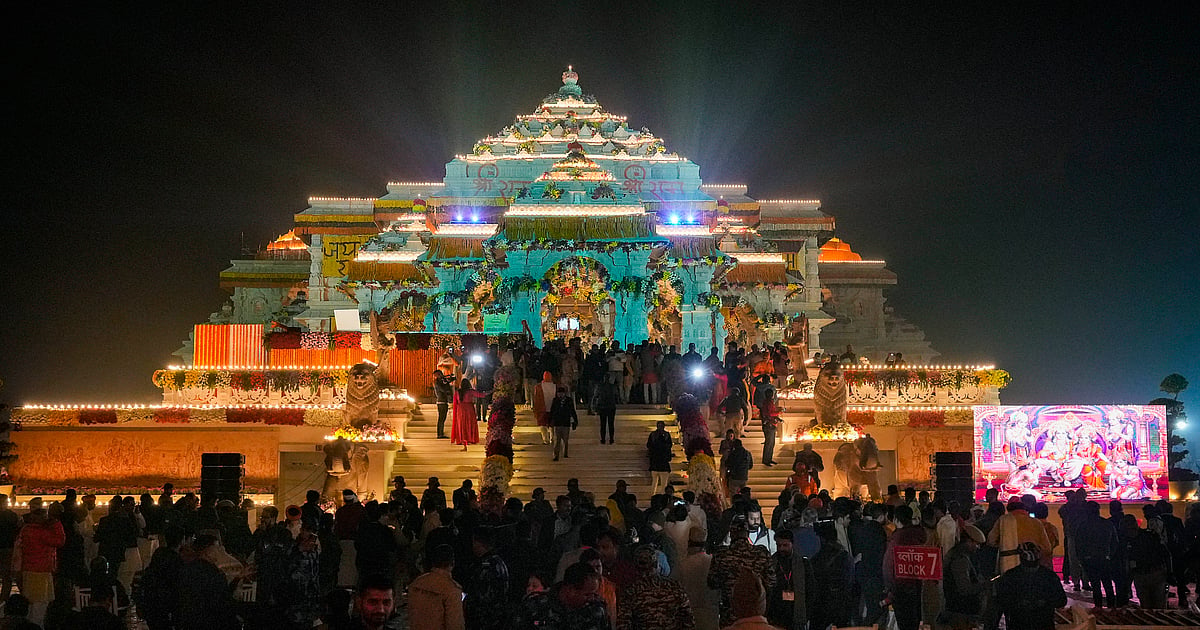
Prime Minister Narendra Modi led the Pran Pratishtha (consecration) ceremony at the Ram Temple in Ayodhya.
The event was attended by over 7,000 people.
Many leaders from the Opposition INDIA bloc stayed away, calling it a BJP-RSS event aimed at gaining votes ahead of the Lok Sabha elections.
Although the Ram Mandir trust invited them, most Opposition leaders declined and said they would visit later.
On the day of the ceremony, Rahul Gandhi continued his Bharat Jodo Nyay Yatra in Assam and was denied entry to a local shrine until after the ceremony.
Parallel coverage highlighted the religious pageantry and Modi’s ritual participation.
An opinion column argued that the consecration enjoys widespread public support and that opponents misread the national mood.
Coverage Differences
tone
India Today (Asian) centers the boycott’s electoral charge, reporting that Opposition leaders labeled the consecration a “BJP-RSS event” aimed at votes, whereas The New Indian Express (Asian) foregrounds rituals and the temple’s inauguration details. The Indian Express (Asian, opinion) frames the event as enjoying “widespread support,” suggesting critics like Rahul Gandhi are out of touch with public sentiment.
missed information
India Today uniquely reports Rahul Gandhi’s parallel itinerary and access restriction to a local shrine during the consecration window; this detail is absent from The New Indian Express and The Indian Express snippets.
narrative
The Indian Express opinion column supports the temple as a symbol of renewal but warns against religion as political ideology, while India Today frames the boycott as a rejection of a BJP-RSS vote push; The New Indian Express reports both the boycott and the ceremonial grandeur without opining on national mood.
Political Reactions to Ceremony
Opposition leaders, including the Congress and Left parties, boycotted the ceremony, arguing it was a political move by the BJP and RSS.
However, reactions were not uniform: some Himachal Pradesh Congress ministers attended the event.
The Aam Aadmi Party held celebrations in Delhi to mark the occasion.
West Bengal Chief Minister Mamata Banerjee led a multi-faith rally promoting religious harmony.
India Today reports that most invitees in the INDIA bloc declined the invitation and planned to visit later, with Rahul Gandhi continuing his Bharat Jodo Nyay Yatra.
In contrast, an Indian Express column states that the consecration resonates widely with Indians and criticizes leaders who dismiss that sentiment.
Coverage Differences
narrative
The New Indian Express (Asian) presents a spectrum of responses—boycott, selective attendance, and cross-party celebrations—while India Today (Asian) foregrounds the boycott as a rejection of a BJP-RSS vote grab. The Indian Express (Asian, opinion) emphasizes popular support and critiques Opposition leaders’ reading of the public mood.
tone
India Today uses the Opposition’s own language about a “BJP-RSS event” to emphasize electoral motives, The New Indian Express maintains a descriptive tone across political reactions and ceremonial elements, and The Indian Express opinion column promotes renewal and reconciliation while warning about politicization.
unique/off-topic
Only The New Indian Express highlights AAP’s celebrations and Mamata Banerjee’s multi-faith rally, a civic-harmony angle missing from India Today’s boycott focus and from The Indian Express opinion’s macro-level mood analysis.
Temple Ceremony and Political Reactions
Reports also detail the ceremony’s religious and cultural grandeur: Modi performed rituals, visited the Kuber Tila shrine, and unveiled a statue of Jatayu.
The temple’s traditional Nagara architecture drew large crowds and enthusiastic workers.
India Today quantifies attendance at over 7,000 and situates those numbers amid a charged political context, with Opposition leaders declining invitations and alleging a vote-focused BJP-RSS event.
The opinion in The Indian Express, however, focuses less on ceremony specifics and more on the broader public mood and the risks of fusing religion with political ideology.
Coverage Differences
focus
The New Indian Express (Asian) offers ceremony-specific and architectural detail, India Today (Asian) combines event details with electoral controversy and attendance figures, while The Indian Express (Asian, opinion) omits ceremony minutiae in favor of commentary on national sentiment and ideological risks.
tone
The New Indian Express conveys ceremonial enthusiasm and scale; India Today injects sharper political contention with boycott and vote-grab language; The Indian Express adopts an admonitory tone about ideological misuse of religion and calls for renewal and reconciliation.
Political Reactions to Consecration
The clash over the consecration’s meaning is thus sharply drawn.
India Today documents the Opposition’s boycott and its argument that the ceremony was a BJP-RSS vote grab before national elections.
The New Indian Express captures a more variegated response that includes boycotts, selective attendance, and harmony-focused rallies.
The Indian Express op-ed asserts that the temple enjoys widespread support and that leaders like Rahul Gandhi misread the national mood.
The same op-ed cautions against turning religion into political ideology, urging renewal and reconciliation rather than polarization.
Coverage Differences
contradiction
India Today (Asian) reports the Opposition’s claim that the event is an electoral “BJP-RSS event,” while The Indian Express (Asian, opinion) asserts the consecration has “widespread support,” implying the boycott narrative misjudges public sentiment. The New Indian Express (Asian) complicates a binary by showing both boycott and participation across parties.
missed information
Only India Today provides a concrete crowd estimate and the Rahul Gandhi access-delay detail; The New Indian Express and The Indian Express do not include those specifics in their excerpts.
narrative
The Indian Express urges the temple to symbolize renewal and warns of Pakistan/Iran-style pitfalls if religion becomes political ideology, adding a comparative caution absent from the other two sources’ reporting frames.