Oxford University Press Names 'Rage Bait' Word of the Year After Threefold Surge in Online Use

Oxford University Press Names 'Rage Bait' Word of the Year After Threefold Surge in Online Use

01 December, 202514 sources compared
Technology and Science

Key Points from 14 News Sources

  1. 1

    Oxford University Press chose 'rage bait' after a public three-day vote by about 30,000 people

  2. 2

    Usage of the term rose nearly threefold during 2025
  3. 3

    Term describes online content deliberately designed to elicit anger to boost engagement

Full Analysis Summary

OUP 2025 Word Choice

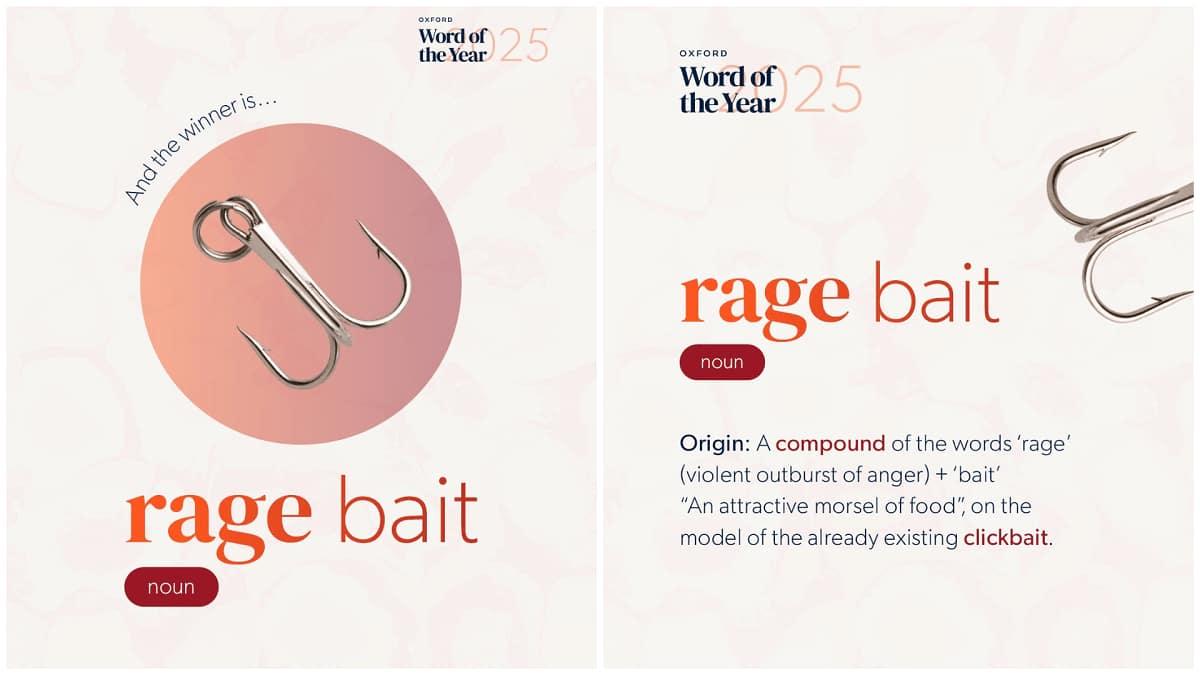
Oxford University Press has named "rage bait" its Oxford Word of the Year for 2025 after usage reportedly tripled over the past year.

The selection followed a three-day public vote involving roughly 30,000 people.

Global News reported that OUP chose the compound after 'three days of voting by about 30,000 people.'

It described the term as combining 'rage' and 'bait' and noted the tripling of use amid social unrest and debates over online-content regulation.

Moneycontrol said OUP selected the term after a three-day public vote involving more than 30,000 people and linked the choice to OUP's lexical data and sentiment analysis.

lbc.co.uk highlighted that Oxford Languages/Oxford University Press named 'rage bait' its word of the year after usage tripled over the past 12 months and noted it beat out 'aura farming' and 'biohack'.
Coverage Differences

Emphasis/location of detail

Western mainstream outlets emphasize the public vote and the statistical surge (30,000 voters; threefold/ tripled usage) as the decisive factors in OUP’s selection, while some alternative or regional outlets stress different aspects such as origin or cultural framing. For example, Global News (Western Mainstream) foregrounds the vote and tripling of usage; Moneycontrol (Asian) notes OUP’s lexical analysis and sentiment-data methods; Storyboard18 (Western Alternative) frames the term as reflecting content-strategy shifts and records the earlier Usenet origin.

Unique/off-topic detail

Some outlets add related or off-topic context: Daily Mail (Western Tabloid) mentions that Cambridge Dictionary picked a different Word of the Year (“parasocial”), which is not central to OUP’s announcement but appears as comparative context in that outlet’s coverage.

Rage bait definitions

Outlets repeatedly defined the term as online content deliberately engineered to provoke anger or outrage to drive engagement, shares, or traffic, often amplified by algorithms.

EasternEye quoted Oxford as defining 'rage bait' as online content deliberately designed to provoke anger or outrage, calling it a sharper cousin of clickbait aimed at driving traffic, shares, and engagement.

lbc.co.uk specified where this occurs, noting it plays out on platforms like X, TikTok, and YouTube.

Moneycontrol described 'rage bait' as distinct from but related to clickbait, and linked it to practices like 'rage-farming' and misinformation amplified by social-media algorithms.

Coverage Differences

Tone and framing

Western mainstream sources (EasternEye, lbc.co.uk) provide a definitional, descriptive frame that connects the term to clickbait and social platforms; Moneycontrol (Asian) and Storyboard18 (Western Alternative) add a more critical framing that emphasizes manipulation, misinformation and strategy. The precise emphasis differs: EasternEye focuses on definition and algorithmic reward, lbc.co.uk names platforms, and Moneycontrol links the term to misinformation and 'rage-farming'.

Reported commentary vs. reporting

Some outlets include quoted experts or commentators (EasternEye quotes lexicographer Susie Dent on how social media rewards outrage) while others summarize OUP’s definition without extra commentary.

OUP word selection process

OUP's selection blended public voting with lexical analysis and cultural commentary.

Several outlets noted OUP opened a three-day public vote that attracted roughly 30,000 participants and used sentiment analysis and usage trends to inform the decision.

Careers360 described the mix of public votes, commentary sentiment, and OUP's lexical data; Free Press Journal said the process combined public voting, sentiment analysis, and linguistic research, and Global News emphasized both the vote and the surge in usage that pushed 'rage bait' ahead of runners-up 'aura farming' and 'biohack'.

Coverage Differences

Narrative emphasis

Some reports foreground the public-vote element (Global News, Moneycontrol), while others stress OUP’s analytic methods (Careers360, Free Press Journal). That leads to differing narratives about whether the win is primarily a popular choice or a data-driven lexicographic conclusion.

Depth of background

Some outlets connected this year’s choice to previous winners and a perceived cycle in online attention; Careers360 explicitly linked the decision to past winners like 'brain rot', while tabloid and regional outlets sometimes added broader cultural comparisons or omitted the historical thread.

Platform, AI and attention debates

Coverage framed the choice as a symptom of broader 2025 debates about platform incentives, AI, and mental health.

Free Press Journal reported that OUP's president linked the pick to 'wider 2025 concerns about AI-driven deepfakes, virtual influencers, and the changing ethics of online attention,' while Moneycontrol and Storyboard18 called the surge evidence that 'emotional manipulation has become central to content strategies' and flagged ties to misinformation and algorithmic amplification.

South Florida Reporter summarized this as a cultural shift 'from informational exchange to emotional, outrage-driven engagement' and urged creators and platforms to reflect.

Coverage Differences

Severity and framing

Some outlets stress technological threats and ethical questions (Free Press Journal emphasizes AI-driven deepfakes and virtual influencers), while others stress public-health and attention-economy concerns (South Florida Reporter, Moneycontrol). Western Alternative and mainstream outlets may differ in how strongly they condemn platform incentives versus neutrally describing them.

Reported voices vs. summary judgment

Some pieces quoted OUP figures or lexicographers directly, while others offered broader editorial summaries. EasternEye included lexicographer Susie Dent’s comment about social media rewarding outrage, whereas other outlets presented a summarised cultural reading without named expert quotes.

Origins of rage bait

Contextual and historical notes across the coverage underline that "rage bait" evolved from earlier internet slang and sits alongside recent dictionary picks that map cultural anxieties.

Storyboard18 and multiple mainstream outlets point out the term’s early Usenet appearance in 2002; Storyboard18 wrote "The phrase first appeared on Usenet in 2002," and Free Press Journal likewise traces the compound from early online use to mainstream discourse.

Careers360 placed the selection in the continuity of OUP’s recent public-engagement picks, listing past winners such as "goblin mode," "rizz" and last year’s "brain rot," while some outlets added comparative notes, with the Daily Mail mentioning Cambridge’s "parasocial" pick.

Coverage Differences

Omissions and breadth

Not all outlets include historical origin or comparisons: some (Storyboard18, Free Press Journal, Moneycontrol) highlight the term’s Usenet origin and etymology, whereas others focus on the immediate selection and implications and omit deeper etymological context. Similarly, Careers360 gives explicit continuity by naming past winners, while other pieces do not.

Tone: historical vs. immediate news

Tabloid and some regional outlets incorporate sideways references and comparisons (Daily Mail noted Cambridge Dictionary’s selection of 'parasocial'), while others keep a tight lexicographic and cultural-analysis focus.

All 14 Sources Compared

Careers360

Rage bait is Oxford Word of the Year 2025, reflecting a year shaped by online anger, unrest, manipulation

Read Original

CNN

Oxford’s Word of the Year 2025 is utterly infuriating

Read Original

Daily Mail

'Rage bait' is named Oxford word of the year: Phrase describing anger-inducing online content beats 'aura-farming' and 'biohack' to the number one spot

Read Original

EasternEye

‘Rage bait’ is Oxford University Press’s word of the year for 2025

Read Original

ETV Bharat

Oxford University Press Word Of Year Reflects Online Outrage With ‘Rage Bait’

Read Original

Free Press Journal

‘Rage Bait’ Declared Oxford Word Of The Year 2025; Know Meaning, Usage & Why It Was Chosen

Read Original

Global News

‘Rage bait’ is Oxford University Press’s 2025 word of the year

Read Original

lbc.co.uk

'Rage bait' named Oxford word of the year

Read Original

Moneycontrol

What is 'rage bait'? Oxford Word of the Year 2025

Read Original

New York Post

Oxford English Dictionary’s word of the year introduces a new way to troll social media users

Read Original

South Florida Reporter

And the Oxford Word of the Year 2025 is…Rage Bait

Read Original

Storyboard18

Oxford names ‘rage bait’ as Word of the Year for 2025

Read Original

The Journal

Oxford has revealed its Word of the Year 2025, and it's another double barrel

Read Original

Times of India

Oxford word of the year: It's ‘rage bait’ — here's what it means

Read Original