Palestinians Vote April 25, 2026 For 183 Local Bodies, Central Elections Commission Says
Key Takeaways
- Approximately 1.03 million Palestinians eligible to vote on April 25, 2026.
- 183 local councils to elect representatives out of 420 nationwide.
- 70,449 voters in Deir al-Balah among eligible voters.
Local elections set for April 25
Palestinians are set to vote on Saturday, April 25, 2026, to elect representatives for 183 local bodies out of 420 across the Palestinian territories, according to the Central Elections Commission – Palestine.
“RAMALLAH, April 24, 2026 (WAFA) – Around 1”
WAFA said “Around 1.03 million Palestinian citizens are set to head to the polls on Saturday, April 25, 2026,” and that the commission listed “1,029,550 voters” as eligible.

The WAFA report specified that Deir al-Balah is the “only constituency in the Gaza Strip included in the vote,” with “70,449 voters” there.
SadaNews similarly said “approximately 1 million and 30 thousand citizens, including 70,449 voters in Deir al-Balah, will head to polling stations” on April 25.
Both reports tied the vote to a broader adjustment of where elections would be held, with WAFA saying the Palestinian government called for local elections across the country and later postponed voting in most Gaza Strip areas except Deir al-Balah.
The WAFA piece also said the elections are being held under “a new electoral law issued in November 2025,” while SadaNews said the law was issued on “November 19, 2025.”
In al-Bireh, the Central Elections Committee is also preparing to host media coverage, with Al-Najah News reporting it is equipping “a media center at its headquarters in al-Bireh” for Election Day.
Voter numbers and council breakdown
The election preparations described by WAFA and SadaNews include detailed voter distribution and the structure of the local contests.
WAFA said the Central Elections Commission reported “494,733 male voters (51.6%) and 464,368 female voters (48.4%),” and it added that “31,570 voters are persons with disabilities, representing 3.3% of the electorate.”
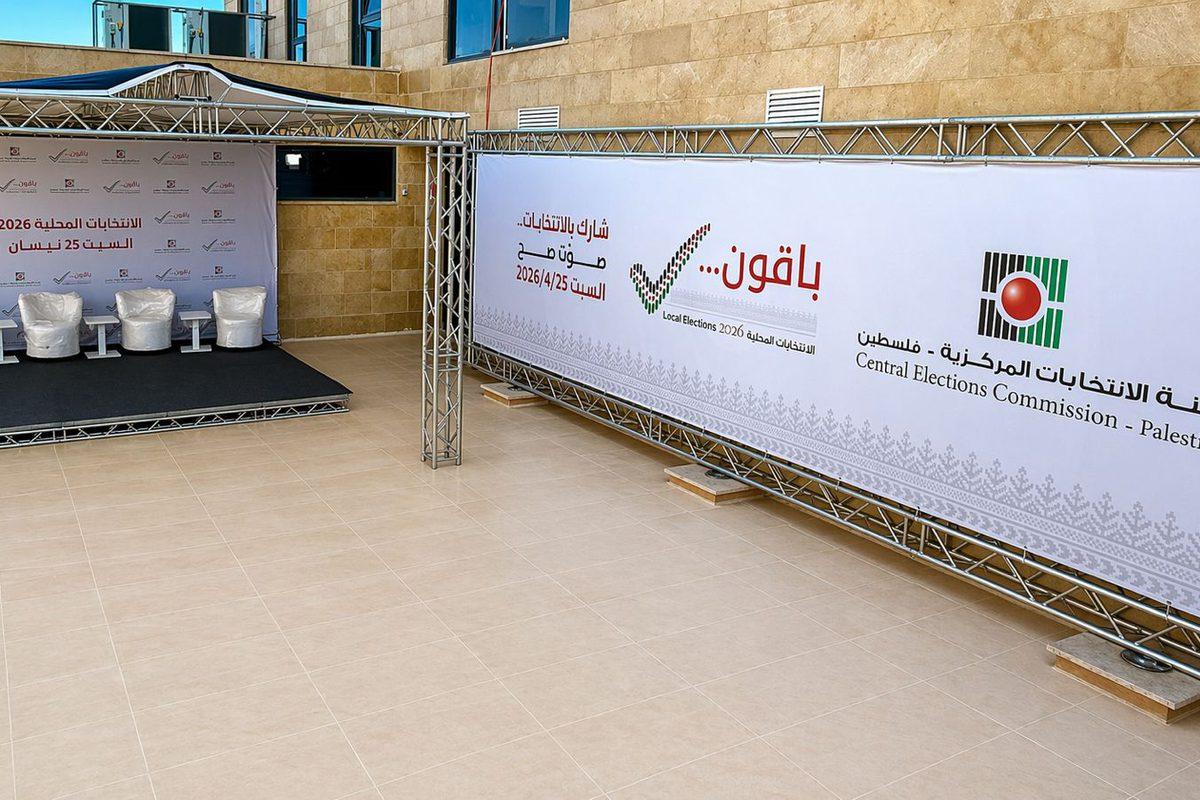
SadaNews echoed the same gender split by stating “494,733 male voters in the West Bank, constituting (51.6%), and 464,368 female voters, constituting (48.4%),” and it gave disability figures as “31,570 male and female voters (3.3%), including 14,768 females and 16,802 males.”
On the council level, WAFA said elections are being held in “90 municipal councils,” including Deir al-Balah, and in “93 village councils,” with the total local bodies reaching “420.”
SadaNews matched the same council counts, saying elections will take place in “90 municipal councils” and “93 village councils,” and it described the competition in Deir al-Balah as “321 electoral lists with 3,773 candidates—2,573 men and 1,200 women.”
Both reports also described lists that will be formed by acclamation, with WAFA saying “42 municipal councils and 155 village councils will be formed by acclamation,” while SadaNews said the number of local authorities formed by acclamation reached “42 municipal councils and 155 village councils.”
WAFA further said the commission prepared “491 polling centers,” including “12 in Deir al-Balah,” and it said there are “1,922 polling stations in total.”
Candidates, agents, and observers
The sources also lay out the scale of candidate participation and the accreditation of election-day personnel.
“Al-Najah News reported that the Central Elections Committee said it is working within the framework of its preparations to hold the local elections on the upcoming Saturday by equipping a media center at its headquarters in al-Bireh to serve journalists, media professionals, and visitors to the committee on Election Day”
WAFA said “321 electoral lists are competing, comprising 3,773 candidates—2,573 men and 1,200 women,” and it noted that “Eight of these lists are headed by women.”
It added that “Party-affiliated lists make up 12%, while independents account for 88%,” and it said elections in village councils involve “1,358 candidates competing, including 1,049 men and 309 women.”
WAFA reported that “42 municipal councils and 155 village councils will be formed by acclamation, while 40 local bodies had no candidates at all,” and it described the commission’s preparations for oversight as “2,539 observers from 69 monitoring bodies.”
SadaNews similarly said the commission has approved “6,463 electoral list agents and candidates, 145 guests and diplomats, and 2,539 observers accredited from 69 accredited monitoring bodies,” and it specified that “336 observers from 12 institutions” are accredited in Deir al-Balah.
WAFA said “806 journalists from 120 media outlets, including 14 international ones, will cover the elections,” and it added that “More than 10,600 staff members will also manage election day operations, including 651 in Deir al-Balah.”
SadaNews gave a matching election-day staffing figure, stating “a team of 10,677 employees, including 651 in Deir al-Balah, will work under the Central Election Commission.”
Law and electoral systems
The election-day rules described in the sources center on a “new elections law” issued in November 2025 and two different electoral systems for municipal and village councils.
WAFA said the elections are being held under “a new electoral law issued in November 2025,” and it specified that the law uses “proportional representation for municipal councils and a majority system for village councils.”
SadaNews provided the same framework but tied it to a specific issuance date, stating the law was “issued on November 19, 2025,” and it described the municipal system as “the proportional representation system (open list) for municipal councils, and the majority system (individual candidacy) for village councils.”
SadaNews explained that in municipal councils, “candidacy in municipal councils is through open lists,” where “the electoral list name and the names of all its candidates are included on the ballot paper,” and it said “Voters choose one list and five (5) candidates or less from the same list they voted for.”
It also stated that seats are allocated to lists that receive “5% (threshold) or more of the valid votes,” with distribution “according to the "Sainte-Laguë" method,” and it added that seats are distributed to candidates “taking into account the representation of women and the Islamic-Christian quota.”
For village councils, SadaNews said “candidacy is individual (majority system), and the names of candidates appear on the ballot paper arranged by the order of nomination,” and it said voters “select five (5) candidates or less” with seats distributed “in descending order,” again “while considering the representation of women and the Islamic-Christian quota.”
Al-Quds Al-Arabi’s report also framed the election timing and process in terms of political conditions, saying “U.S. President Donald Trump’s decision to extend the ceasefire with Iran increased the likelihood of holding the elections,” and it reiterated that the vote is scheduled “on Saturday, April 25, in 183 local authorities.”
Media center, turnout messaging, and risks
Beyond the mechanics of voting, the sources describe how the election process is being communicated and monitored, and they also outline concerns about security and participation.
“RAMALLAH, April 24, 2026 (WAFA) – Around 1”
Al-Najah News said the committee’s media center includes “several zones prepared for filming and live broadcasting,” “advanced technical equipment,” and “a specialized media team,” and it said it is “planned that the center will host press conferences on Election Day and on the day the results are announced.”
It also said the committee invited media institutions and journalists “to visit the center starting from the morning of Saturday, April 25, through the evening of Sunday, April 26,” and it stressed that establishing the center comes within its commitment to “enhancing transparency and facilitating access to information for the media and the public.”
In parallel, Al-Quds Al-Arabi reported that the Central Election Committee is working to deepen its advertising campaign and said the last advertisement on the committee’s website emphasized that “voting is a right and obstructing it is a crime.”
That report also quoted Farid Ta’m Allah, the spokesperson for the Central Election Committee, saying “there seems to be a widespread impression that there is apathy toward participating in the municipal election process,” but adding that “there are indicators that contradict that.”
Al-Quds Al-Arabi said Ta’m Allah told the outlet that “we have about 2,500 local observers, about 6,000 candidates, more than 700 journalists from 150 countries, in addition to about 150 international observers, alongside local observers.”
The same report described how the committee expects disruptions and coordination, with Ta’m Allah saying “in principle, we assume that the government has coordinated with the Israeli side,” and that “during the vote we may face things beyond our control, such as incursions, curfews, or settler attacks.”
More on Other
Benjamin Netanyahu Discloses Early-Stage Prostate Cancer After Two-Month Delay Amid Iran War
33 sources compared
Pentagon Seeks $1.5 Trillion for Golden Dome, Drones, and Counter-Drone Systems in Fiscal 2027
11 sources compared

Israel Intensifies Ceasefire Violations, Establishing ‘Yellow Line’ in Southern Lebanon
37 sources compared

Pope Leo XIV Leads Open-Air Mass in Douala as 120,000 Attend
15 sources compared