Iran10 May, 20263 min read
Pentagon And IAEA Warn Tehran Over 450 Kilograms Of Enriched Uranium Stockpile
This article is an automated aggregation of coverage from news outlets. Our editorials offer in-depth analysis curated by the NewsCord team.
Pentagon and IAEA issued simultaneous warnings to Tehran. US defense secretary spoke with Iraqi counterpart about Iran’s proxy forces.

Nuclear pressure and warnings
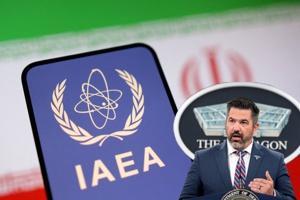
The Pentagon and the International Atomic Energy Agency issued “serious warnings to Tehran” as Washington and the IAEA coordinate pressure over the “fate of 450 kilograms of enriched uranium” that Iran has stockpiled. In a telephone exchange described by Al-Sharq Al-Awsat as “the strongest warning Washington has issued to Baghdad,” the US Secretary of Defense, Pete Hegseth, warned Iraq’s Defense Minister, Thabit Al-Abbasi, against any involvement by Tehran’s proxy militias in response to “the United States–planned military operation in the region.”
Rafael Grossi, the director-general of the IAEA, said Iran must “seriously improve” its cooperation with UN inspectors to prevent escalation, and he added that since the twelve-day war between Iran and Israel in June, the Agency has not yet gained access to key Iranian nuclear facilities such as Fordo, Natanz, and Isfahan. Gooya News also says a former Pentagon official, citing security sources to Reuters, said Washington is concerned about the “revival of hidden parts of the Natanz and Fordo enrichment facilities,” which were targeted during last summer’s war but “have not been completely destroyed.”

Human rights, courts, torture
A BBC account of human rights in Iran traces how the Shah’s security organization, SAVAK, was “tied to torture and terror,” and it says an American writer described SAVAK as elevating torture to the highest degree. The BBC reports that Amnesty International said opponents in SAVAK prisons faced “whippings and beatings, electric shocks, nail and tooth extraction, boiling-water enemas, hanging weights from the testicles, confinement to a hot iron bed, insertion of broken glass into the anus, and rape.”
The BBC also describes how defendants in military courts were denied access to independent lawyers and that harsh sentences led opponents to nickname them “tyranny courts.” It adds that jurist Abol-karem Lahiji said handing political dossiers to military courts was part of the law establishing SAVAK in 1335 (1956), and it quotes Lahiji telling BBC Persian: “Now the Islamic Republic likewise says we have no political prisoners.”
Death sentence and diplomacy
Amnesty International called for the immediate repeal of the death sentence for Mohammad Javad Vafaei-Tani, described as a sportsman and political prisoner, and it told The Guardian that the accusation does not align with legality and transparency required by international law. The Al Jazeera-linked reporting in the Iran International ecosystem also includes HRANA’s account that the death sentence of Mohammad Javad Vafaei-Tani, a 30-year-old boxer and political prisoner held in Vakilabad Prison in Mashhad, was upheld again by the Supreme Court after the appeal for retrial was denied.
Maria Malmer Stenergard, Sweden’s foreign minister, announced that Sweden summoned the Iranian ambassador in Stockholm after reports about a Swedish citizen being sentenced to death in Iran, and she said the Swedish Foreign Ministry had received information indicating the man accused of espionage had been initially sentenced to the death penalty. On Azar 26, Sweden’s Foreign Ministry confirmed the arrest of a Swedish-Iranian citizen in Iran in response to Iran International, and the report says the Swedish embassy in Tehran and the country’s foreign ministry are in contact with the detained individual’s family.