Gaza Genocide26 November, 20252 min read
Pope Leo Meets Middle East Christian Leaders in Turkey, Condemns Religious Violence
Condemned violence in religion and urged Christian unity at 1,700th‑anniversary gathering in Iznik Warned escalating, piecemeal wars threaten humanity, urging renewed global dialogue and peace

60 outlets told this the same way.
Outlets did split on Israel Marks Oct. 7 Anniversary With Strikes on Gaza, Netanyahu Faces Election After Nova Tribute →
Pope's Türkiye visit
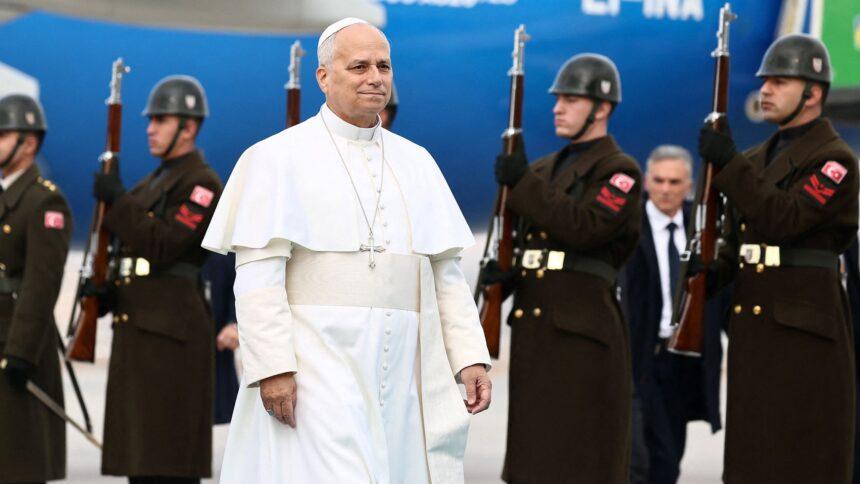
Pope Leo opened his Middle East visit in Türkiye by meeting senior Christian leaders and presiding over ecumenical gatherings timed to the 1,700th anniversary of the Council of Nicaea. He condemned religiously‑motivated violence in direct terms. Reporting highlights include a joint Iznik prayer and declaration meant to signal Catholic–Orthodox rapprochement.
“Pope Francis’s trip centers on a visit to Iznik (ancient Nicaea) to mark the 1,700th anniversary of the Council of Nicaea, presented as a gesture of unity and healing between Eastern and Western Christianity.”
There were visible interfaith gestures in Istanbul, including a planned Blue Mosque visit and a Mass for local Christians. Sources characterize the trip as both symbolic and substantive.
Symbolically, it served as a gesture of unity and healing between East and West. Substantively, the pope urged religious leaders to reject violence done in the name of religion and to work for peace.
Pope urges Turkish mediation
In Ankara, the pope used blunt language about the global stakes of local wars, warning that current conflicts risk becoming a 'third world war fought piecemeal.' He urged Turkey to act as a mediator and 'bridge' between East and West.
He told President Recep Tayyip Erdoğan and the diplomatic corps that Turkey’s regional diplomacy - including efforts around Gaza and Ukraine - obliges it to promote stability, dialogue and patient mediation rather than polarization. Coverage repeatedly quoted his warning about a fragmenting world and emphasized his appeal that religious and political leaders alike resist the logic of military escalation.
Pope and Ecumenical Patriarch
The İznik ceremony and meetings with Ecumenical Patriarch Bartholomew were widely reported as a concrete attempt to narrow the Catholic–Orthodox divide. Multiple outlets described a joint declaration and symbolic prayers at the ancient basilica site. Some observers stressed the patriarch's greater caution compared with the pope's more assertive outreach.
“The program includes a planned prayer and a joint declaration with Ecumenical Patriarch Bartholomew intended to advance Christian unity nearly 1,000 years after the Great Schism, though observers say the patriarch has been more cautious than Francis.”
Coverage detailed the languages used, the candle-lighting, and the theological framing of 'healing' the 1054 Schism. Reports also noted that practical obstacles remain despite the high symbolism.
Pope's Lebanon visit
The pope's Lebanon stop was framed as solidarity with a fractured Christian community and as a demand for accountability over the 2020 Beirut port explosion. Security realities forced a scaled-back itinerary, with organizers saying he would steer clear of southern Lebanon and avoid planned visits there after recent Israeli airstrikes.
He will hold a silent prayer at the blast memorial and meet young Lebanese suffering economic collapse. Coverage attributes the strikes and recent escalation to Israeli actions and reports heightened security measures for the visit.

Pope and Gaza coverage
Coverage diverges sharply on how the pope approached Gaza and Israel. Several regional sources note Vatican criticism of Israel's actions in Gaza has bolstered the pope's credibility with many Muslim communities. The available reporting in this set does not present source material that uses the term 'genocide' for Gaza.
“Vatican criticism of Israel’s actions in Gaza has reportedly bolstered the pope’s credibility with many Muslims.”
Multiple outlets quote the pope urging Israel to address Gaza, and others describe his warnings about conflicts spiraling into wider wars. Where sources differ or are silent on characterizing Israeli operations, I note ambiguity rather than invent labels not in the reporting.
