South America08 November, 20252 min read
Powerful Tornado Destroys Brazilian Town, Kills 6 and Injures Over 700
This article is an automated aggregation of coverage from news outlets. Our editorials offer in-depth analysis curated by the NewsCord team.
Tornado struck Rio Bonito do Iguaçu, Paraná, destroying about 80% of the town. At least six people died and over 700 were injured due to the tornado.
7 outlets told this the same way.
Outlets did split on Brazil Police Kill Suspect After 13 Kindergarteners Held Hostage In Curitiba →
Tornado Impact in Southern Brazil
A powerful tornado tore through Rio Bonito do Iguaçu in Paraná, southern Brazil. Multiple outlets agree on severe casualties and destruction but differ on the exact toll. Western mainstream outlets report higher numbers.
“A powerful tornado with winds exceeding 155 mph struck the southern Brazilian state of Parana on Friday night, killing six people and injuring over 400.”
CBS News says the Friday-night twister had winds exceeding 155 mph, killing six people and injuring over 400. DW also reports at least five deaths and over 400 injuries. Asian outlets vary in their reports.

The Hindu reports the November 7, 2025 strike killed at least five people and injured around 130. The Straits Times puts the toll at at least six deaths with 432 injured. All sources underscore the extraordinary force of the tornado.
The Hindu cites winds of 180-250 km/h (110-155 mph). CBS News reports a state of emergency has been declared.
Tornado Damage Assessment
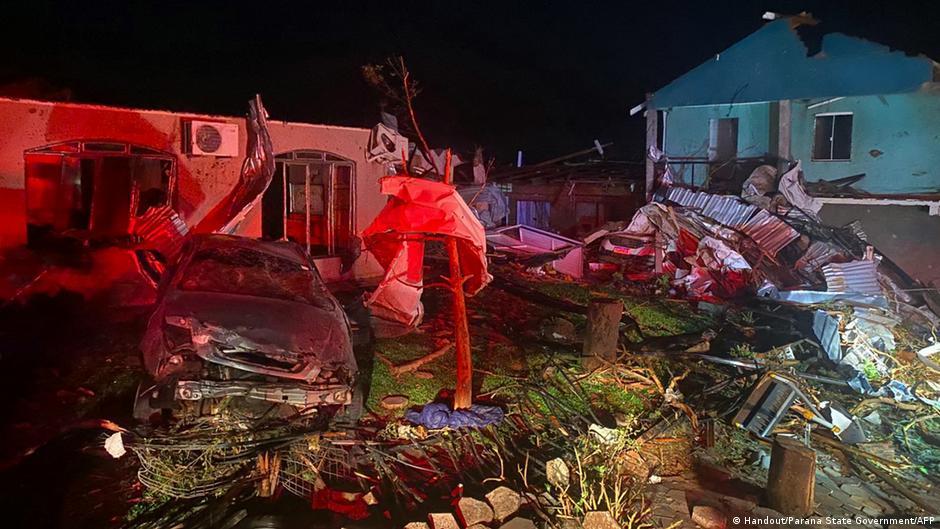
The physical devastation is described in stark terms across reports, though estimates vary. DW says the tornado destroyed 80% of the town. The Straits Times reports that about 90% of the town was damaged, resembling a war zone.
NDTV underscores the near-total destruction shown in imagery, stating that aerial photos reveal the town has been almost completely destroyed, with widespread wreckage and debris scattered throughout. CBS adds that the twister also destroyed dozens of homes in nearby cities, broadening the footprint beyond a single municipality.

Emergency Response to Severe Storm
Authorities have mobilized significant emergency responses. CBS News reports that the government declared a state of emergency in the affected areas. The Straits Times details on-the-ground efforts, stating that rescue teams are searching for survivors and a shelter has been set up nearby.
“In response, the government declared a state of emergency in the affected areas.”
There are two people reported missing. The Hindu adds that local authorities are actively responding and that a severe storm alert remains in effect for Paraná and the neighboring states of Santa Catarina and Rio Grande do Sul. This signals continued weather risks beyond the immediate disaster zone.
Severe Wind Damage Reports
Reports converge on extraordinary wind speeds and violent impacts on the built environment. CBS notes winds exceeding 155 mph, while The Hindu specifies speeds between 180-250 km/h (110-155 mph). DW describes community-level devastation, including overturning cars and demolishing neighborhoods.
The Hindu catalogs impacts such as overturned cars, damaged homes, and uprooted trees. The Straits Times adds a risk perspective, stating that officials highlighted the high lethality of tornadoes in urban areas.
Casualty and Damage Reports
Casualty and damage tallies are still evolving, and the figures in coverage are inconsistent. None of the sources cited report injuries exceeding 700. The Hindu reports around 130 injured.
“The disaster resulted in at least five deaths and over 400 injuries.”
DW and CBS cite over 400 injuries. The Straits Times reports 432 injured people, while also cautioning that the death toll is expected to rise. Given the scale of destruction—ranging from DW’s estimate of destroying 80% of the town to The Straits Times’ estimate of about 90% damaged—numbers may continue to change as rescue efforts proceed.
