
President Donald Trump deploys ICE agents to US airports to assist with TSA staffing shortages.
Key Takeaways
- ICE officers deployed to 13–14 airports nationwide to assist TSA.
- Long security lines persist at major airports due to TSA staffing shortages.
- Trump directs deployment amid DHS funding lapse and partial government shutdown.
ICE Deployment Overview
President Donald Trump deployed Immigration and Customs Enforcement (ICE) agents to approximately 14 U.S. airports to assist with Transportation Security Administration (TSA) staffing shortages during an ongoing partial government shutdown.
“So far, no California airports are on the list of locations where ICE agents have been deployed to help TSA with security”
The deployment came as TSA officers faced unprecedented callout rates, with some airports experiencing wait times exceeding four hours.

Trump announced the move on his Truth Social platform, blaming 'Radical Left Democrats' for the shutdown while claiming ICE agents would help 'bolster TSA efforts to keep our skies safe and minimize air travel disruptions.'
The airports receiving ICE agents include major hubs like Chicago-O'Hare, Atlanta's Hartsfield-Jackson, New York's JFK and LaGuardia, and Houston's William P. Hobby, though no California airports were initially listed for the deployment.
TSA Staffing Crisis
The TSA staffing crisis has reached critical levels as federal workers have gone without pay for over a month since the Department of Homeland Security funding lapsed in February.
Nationwide data shows that approximately 11.8% of TSA agents called out from work on Monday, with nearly 3,500 officers absent - the highest callout rate since the shutdown began.

More than 400 TSA officers have quit during the shutdown due to financial strains, with employees struggling to afford basic necessities like gas, childcare, food, and rent.
The funding disparity is striking: while TSA workers face financial hardship, ICE agents continue to receive paychecks thanks to an influx of cash from Trump's tax breaks bill passed last year.
This inequity has fueled resentment among TSA workers and travelers alike, who view the deployment of ICE agents as a political move that fails to address the root cause of the staffing crisis.
Criticisms and Concerns
The deployment of ICE agents to airports has sparked significant criticism and concerns from multiple stakeholders.
“For now, operations remain strained, with no immediate resolution in sight”
The American Civil Liberties Union (ACLU) issued a strong condemnation, stating this is the first time a president has sent armed ICE agents to airports to replace trained security agents, warning the move will 'instill fear in families and other travelers.'
Aviation experts and union leaders have raised serious safety concerns, emphasizing that ICE officers are not trained in aviation security and cannot replace the specialized skills required for TSA positions.
Keith Jeffries, a former head of TSA security at Los Angeles International Airport, described substituting ICE for TSA workers as 'an imperfect solution' that raises questions about effectiveness.
The ACLU further accused Trump of 'using ICE as his private security force' and 'manufacturing a crisis' to score political points, while noncitizens are being advised to consider the risks of flying due to potential ICE enforcement actions.
Airport Implementation
The implementation of ICE agents at airports has varied significantly across different locations, with some airports experiencing immediate deployments while others have no current plans for ICE involvement.
Travelers at airports like Atlanta reported seeing ICE agents near security lines but not actively screening passengers, while descriptions of their duties remain vague.

Acting Deputy TSA Administrator Adam Stahl indicated that ICE agents would be 'conducting non-specialized security support, manning the exit lanes, crowd management, line control,' though Reuters reported that ICE agents would not immediately be deployed in secure areas due to lack of appropriate security clearances.
Sacramento International Airport officials explicitly stated there are 'currently no plans to use ICE to support TSA at SMF,' and John Wayne Airport in Orange County emphasized that responsibility for TSA staffing 'are determined at the federal level.'
Despite no official deployment to California airports, travelers at San Francisco International Airport captured video of federal agents detaining a woman on March 22, though airport officials confirmed this was a separate enforcement incident not related to the TSA assistance program.
Political Reactions
Political leaders and aviation unions have reacted strongly to the ICE deployment, with criticism spanning both Democratic officials and industry representatives.
New Jersey Gov. Mikie Sherrill condemned Trump's involvement, stating that his 'involvement creates chaos for the American people' and that 'Trump's ICE has a track record of making communities less safe, and sending untrained ICE agents to staff our airports is not an acceptable solution.'
California Gov. Gavin Newsom called for the immigration unit to be 'reined in,' though he stopped short of specifying actions if officers were sent to California sites.
Aviation unions representing flight attendants and mechanics issued a joint statement criticizing the move as 'another distraction from solutions that protect Americans' and emphasizing that TSA officers 'can't simply be replaced' by immigration agents.
The political blame game continued as Trump accused Democrats of 'protecting hard line criminals who have entered our Country illegally,' while Democrats maintained that Republicans were using TSA workers as pawns in their budget fight over immigration enforcement policies.
Traveler Impact
Travelers across the country have faced significant disruptions and heightened anxiety at airports experiencing the ICE deployment.
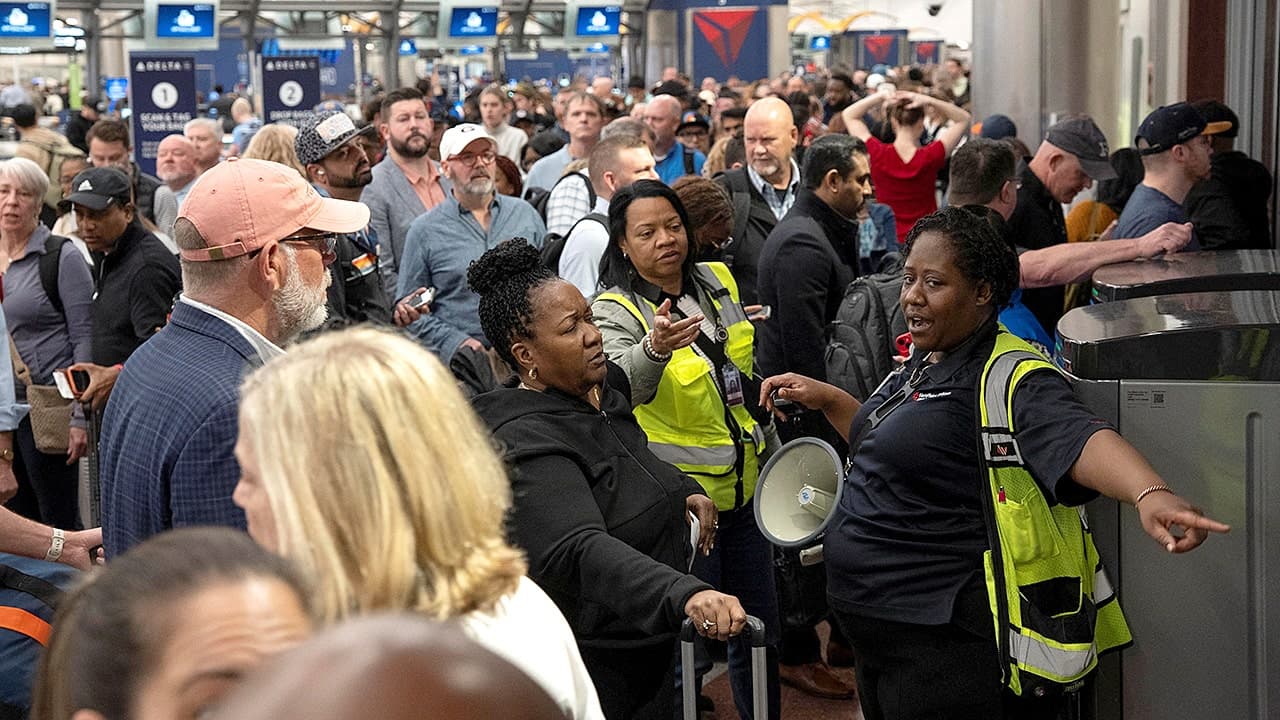
At Houston's George Bush Intercontinental Airport, passengers reported standing in lines that extended three stories, with some waiting up to five hours and ultimately missing their flights.
CBS News documented particularly dire conditions at Houston's Terminal E, where lines 'wrapped around three terminals in the subway corridor at the basement level, an area with no access to food, water, working air conditioning or restrooms — and limited cell service.'
Travelers expressed a mix of frustration and sympathy for TSA officers, with many acknowledging that frontline workers have been placed in an untenable situation.
Despite the deployment of ICE agents, many airports continued to experience long wait times, though some reports suggested marginal improvements.
One Atlanta traveler noted that if lines had been much longer, he would have driven the 3 hours and 45 minutes to Charlotte instead of flying, highlighting the severe impact on travel decisions.
As the shutdown continues into its 39th day, the long-term consequences for both travelers and the aviation industry remain uncertain.
More on USA
USC Cancels California Gubernatorial Debate Amid Backlash Over Candidate Criteria
37 sources compared

President Donald Trump Voted by Mail in Florida Special Election
18 sources compared

Democrat Emily Gregory Defeats Republican Jon Maples in Florida's House District 87 Special Election.
65 sources compared
Delta suspends special congressional services for members of Congress amid shutdown
25 sources compared