
President Donald Trump's Hormuz Warship Push Falls Flat as Allies Rebuff Coalition
Key Takeaways
- European and allied nations declined to join the Strait of Hormuz mission.
- Trump said about seven countries were asked to join; no commitments yet.
- Allies cite escalation risks and NATO mandate and legal limits.
Coalition Faces Resistance
President Donald Trump's urgent push to form an international naval coalition to secure the Strait of Hormuz has faced widespread resistance from allies across Europe and Asia.
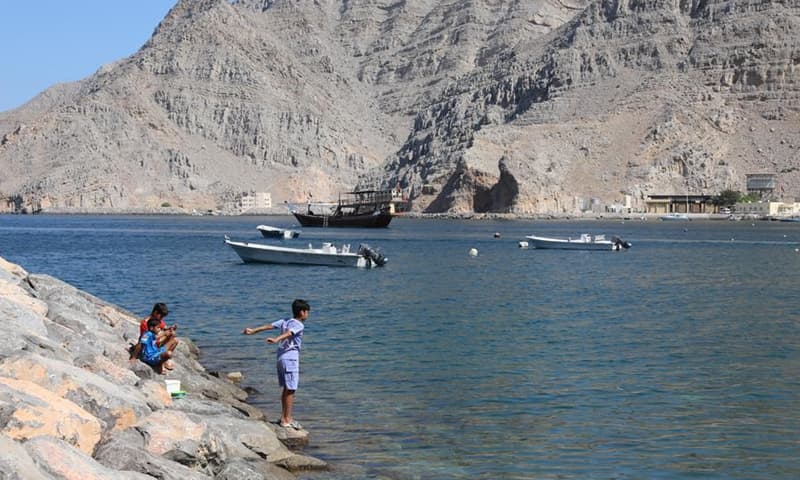
“Children play by the shore at Kumzar Village in Oman, Feb”
The US President has demanded that countries heavily dependent on Gulf oil contribute ships and forces to protect the vital shipping lane, through which roughly 20% of the world's oil and liquefied natural gas supplies pass.
Trump has claimed that China receives about 90% of its crude imports through the strait while the US only relies on it for minimal amounts, arguing that 'countries of the world that receive oil through the Hormuz Strait' should 'take care of that passage.'
The initiative comes amid Iran's effective closure of the strait in response to US-Israeli military attacks launched on February 28, which has sent global oil prices soaring by 40-50 percent.
This disruption threatens an international economic shock as the waterway remains effectively shuttered, with tankers stranded and global energy markets severely affected.
European Rejection
European leaders have flatly rejected Trump's calls for military involvement, with Germany, Spain, Italy, and other EU nations refusing to deploy naval forces to the region.
German Defense Minister Boris Pistorius succinctly captured the European sentiment: 'This is not our war, we have not started it.'

German Chancellor Friedrich Merz's spokesman Stefan Kornelius reinforced this position, stating that 'NATO is an alliance for the defence of territory' and 'the mandate to deploy NATO is lacking' in the current situation.
Spanish Defense Minister Margarita Robles went further, declaring 'Spain will never accept any stopgap measures' to keep the strait open, insisting 'the objective must be for the war to end, and for it to end now.'
Italian Foreign Minister Antonio Tajani emphasized that 'diplomacy needs to prevail,' while British Prime Minister Keir Starmer made clear the UK would not participate in a NATO mission and would not be 'drawn into the wider war.'
This unified European stance reflects both strategic caution and political resistance to being pulled into an escalating conflict initiated by the US and Israel.
Asian Allies Hesitate
Asian allies have similarly rebuffed Trump's pressure, with Japan, Australia, and South Korea declining to send military vessels to the Strait of Hormuz despite their heavy dependence on Gulf energy supplies.
“Speaking on Monday, Iran’s Foreign Minister Abbas Araghchi indicated Tehran would continue its operations”
Japanese Prime Minister Sanae Takaichi emphasized constitutional constraints, stating that Tokyo had not decided to dispatch escort vessels due to legal limitations that restrict Japan's military operations overseas under its post-World War II pacifist constitution.
Australia's Energy Minister Catherine King explicitly stated Canberra had no plans to contribute ships, while South Korea's Foreign Ministry merely said it would 'closely coordinate and carefully review' the situation with the US.
Trump has attempted to leverage China's dependence on the strait, claiming Beijing should participate in securing the route and suggesting his planned meeting with Chinese President Xi Jinping could be delayed if China doesn't cooperate.
However, China has remained noncommittal, with its foreign ministry only stating that 'all parties have the responsibility to ensure stable and unimpeded energy supply' and that it would 'strengthen communication with relevant parties' for de-escalation.
Trump's Warnings
Trump has responded to the allied resistance with both frustration and warnings about the future of NATO.
The President has repeatedly expressed disappointment at what he perceives as a lack of enthusiasm and reciprocity from allies, stating 'The level of enthusiasm matters to me' and criticizing countries that 'have been helped for many, many years' but now refuse to participate.

In an interview with the Financial Times, Trump issued a stark warning that a lack of support would be 'very bad for the future of NATO,' suggesting the alliance could face serious consequences if members don't help secure the strait.
Trump also revealed that his push for coalition participation was partly a test of allied commitment, admitting 'I'm almost doing it, in some cases, not because we need them, but because I want to find out how they'll react.'
He further claimed to have spoken with a former US president who 'regretted not taking military action against Iran while in office,' though he declined to identify which predecessor made the remark.
Energy Crisis Deepens
As the diplomatic stalemate continues, the global energy crisis deepens with oil prices hovering around $100 per barrel, Brent crude trading at $104.84, and the International Energy Agency announcing plans to release nearly 412 million barrels of emergency oil stocks to market.
“Countries are cautious after Trump’s call U”
The agency described this as 'by far the largest ever' coordinated release, with Asian member countries planning to release stocks 'immediately' and reserves from Europe and the Americas to follow 'from the end of March.'
Meanwhile, Iran has remained defiant, with Foreign Minister Abbas Araqchi stating the country had 'neither requested a ceasefire nor negotiations' and was 'prepared for a prolonged confrontation.'
Despite Trump's claims of military success against Iran—he reported sinking or destroying more than 100 Iranian naval vessels and striking over 7,000 targets—the conflict shows no signs of abating.
The situation has created a complex geopolitical puzzle where traditional alliances are strained, energy security concerns clash with military caution, and the global economy faces ongoing disruption as the strategic waterway remains effectively closed.
More on USA

Joe Kent Resigns as Director of the U.S. National Counterterrorism Center Over Iran War
43 sources compared
Drones and rockets attack U.S. Embassy in Baghdad; no injuries reported.
10 sources compared

Trump says US could reach Cuba deal as Cuba power grid collapses under oil blockade
10 sources compared
Trump Threatens Broadcasters' Licenses as Iran War Coverage Draws Scrutiny
17 sources compared