President Nicolas Maduro Makes First Public Appearance in Caracas After Trump Ultimatum

President Nicolas Maduro Makes First Public Appearance in Caracas After Trump Ultimatum

01 December, 20259 sources compared
South America

Key Points from 9 News Sources

  1. 1

    Maduro reappeared publicly in Caracas after several days out of sight

  2. 2

    Trump confirmed a phone call with Maduro but declined to disclose discussion details
  3. 3

    Maduro's absence had sparked widespread speculation he fled amid rising U.S. tensions

Full Analysis Summary

Maduro's Caracas appearance

Venezuelan President Nicolás Maduro made a rare public appearance on Sunday at an annual specialty-coffee awards ceremony in eastern Caracas, handing out medals and briefly ending days of speculation about his whereabouts.

Reports noted his last public sign of life had been a video of himself driving around Caracas earlier in the week.

At the event, Maduro led chants asserting Venezuela’s resilience, using language such as 'indestructible, untouchable, unbeatable,' while he did not use the occasion to directly address the escalating standoff with the United States.

Observers treated the ceremony as both a show of normalcy and a political message amid heightened tensions.

Coverage Differences

tone/narrative focus

Some outlets emphasize the ceremonial, defusing aspect of Maduro’s appearance, while others foreground the political context and speculation about his safety or resignation. The Diplomatic Insight and Nepal Samaj present the visit as a rare, symbolic public appearance and quote his chant; by contrast, New York Post frames the resurfacing in the immediate context of a reported ultimatum and speculation he had fled, and Українські Національні Новини highlights the end of speculation that he had fled.

missed information / emphasis

Some sources stress that Maduro's remarks did not address the crisis directly, while others use the event to recount broader allegations against him (e.g., U.S. indictments) or reported diplomatic pressure; this leads to differing emphases between descriptive reporting of the event and inclusion of background political claims.

Trump-Maduro phone call

Maduro's appearance came shortly after U.S. President Donald Trump confirmed he had spoken by phone with Maduro.

Trump declined to provide details, calling it 'a phone call' while aboard Air Force One, though major U.S. papers had earlier reported the leaders talked.
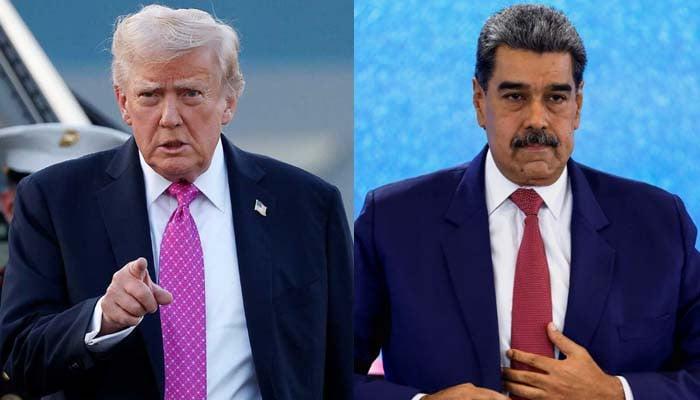
Several outlets reported that both governments largely declined to detail the conversation: Tribune India noted that 'neither Maduro nor other top Venezuelan officials have commented,' and Nepal Samaj said Maduro's brief remarks at the ceremony 'did not directly address the crisis.'

Coverage Differences

reporting vs official denial

Some outlets recount external reports of a phone call (citing NYT/WSJ), while others quote Trump’s on-record confirmation and his framing that he would not give details. Tribune India reports the NYT/WSJ accounts and notes silence from Venezuelan officials; Українські Національні Новини quotes Trump’s confirmation and his characterization of the call as 'a phone call.'

source emphasis on secondary reports

Some outlets incorporate secondary reporting (e.g., Miami Herald claims reported by New York Post) about an alleged ultimatum and offers of safe passage, which are not confirmed by the official statements quoted elsewhere; this highlights divergence between reported allegations and on-the-record remarks.

Rising U.S.-Venezuela tensions

The surrounding context is one of sharply elevated tensions.

Outlets report that Trump warned airlines, pilots and criminal groups to avoid Venezuelan airspace and said strikes against land-based drug networks could happen 'very soon'.

He later told reporters the airspace warning 'did not signal an imminent airstrike'.

Multiple sources describe a significant U.S. military presence in the region, including 'more than a dozen warships and roughly 15,000 troops'.

Washington frames this presence as anti-drug operations, while Caracas portrays it as pressure meant to threaten Maduro's hold on power.

Coverage Differences

tone and framing

U.S.-facing outlets and wire reports emphasize the operational justification for the military deployment and warnings (anti-drug trafficking), while Venezuelan and regional-focused reports stress Caracas’s interpretation that the buildup is aimed at pressuring or ousting Maduro and threatening oil production. The Diplomatic Insight and Nepal Samaj explicitly contrast Washington's anti-drug framing with Caracas's view that it amounts to political pressure.

official caveat vs public warning

Some sources place weight on Trump’s public warnings and advisories, while others highlight his subsequent caveat that the airspace advisory should not be read as signaling an imminent strike—this creates a split between initial public posture and later downplaying of immediate action.

U.S.-Venezuela tensions

Venezuelan authorities shifted attention from military maneuvers to alleged recent U.S. maritime strikes on suspected drug-smuggling boats in the Caribbean, which several reports say killed more than 80 people.

National Assembly head Jorge Rodríguez announced an investigation and declined to discuss the reported call.

Some outlets separately recount U.S. legal actions and allegations against Maduro, including a 2020 U.S. indictment and claims he leads the so-called 'Cartel de los Soles', which shape the broader conflict narrative but are distinct from the immediate diplomatic exchanges.

Coverage Differences

focus on casualties vs legal allegations

Tribune India and Nepal Samaj highlight the inquiry into maritime strikes and reported casualties ("killed more than 80 people") as the Venezuelan government's immediate response, while New York Post foregrounds long-standing U.S. criminal allegations against Maduro (indictment, 'Cartel de los Soles')—two different strands of coverage that emphasize human cost versus criminal-justice background.

reporting vs on-the-record statements

Some outlets report claims from other newspapers (e.g., NYT/WSJ/Miami Herald) or use adjectives like 'reportedly' about casualties, while Venezuelan officials are quoted as declining to discuss the call and choosing to announce the inquiry—this distinction matters for attribution and certainty in the accounts.

Coverage of Venezuela tensions

Sources present a mix of confirmed on-the-record remarks, secondary reports, and competing national framings.

Trump confirmed a phone call but offered few details and urged caution about reading too much into his social-media warning.

Some outlets report an alleged ultimatum and offers of safe passage.

Caracas points to U.S. military movements and maritime strikes as evidence of political pressure.

The result is a story with clear facts (Maduro's public appearance, Trump's confirmation of a call, and U.S. deployment) but with notable ambiguities and differences in emphasis across outlets and regions.

Coverage Differences

ambiguity / conflicting accounts

There is ambiguity because major elements rely on differing types of sourcing: on‑the‑record comments from Trump and Venezuelan officials (as reported by Українські Національні Новини and The Diplomatic Insight), secondary press reports about negotiations or ultimatums (as cited by New York Post), and regional reactions focusing on casualties and investigations (as in Tribune India and Nepal Samaj). Each source’s type and editorial focus shapes what it highlights.

All 9 Sources Compared

CNN

Maduro rallies supporters in Venezuela amid US pressure

Read Original

Daily Jang

US and Venezuela in talks? Trump speaks with Maduro amid rising tensions

Read Original

Latin Times

Maduro Reportedly Offered Free Elections In Exchange For Keeping Control Of The Armed Forces; Trump Said No

Read Original

Nepal Samaj

Maduro resurfaces in Caracas as Trump says he has spoken with the Venezuelan president

Read Original

New York Post

Venezuela’s Maduro spotted for first time in days, ending flight speculation

Read Original

The Diplomatic Insight

Maduro Returns Publicly, Trump Speaks with Venezuelan President

Read Original

The Media Line

‘It Was a Phone Call:’ President Trump Mum on Conversation With Maduro Who Reappeared Sunday

Read Original

Tribune India

Venezuelan President makes public comeback as Trump confirms phone call

Read Original

Українські Національні Новини

Trump announced a phone call with Maduro but refused to disclose details

Read Original