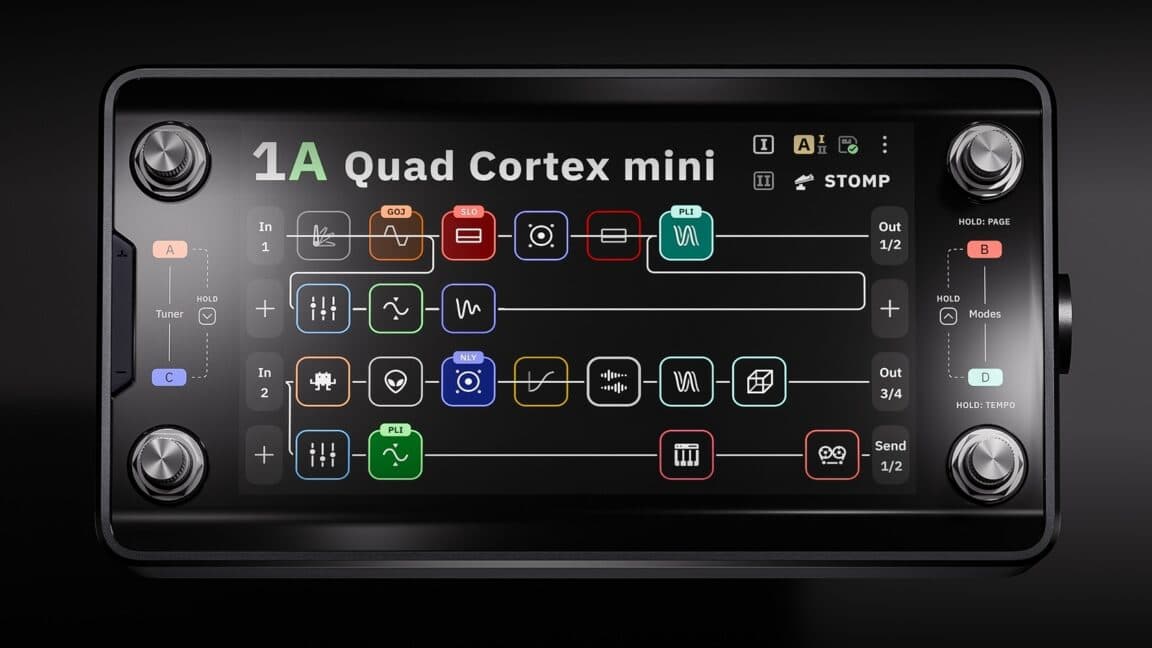
Quad Cortex mini amp modeler: All the power, half the size
Key Takeaways
- Six products won “best of show” awards at January’s NAMM music tech show.
- Neural DSP, founded in 2017 by Chilean immigrants to Finland, won one award.
- Neural DSP operates from the Helsinki area and focuses on machine learning for music tech.
Neural DSP NAMM win
At this January's NAMM music tech show in Los Angeles, six products won "best of show" awards, and one of those six went to Neural DSP, a much smaller company started in 2017 by Chilean immigrants to Finland.
“At this January’s massive NAMM music tech show in Los Angeles, six products won “best of show” awards”
From its base in the Helsinki area, Neural has built expertise in machine learning, robots, and impulse response technology to automate the construction of incredibly lifelike guitar amp modeling software, and it quickly jumped into the top ranks of an industry dominated by Universal Audio, Kemper, Line 6, and Fractal.
The article notes that for a hundred bucks you could buy one of the company’s plugins and sound like a guitar god with a $10,000 recording chain of amps, cabinets, effects pedals, and microphones.
Neural's Quad Cortex hardware
In 2020, Neural branched out into hardware, putting its tech not in your computer but in a floor-based box covered with footswitches called the Quad Cortex.
While the company’s plugins could each replace one entire pedalboard of gear—plus a few amps and cabs—the Quad Cortex could replace a Guitar Center-sized warehouse of devices, offering hundreds of amps, cabs, and effects.
Neural's modeling method
The article explains how Neural achieves that scale.
“At this January’s massive NAMM music tech show in Los Angeles, six products won “best of show” awards”
High-quality gear models used to take much longer and often required modeling every single component of the underlying circuit.
Machine learning offered a faster way that does not depend on knowing the circuit itself.
Instead, the system uses the known input signal and the output signal, which contains all the changes imposed by the circuit, the speaker, the cabinet, and/or the mic, so a computer can calculate what the device is doing to the signal without knowing how it works.
More on Technology and Science

Chemical odor forces FAA to halt flights across DC-area airports
27 sources compared

Apple Cuts China App Store Commissions to 25% After Regulator Pressure
25 sources compared

FBI Investigates Hacker Who Uploaded Malware-Laced Games to Steam
12 sources compared

University of Cambridge Researchers Urge Tighter Regulation Of AI Talking Toys For Under-Fives
10 sources compared