Full Analysis Summary
Russia's National Unity Day Events
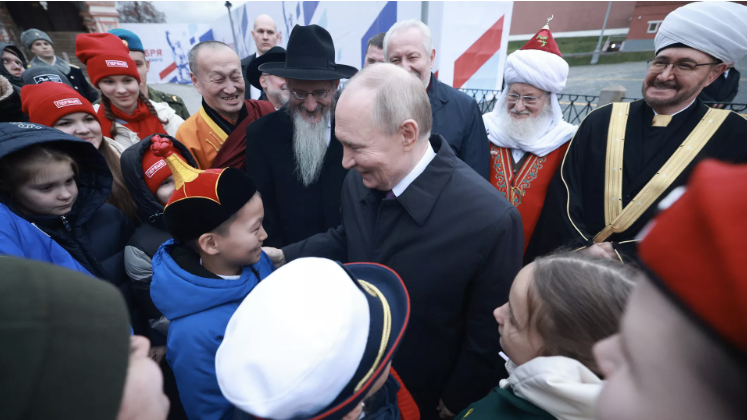
On Russia’s National Unity Day, Vladimir Putin marked the holiday by laying flowers at the Minin and Pozharsky monument.
At the same time, Russia launched a heavy bombardment on Ukraine that killed civilians, including children.
The reported death toll was at least seven people.
Despite the ongoing conflict, Moscow and Washington remain in uninterrupted diplomatic contact, according to Deputy Foreign Minister Sergey Ryabkov.
These details highlight a stark contrast between domestic ceremony, lethal military actions, and continued great-power communication on a day of national symbolism in Russia.
Coverage Differences
tone
The Star (Asian) frames the day with a stark juxtaposition: Putin’s ceremonial commemoration alongside a lethal bombardment that killed children, while also noting ongoing U.S.–Russia communication. This coupling emphasizes contrast between national pageantry and wartime violence rather than focusing solely on battlefield dynamics or diplomatic nuance.
missed information
Only an Asian source (The Star) is provided; no Western Mainstream, West Asian, or Western Alternative sources are available to compare casualty details, target locations, or official statements from Kyiv or the Russian MOD. Therefore, cross‑source verification, casualty breakdowns, and on‑the‑ground specifics are unclear.
Civilian Casualties in Bombardment
The report highlights civilian harm, noting that at least seven people were killed, including children, in what it describes as a heavy bombardment.
While the term "heavy" signals the scale of the attack, the report does not provide specific locations, weapon types, or a breakdown of the child casualties.
This lack of detail leaves important information unclear, such as whether the strikes targeted residential areas, infrastructure, or military sites.
Coverage Differences
missed information
The Star (Asian) reports a minimum death toll and the presence of child victims but omits key specifics like strike locations, target types, and independent verification. Without additional Western Mainstream or West Asian sources, there is no multi‑angle corroboration or detail expansion.
narrative
The Star’s narrative focuses on the human toll and the descriptor “heavy bombardment” rather than operational or tactical military context, which some Western Mainstream outlets might emphasize if available (e.g., air defense activity, missile types). In the absence of other sources here, that broader operational framing cannot be confirmed.
Diplomatic Relations Amid Conflict
Diplomatically, the report notes that Russia and the United States maintain uninterrupted channels.
This detail—attributed to Deputy Foreign Minister Sergey Ryabkov—suggests that, despite battlefield escalation and civilian deaths, Washington and Moscow are still talking.
The inclusion of this point alongside the attack underscores an ongoing separation between military confrontation and diplomatic communication.
Coverage Differences
unique/off-topic
Relative to the core focus on the bombardment and casualties, The Star (Asian) uniquely highlights the continuity of U.S.–Russia communication as stated by Ryabkov, which is adjacent to but not strictly part of the casualty report. This places the attack in a broader geopolitical context even as specifics of the strike remain sparse.
missed information
The report does not elaborate on what ‘uninterrupted communication’ entails—its channels, frequency, or topics—nor does it include U.S. confirmation. Without additional sources of other types (e.g., Western Mainstream), the scope and substance of these contacts remain unclear.
Timing and Impact of Strikes
The timing is central: the strikes coincided with National Unity Day, when Putin honored historic defenders by laying flowers at the Minin and Pozharsky monument.
This juxtaposition suggests the Kremlin’s signaling of domestic unity and historical continuity while prosecuting a war that, on this day, produced child casualties.
The article does not present reactions from Ukraine, Western governments, or Russian officials beyond Ryabkov, leaving broader international and domestic responses unspecified.
Coverage Differences
tone
The Star (Asian) emphasizes symbolism and contrast—ritual commemoration alongside lethal wartime actions and child deaths—rather than, for example, a purely military or policy‑centric framing one might expect if more sources were available for comparison.
missed information
The article does not include Ukrainian official statements, independent casualty verification, or detailed international reaction, limiting cross‑source and cross‑type comparison (e.g., Western Mainstream vs. West Asian vs. Western Alternative).