Ukraine War24 February, 20262 min read
Russia Continues Full Scale Invasion Into Fifth Year as Zelenskyy Urges Continued Support
Russia's full-scale invasion enters its fifth year as Ukraine marks the anniversary. President Volodymyr Zelenskyy urges continued international military and financial support during leaders' Kyiv visits.

16 outlets told this the same way.
Outlets did split on Russian Attack Kills At Least 33 On Two Buses In Kramatorsk →
Stalemate and stalled diplomacy
As Russia’s full-scale invasion of Ukraine enters its fifth year, fighting remains largely frozen along front lines and diplomacy is stalled, producing what multiple outlets describe as a military stalemate. EL PAÍS reports a 'military stalemate' with 'front lines largely frozen' and notes three-way peace talks due to resume.
RFI says fighting continues 'with only slow battlefield gains and stalled diplomacy.' The BBC describes sombre commemorations and that the conflict 'shows no sign of ending,' reflecting a widespread view across sources that the war has become a grinding, protracted confrontation rather than a rapidly changing campaign.

Kyiv anniversary: solidarity appeals
President Volodymyr Zelenskyy used the anniversary to urge continued Western support and to praise Ukrainians' resolve. Al Jazeera reports Zelenskyy praised Ukrainians' 'immense courage' and declared they had defended statehood.
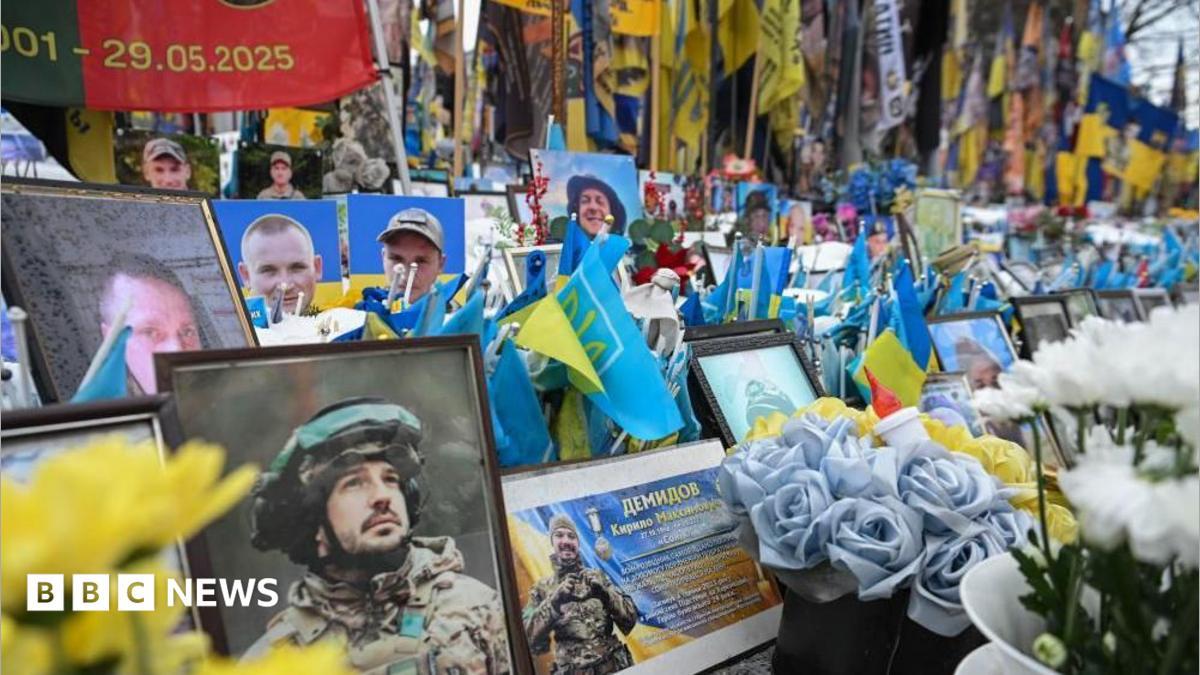
NDTV and BBC document visits and shows of solidarity from top EU leaders and ceremonies led by Zelenskyy, noting public memorials in places such as Bucha. France 24 highlights diplomatic gestures and international calls for de-escalation, indicating coordinated political symbolism alongside appeals for sustained assistance.
Humanitarian and economic costs
EL PAÍS reports displacement figures, saying 'almost 4 million people are internally displaced' and '6.7 million live abroad'. EL PAÍS also cites Kyiv’s estimate that reconstruction will cost about '$588 billion over the next decade'. NDTV and vocal.media report massive displacement and tens of thousands dead or wounded, and NDTV cites a joint World Bank–EU–UN–Ukraine estimate of 'about $558 billion' for reconstruction.
“A joint World Bank–EU–UN–Ukraine report estimates post-war reconstruction will cost about $558 billion over the next decade.”
RFI and CBC cite CSIS casualty estimates that are far higher than official tallies, underscoring major discrepancies in reported human costs and economic needs. These differing reconstruction estimates and widely varying casualty tallies indicate contradictions across the sources.
Battlefield technology and territory
On the battlefield, technology and modest shifts in territory shape the military picture, with EL PAÍS and vocal.media highlighting the dominance of drones. EL PAÍS cites Ukrainian military medical sources saying drones 'cause more than 90% of current casualties'.
Outlets such as UPI and BBC place Russian control at about '20% of Ukrainian territory' or 'just under 20%'. CBC and RFI emphasise that net territorial gains last year were minimal—about 0.79% per ISW—even as casualties remained high, suggesting a costly war of attrition with limited strategic shifts.

Stalled Donbas negotiations
Diplomacy remains deadlocked as Kyiv rejects Moscow’s demands over Donbas and insists on security guarantees, while mediators press for talks. EL PAÍS and tovima report Kyiv refuses to cede the Donbas region — Moscow’s main demand — and say this impasse is the principal obstacle to any deal.
“Kyiv refuses to cede the eastern Donbas region — Moscow’s main demand and the principal obstacle to any deal.”
CBC and RFI note U.S.-brokered talks have been arranged but remain blocked by disagreements over Russian-occupied territory and security guarantees. France 24 reports international voting and reactions at the UN and mentions warnings from Amnesty and UNICEF, showing how legal, humanitarian and political threads converge around the stalled negotiations.
