Full Analysis Summary
Recruitment amid the invasion
After four years of the Kremlin’s full‑scale invasion of Ukraine (launched 24 Feb 2022), local authorities in provincial towns such as Yelets are using recruitment incentives to fill ranks.
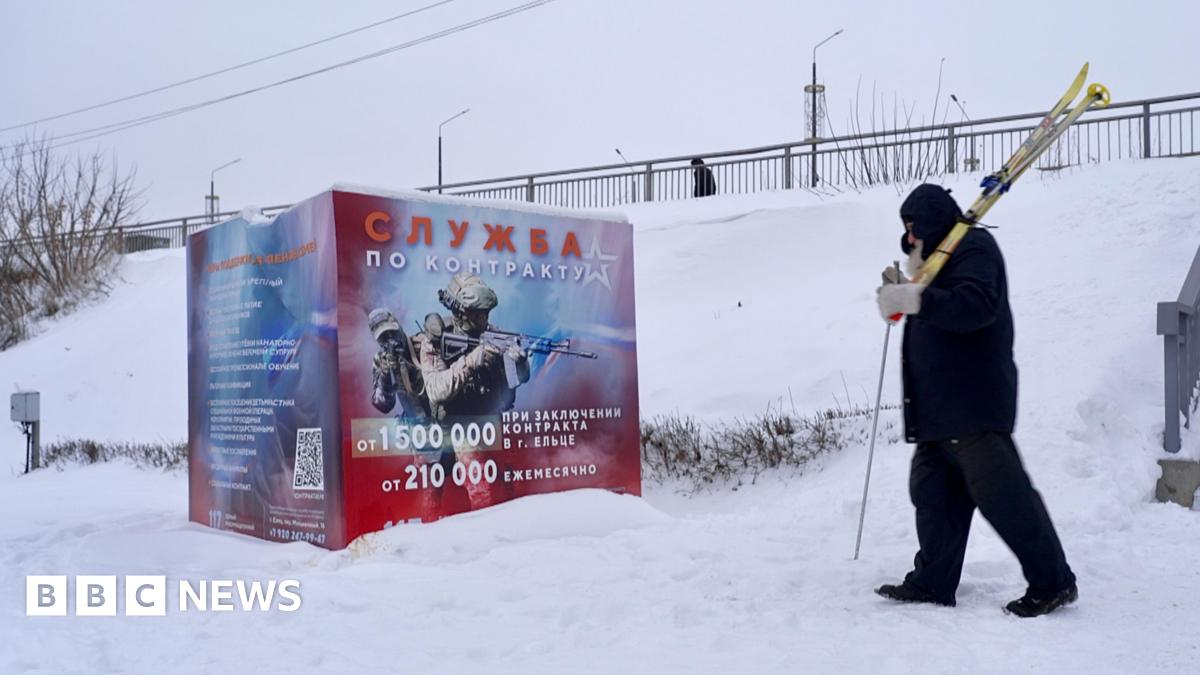
Recruitment posters promising large one‑off payments — one cited as about £15,000 — are widespread, the BBC reports.
The article presents Yelets as a microcosm of the wider national picture, linking these recruitment pushes directly to the prolonged conflict that began in February 2022.
Coverage Differences
Missed Information
Only one source is provided (BBC, Western Mainstream). Because no other sources were supplied, it is not possible to compare how other source types (e.g., Western Alternative, West Asian) report on the £15,000 payments, recruitment drives, or the four‑year framing. The BBC text itself reports the payments and frames Yelets as a snapshot of the wider impact.
War's impact on Yelets
Visible signs of war now punctuate everyday life in Yelets, including a nine-storey mural honoring five local men killed in Ukraine.
There are new cemetery sections and monuments to recent war dead.
V and Z symbols appear on shops, and public slogans echo Kremlin rhetoric, the BBC documents.
Residents face a closer frontline, as the Lipetsk region has been targeted by Ukrainian drones.
The town has installed emergency shelters at bus stops, parks and in apartment basements as people report nightly air-raid sirens.
Coverage Differences
Unique Coverage
Because only the BBC snippet is available, its emphasis on visible memorials, V and Z symbols, and local emergency measures is uniquely visible here. Other perspectives or source types could have emphasized different diagnostics (e.g., accusations of propaganda, resistance, or economic policy debates), but those cannot be evaluated without additional sources. The BBC text directly reports the murals, symbols and civil‑defence measures.
Economic strain and recruitment
The BBC reports that economic strain is portrayed as acute and widespread, noting the government raised VAT from 20% to 22% citing defence needs and that inflation, higher utility and rent bills and stagnation are squeezing small businesses and household budgets.
The report presents these pressures alongside recruitment incentives, suggesting financial hardship is motivating some city-level and regional efforts to bolster forces.
Coverage Differences
Narrative Framing
The BBC frames the VAT rise and inflation as direct economic consequences of the prolonged war and as part of the rationale for higher defence spending. Without other source types to compare, it is not possible to see if alternative outlets prioritize different causes (e.g., pre‑war economic trends or sanctions). The BBC explicitly links VAT rises and economic pain to defence needs and household strain.
State messaging and sentiment
State media frames the conflict as a Western-forced war that requires higher defence spending, and public messaging displays President Putin’s expansionist statements, the BBC says.
Local workers express sympathy for soldiers yet report confusion about the war’s purpose.
This shows cognitive dissonance between patriotic displays and private uncertainty.
Coverage Differences
Tone
The BBC emphasizes both the strength of state messaging and the ambivalence of ordinary citizens — noting public slogans and Kremlin rhetoric but also workers' confusion. Without other sources, it's not possible to compare whether other outlets would stress dissent, complicity, or alternative explanations for public sentiment; the BBC presents both visible propaganda and private uncertainty.
Yelets social and economic toll
The BBC presents Yelets as a portrait of the social, emotional and financial toll of a prolonged war.
Recruitment incentives, including one-off sums of roughly £15,000, sit alongside rising costs, visible memorialisation of recent dead, and civil-defence measures.
Russia does not publish full casualty figures, and battlefield losses are described as large.
The article links monetary recruitment offers to a wider context of sustained human and economic pressure.
Coverage Differences
Missed Comparison
The BBC concludes by portraying the cumulative toll in Yelets. Because no other sources were provided, it is not possible to compare whether other outlets would reach the same overall assessment or would use different language (e.g., stronger terms like 'genocide' or alternative emphases like culpability, international response, or sanctions). The BBC text explicitly notes the absence of published full casualty figures and stresses known large battlefield losses.