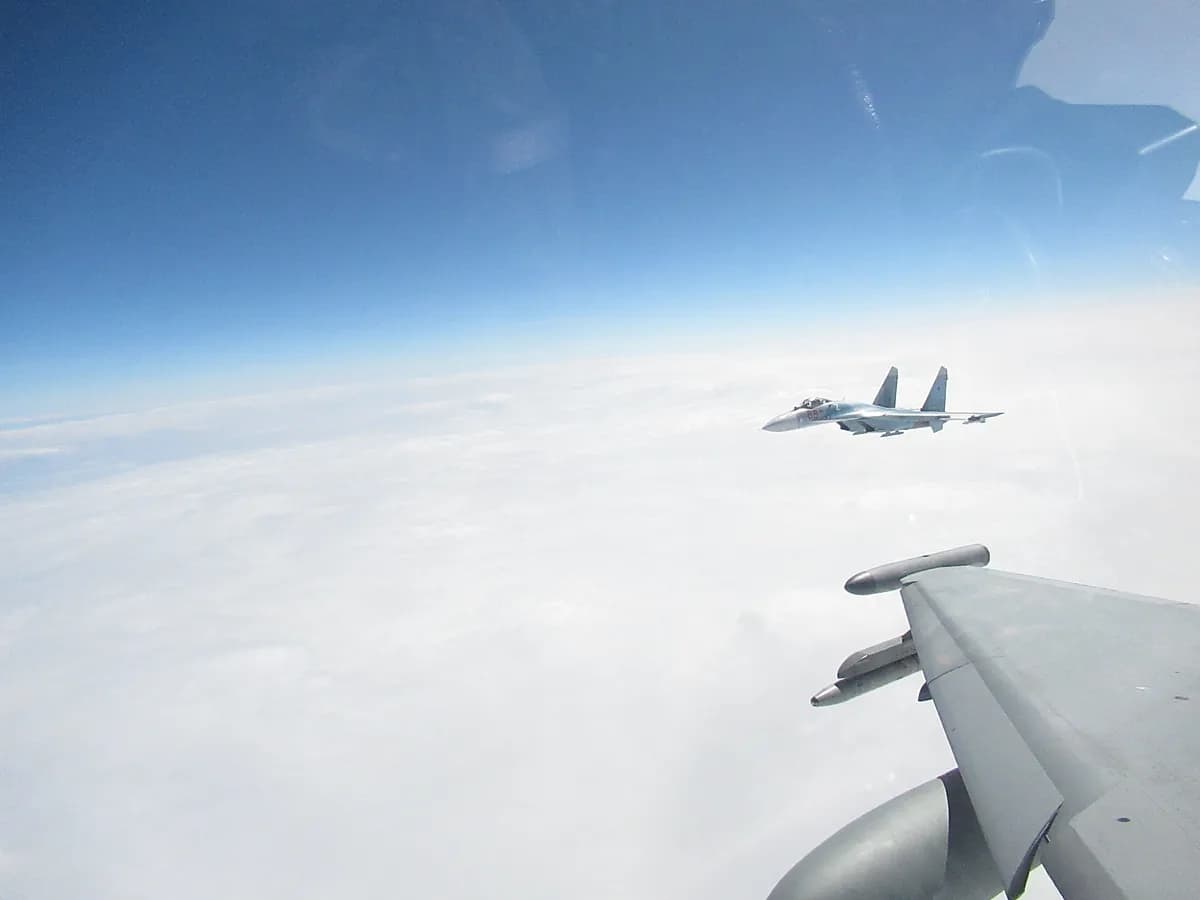
Russia's 'hypersonic pranks' over Estonia put NATO fighter jets on alert
Key Takeaways
- Russian hypersonic activity over Estonia prompted NATO fighter jets to be placed on alert.
- NATO organized Steadfast Foxtrot war games to protect itself from Russia.
- Trump said retaliatory action against NATO requires no Congressional approval.
Estonian airspace breach
A Russian Su-30 violated Estonia's airspace by approaching the Estonian island Vaindloo and staying there for about a minute.
“NATO Trump, very upset, says that taking retaliatory action against NATO is 'something we should reflect on”
Estonia summoned the acting head of the Russian diplomatic mission in Tallinn in protest at Wednesday's incident.
The Estonian Ministry of Defense said this was the first violation of Estonian airspace by a Russian Federation aircraft this year, though such incursions are described as somewhat recurrent.
The article notes that Russian aircraft have carried out dozens of sorties near allied airspace, typically involving Su-24 bombers, Su-34s, Su-27 fighters or MiG-31s, as Moscow tests reaction capacity and Europe’s willingness to monitor its skies.
NATO air policing details
NATO's Baltic air policing operates as peacetime air police around the clock within the Alliance's integrated air defence and missile defence system.
When a contact must be identified, alert aircraft at Amari or Siauliai can be launched by the Combined Air Operations Centre in Uedem, Germany.
Baltic coverage began in 2004 from Siauliai, Lithuania; since 2014 it has been supported at Amari, and since 2024 Lielvarde in Latvia is prepared to host mission aircraft.
The aircraft heading Amari is the Italian Eurofighter Typhoon, which is used for air policing; the F-35A stands out in situational awareness.
Spanish troops have passed through Amari, and the British Royal Air Force also deployed within Operation Azotize in Estonia to carry out NATO's Baltic air policing mission.
The mission has seen UK and German forces operate as a single team, as RAF's Scott Maccoll notes.
The interception sequence follows radar data and visual identification, then a radio contact attempt and signals such as wing rock to indicate interception.
Context and implications
The article frames Russia's flights as a test of Europe’s willingness to monitor its skies and of NATO's rearmament costs.
“NATO Trump, very upset, says that taking retaliatory action against NATO is 'something we should reflect on”
It emphasizes alliance solidarity where allies with fighters protect the airspace of those without sufficient capacity, noting the Baltic states' lack of own fighters.
The piece also describes ongoing joint operations as part of an evolving NATO posture on the eastern edge of the Baltic.
More on Russia

Trump Administration Waives Iranian Oil Sanctions for 30 Days to Ease Global Energy Prices
14 sources compared

Russian intelligence-linked hackers target Signal users, accessing thousands of accounts
10 sources compared

Wally Liaw, Super Micro co-founder, charged in $2.5B AI chip smuggling scheme to China
12 sources compared

Treasury Secretary Scott Bessent Says US May Unsanction Iranian Oil Already Being Shipped
27 sources compared