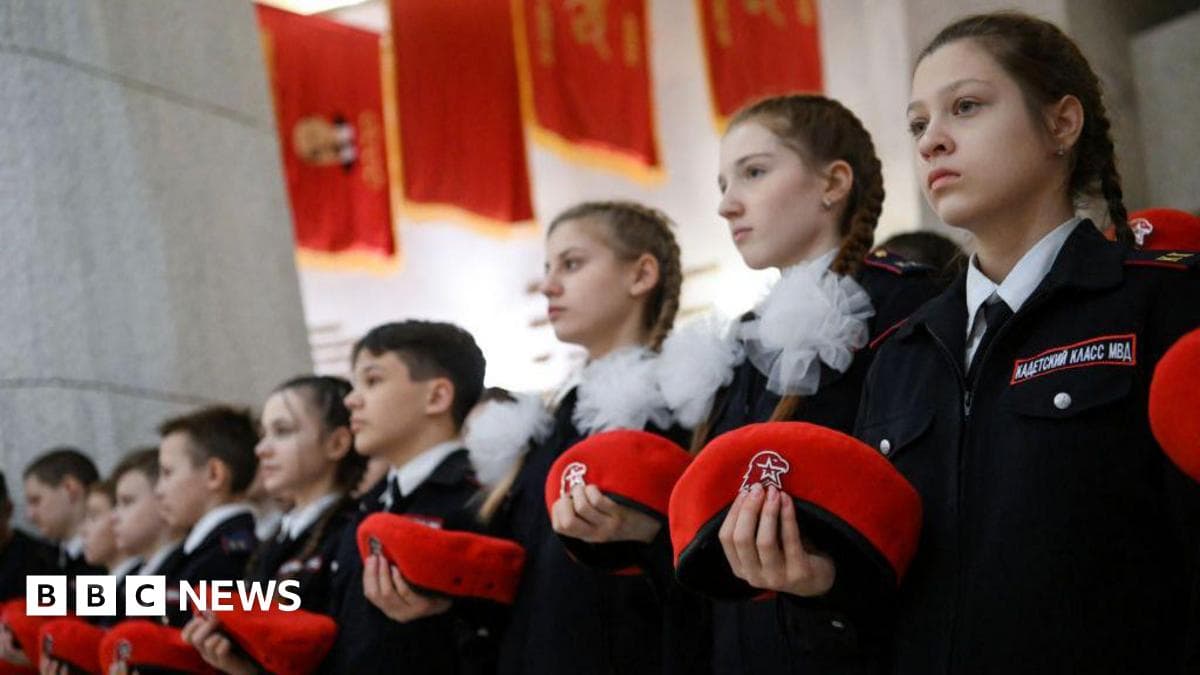
Russia's school propaganda was highlighted by Oscar-winning film - but does it work?
Key Takeaways
- A poem praising Russia's 'glorious army' is used in schools as propaganda.
- A Moscow mother struggles to shield her seven-year-old from rising patriotic activities.
- An Oscar-winning film highlighted Russia's school propaganda for a global audience.
Personal impact on families
When her seven-year-old daughter was told to learn a poem about Russia's 'glorious army' for a school event, Nina from Moscow thought it was too much.
“- Published When her seven-year-old daughter was told to learn a poem about Russia's "glorious army" for a school event, Nina from Moscow thought it was too much”
She has struggled to shield her daughter from an ever-increasing number of 'patriotic' activities and lessons.
The BBC documentary Mr Nobody Against Putin was based on footage by Pavel Talankin in the small provincial town of Karabash in the Ural mountains.
What troubles Nina most is that her daughter enjoys taking part in the state-backed patriotic programme.
Talankin's BBC film documents how he was reluctantly drawn into Putin's propaganda machine as Russia's full-scale invasion of Ukraine unfolded in 2022.
Flag-raising ceremonies were introduced, as well as compulsory lessons to teach pupils about the government's take on Russian values and world events.
Patriotic education in schools
Those diktats have continued.
Only last month Russia's education ministry announced plans to introduce a list of state-approved toys and games for nurseries, to promote 'traditional Russian values'.
The messages the government wants the children to absorb are clear: the invasion is a defensive war and patriotism means unquestioning loyalty.
History books were re-written and updated to include latest developments, including what Russians were told was a 'special military operation'.
To make the most of patriotic education in schools, Russian authorities in 2023 made it easier for school-leavers to join the army, with signing-on payments and other inducements.
Maia, a 14-year-old from St Petersburg, complains they are very boring.
Maia, like her parents, believes Russia's war is wrong but does not discuss it at school and does not know what her classmates think.
The patriotic education lessons are known in Russian as 'Conversations about Important Things'.
Maia explains: 'No one is participating in the discussion. We just sit there and listen to the teacher, and then leave'.
Psychological and social effects
Anastasia Rubtsova, a psychotherapist, says a child has to live in this environment - attending the school, being a part of this group.
“- Published When her seven-year-old daughter was told to learn a poem about Russia's "glorious army" for a school event, Nina from Moscow thought it was too much”
She suggests that parents focus on universal values such as the importance of human life, and the idea that conflicts should always be resolved peacefully.
Emily Willoughby, a researcher in behavioural genetics at the University of Minnesota, says childhood and adolescence provide a genuine window of opportunity for shaping attitudes.
The key question is whether those attitudes will persist, and that is where the individual's broader social world plays a key part.
When parents actively disagree with institutional messaging, family influence usually prevails in the long run.
However, when the state controls most sources of information and alternative narratives are limited, the outcome is less predictable.
Maia, like her parents, believes Russia's war is wrong but does not discuss it at school and does not know what her classmates think.
Implementation variability and expert views
Implementation of the Russian government's guidelines varies widely.
Some schools follow them enthusiastically, while others soften or sidestep them.
Teachers may adapt, dilute or quietly resist the messaging.
In Karabash, one scene shows children handed Russian flags as Putin announces the creation of a children's movement reminiscent of the old Soviet-era Pioneer youth organisation.
In another scene, a class is warned that the enemy will try to recruit from their communities and spread propaganda to defeat them from within.
Paul Goode, a professor of Russian studies at Carleton University, says that compelling citizens to engage in public performances of patriotism is a way of reminding citizens of the regime's overwhelming power, a perception reinforced by state-run media, state-commissioned public opinion polls and rigged elections, he adds.
More on Russia

Trump Administration Waives Iranian Oil Sanctions for 30 Days to Ease Global Energy Prices
14 sources compared

Russian intelligence-linked hackers target Signal users, accessing thousands of accounts
10 sources compared

Wally Liaw, Super Micro co-founder, charged in $2.5B AI chip smuggling scheme to China
12 sources compared
Treasury Secretary Scott Bessent Says US May Unsanction Iranian Oil Already Being Shipped
27 sources compared