Full Analysis Summary
Gaza sandstorm impact
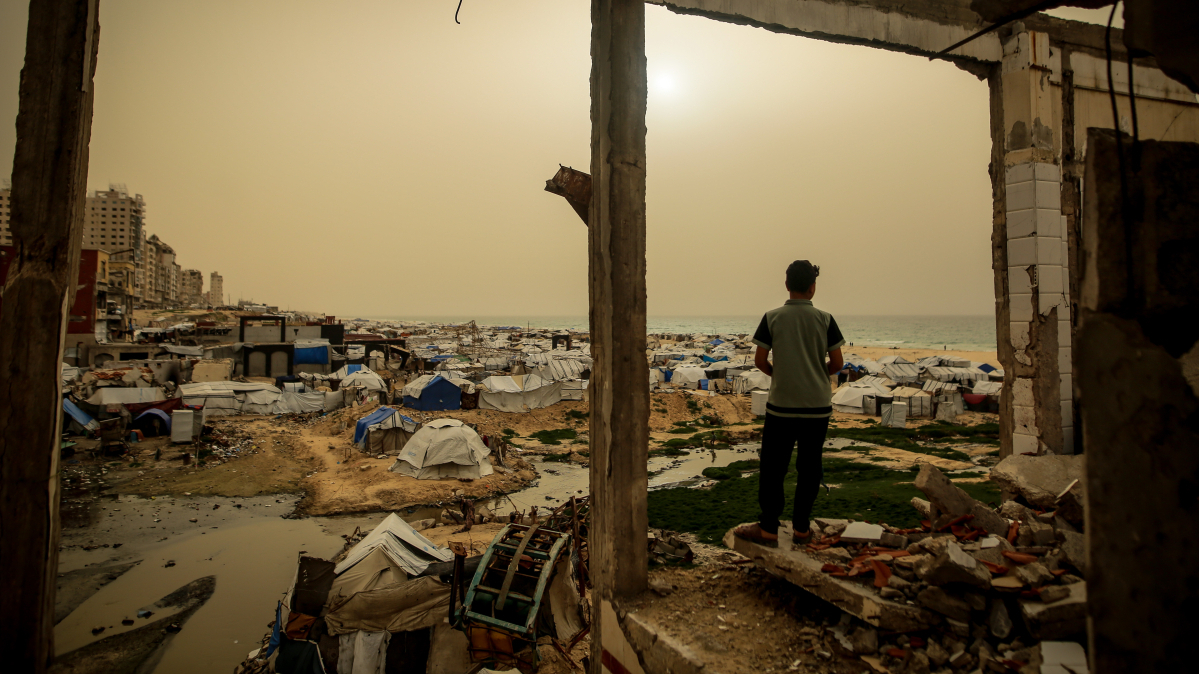
A fierce sandstorm has battered displaced Palestinians living in fragile tents and makeshift shelters across Gaza, exacerbating an already catastrophic humanitarian crisis after the two-year war that began on October 7, 2023.
Displaced people, especially those with chronic respiratory illnesses, told reporters they fear long-term health complications after gusts tore tents and left shelters exposed.
Social media footage showed dusty winds shaking tents and trees.
Al-Jazeera reports that tens of thousands of tents have been blown away or flooded since last December.
The storm damage comes on top of an overwhelming casualty toll from the two-year war.
Meanwhile, wider regional and diplomatic developments occupy other outlets' coverage, with AnewZ focusing on diplomatic and security shifts such as U.S. envoy meetings and the deployment of a second U.S. aircraft carrier to the Middle East.
Coverage Differences
Tone
Al-Jazeera (West Asian) foregrounds humanitarian suffering in Gaza, emphasizing displaced people’s health fears, tent damage, and casualty figures; AnewZ (Other) prioritizes diplomatic and security developments in the region and mentions military deployments, giving less space to on-the-ground humanitarian detail. In other words, Al-Jazeera reports direct human impact in Gaza while AnewZ highlights geopolitical maneuvers.
Missed Information
AnewZ reports on regional diplomatic events and U.S. military movements but does not detail the humanitarian damage in Gaza caused by storms and the two-year war the way Al-Jazeera does — a substantive omission that changes the reader's sense of immediate human suffering.
Storm damage and shelter shortages
The storm has destroyed shelter and magnified immediate risks.
Tents and weakened buildings that survived bombardment and displacement are now open to the elements, increasing respiratory illness and exposing thousands to further injury.
Al-Jazeera reports that tens of thousands of tents have been lost or flooded since December and that dozens of deaths and injuries have followed the weather events.
Al-Jazeera says the humanitarian emergency persists despite a ceasefire because Israel has not fulfilled obligations to allow entry of shelter and construction material needed to rebuild housing, water and sanitation networks.
AnewZ does not foreground that point while reporting on broader diplomatic tensions in the region.
Coverage Differences
Narrative Framing
Al-Jazeera frames the story as a continuing humanitarian emergency tied to concrete needs (shelter, water, sanitation) and notes alleged obstruction by Israel of relief materials; AnewZ frames the same regional environment through diplomatic and security maneuvers (envoys, carriers), which can obscure immediate civilian suffering.
Tone
Al-Jazeera uses direct humanitarian terms — damaged housing, health risks, unmet relief obligations — while AnewZ adopts a more strategic-security tone discussing rifts, envoy visits and military movements.
Media coverage of Gaza
Al-Jazeera’s on-the-ground reporting places the human toll at the center, saying the ceasefire ended a two-year war that left more than 72,000 Palestinians dead, over 171,000 wounded, and damaged roughly 90% of civilian infrastructure, with UN estimates of about $70 billion needed for reconstruction.
Those figures underscore the scale of destruction behind the tents torn by storms.
AnewZ, by contrast, situates the same regional conditions within a diplomatic-security narrative — discussing Munich Security Conference unease about U.S. policy, Türkiye–Greece talks, and Azerbaijan’s charges over plots to seize power — which can leave readers without a clear sense of the day-to-day humanitarian emergency in Gaza.
Coverage Differences
Content Priority
Al-Jazeera prioritizes casualty figures, infrastructure damage, and reconstruction needs that highlight the scale of civilian suffering; AnewZ prioritizes diplomatic and security updates across the region, giving less prominence to Gaza’s casualty and reconstruction figures.
Missed Information
AnewZ’s regional focus means it omits Al-Jazeera’s detailed casualty and infrastructure numbers; that omission results in different reader takeaways about urgency and the scale of civilian harm in Gaza.
Gaza coverage contrasts
The sources show two distinct journalistic emphases: Al-Jazeera details the catastrophic human cost in Gaza — storm-blown tents, health risks, huge casualty and damage tallies, and claims that Israel is not allowing in essential reconstruction materials.
AnewZ maps the broader regional diplomatic and security landscape, including U.S. movements and diplomatic initiatives that the outlet treats as central.
The two perspectives are complementary but reveal a gap: readers relying on region-wide diplomatic roundups may miss the immediacy of civilian suffering in Gaza that Al-Jazeera documents.
The sources do not use the word 'genocide' in the provided excerpts, so labeling the campaign as genocide would require explicit sourcing beyond the text given here.
The articles do, however, document very large Palestinian casualties and persistent humanitarian collapse.
Coverage Differences
Unique Coverage
Al-Jazeera uniquely provides on-the-ground humanitarian detail (torn tents, respiratory risks, casualty figures, and alleged obstruction of relief materials by Israel). AnewZ uniquely compiles diplomatic-security developments (Munich Security Conference unease, envoy meetings, aircraft carrier deployment) — both are accurate in scope but differ in priorities and emphasis.
Ambiguity
The provided excerpts document very high Palestinian casualty figures and unmet relief needs but do not explicitly use the term 'genocide' within the quoted text. Because the sources here do not themselves label the campaign 'genocide' in the passages provided, I cannot assert that label on their behalf without additional source text.