Business23 April, 20266 min read
Sheikh Mohammed bin Rashid Unveils Dubai Metro Gold Line, Dh34 Billion Underground Project
Dubai Metro Gold Line spans 42 km with 18 stations and is fully underground. Project cost is AED 34 billion, making it the emirate's largest transport project.
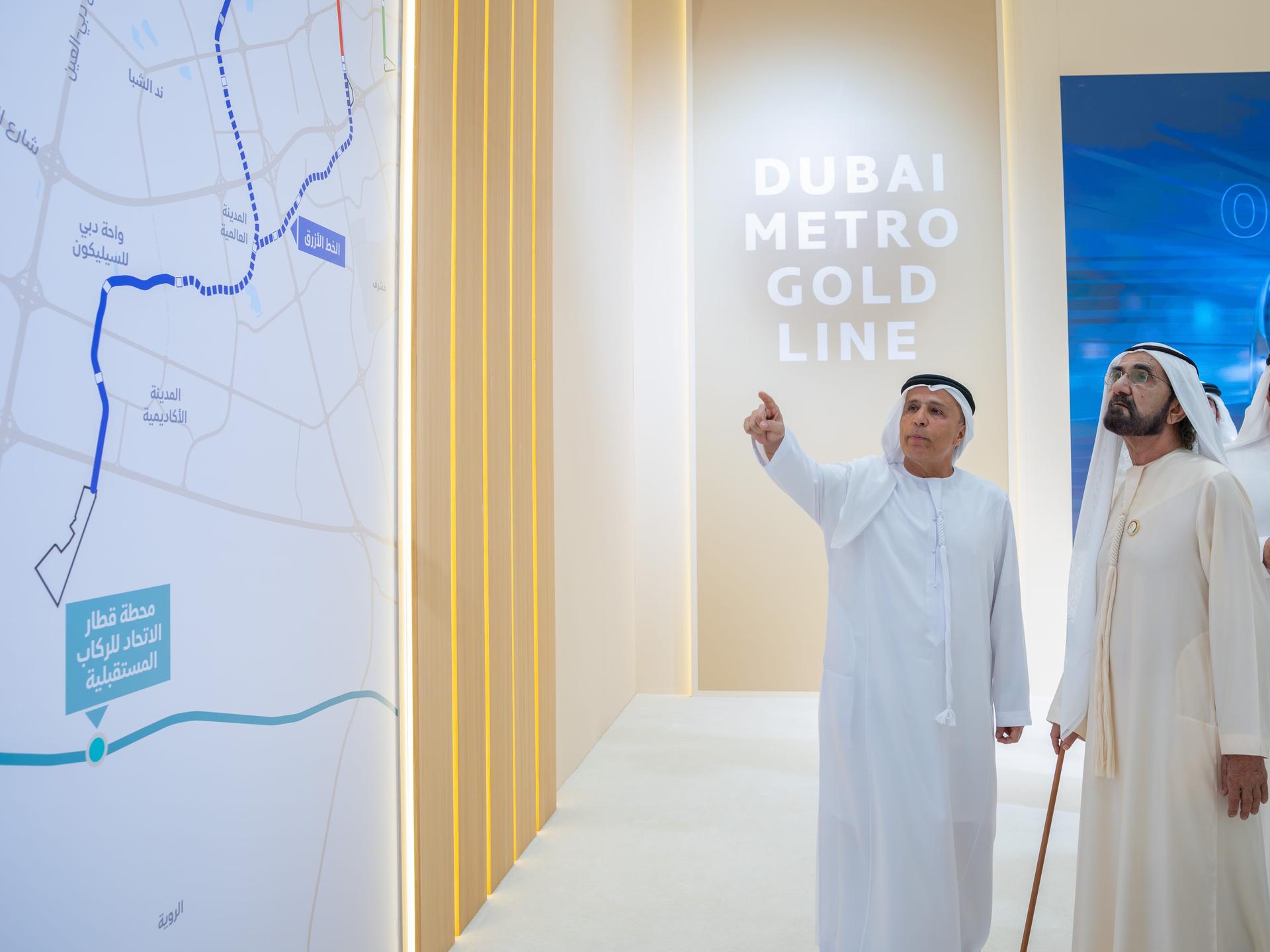
Dubai unveils Gold Line
Dubai has unveiled the Dubai Metro Gold Line, a Dh34 billion ($9 billion) project announced by Sheikh Mohammed bin Rashid Al Maktoum on April 22, 2026, with the line described as “a new Dubai Metro line spanning 42 kilometres, at a depth of 40 metres underground.” The Government of Dubai Media Office said the Gold Line will be Dubai’s first fully underground metro line, extending over 42 kilometres and including 18 stations. The route is scheduled for completion on September 9, 2032, and the Government of Dubai Media Office said the inauguration date reflects a delivery timeframe that is “30% faster than Dubai Metro’s Blue Line.”
Multiple outlets tied the Gold Line to a broader expansion of the metro network, with Gulf News saying the Gold Line adds a further 42 kilometres to bring the total network to 162 kilometres and increase stations from 67 to 85. The National similarly said the Gold Line will expand the network by 35% and carry up to 465,000 daily passengers after 2040. In official remarks carried by the Government of Dubai Media Office, Sheikh Mohammed said the project will connect 15 strategic locations in Dubai, “serving 1.5 million people and supporting mobility across 55 mega development projects currently under construction.”
Route, stations, and links
The Gold Line’s announced corridor is anchored in the historic Al Ghubaiba area and runs to Jumeirah Golf Estates, passing through 15 strategic locations and serving 18 stations across a 42-kilometre alignment. The Government of Dubai Media Office said the route “originating in Al Ghubaiba” will cross developments including Mina Rashid, City Walk, Business Bay, Mohammed Bin Rashid City, Nad Al Sheba, Mohammed bin Rashid Gardens, Meydan, Al Barsha South, Jumeirah Village Circle (JVC), and culminate at Jumeirah Golf Estates. Gulf News listed the same 15 locations and said the Gold Line will connect with the Red Line at Business Bay and Jumeirah Golf Estates and with the Green Line at Al Ghubaiba.
It also said the Gold Line will link with Etihad Rail at Meydan and Jumeirah Golf Estates, describing this as a “vital link to the Etihad Rail.” What's On and the Government of Dubai Media Office both described the Gold Line as Dubai’s first fully underground metro line, with What's On adding that the line will reach a depth of up to 40 metres underground.
Khaleej Times said the Rail Network Plan 2032 map shows interchange points including connections with the Green Line at Al Ghubaiba and with the Red Line at Business Bay, while also highlighting integration with Etihad Rail at Jumeirah Golf Estates. Time Out Dubai went further by using the 2032 network map to predict station placement, describing a first stop that links with the existing Green Line at Al Ghubaiba and a second station on Al Mina Street, while also noting that Satwa is set to be served by the Dubai Metro for the first time when the Gold Line is introduced.
Numbers and projected impact
The Gold Line is presented across outlets with a consistent set of demand and network-growth figures, including a target of serving around 1.5 million residents and carrying up to 465,000 passengers per day beyond 2040. The Times of India said planners estimate the line will serve around 1.5 million residents once fully operational and that “At full capacity, the line could handle up to 465,000 passengers per day.” Gulf News similarly said the route is planned to benefit more than 1.5 million people by 2040 and that daily ridership is expected to hit 465,000 passengers.
The Government of Dubai Media Office said the Gold Line will “serve over 55 development projects” and is projected to benefit “over 1.5 million people by 2040,” with daily passenger numbers expected to reach “465,000 people beyond 2040.” On the network scale, Gulf News said the metro spans 120 kilometres across the Red Line, Green Line, and Route 2020, and that the Gold Line adds a further 42 kilometres to bring the total to 162 kilometres.
For road impacts, Gulf News reported that the RTA estimates the route will remove “over 40 million journeys annually from Dubai's road network,” and it linked that to easing congestion, improving air quality, reducing road accident rates, and cutting carbon emissions. The Indian Express echoed the same release framing, quoting that “Gold Line will significantly ease congestion across major roads, by bringing about a reduction of over 40 million journeys annually.”
Official statements and governance
The approval and rollout of the Gold Line were presented as a leadership-led decision, with the Government of Dubai Media Office describing Sheikh Mohammed bin Rashid Al Maktoum’s approval as coming “in the presence of” multiple senior figures including His Highness Sheikh Hamdan bin Mohammed bin Rashid Al Maktoum, Crown Prince of Dubai, and His Excellency Mattar Al Tayer, Director General and Chairman of the Board of Executive Directors of the Roads and Transport Authority (RTA).
The Government of Dubai Media Office said Sheikh Mohammed directed the “immediate commencement of the project,” and it quoted him delivering the same core figures that appeared across other outlets: “a new Dubai Metro line spanning 42 kilometres, at a depth of 40 metres underground” and “serving 1.5 million people.”

It also quoted him saying the “AED 34 billion Gold Line project will expand the Dubai Metro network by 35%, with completion scheduled for 9 September 2032.”
In the same official text, Sheikh Mohammed framed the project as part of ongoing development, stating: “Our major projects to build the world’s best city to live in are ongoing. Our future projects will not stop; rather, they will gather pace.”
The National carried a separate quote from Sheikh Mohammed: “We are pleased to announce the largest transportation project in Dubai,” and it described the announcement as “the largest transport project in the emirate's history.”
Khaleej Times and Gulf News both tied the Gold Line to the Rail Network Plan 2032 map, with Khaleej Times saying the map “has revealed the full route of the upcoming Gold Line.”
The Government of Dubai Media Office also said the Gold Line will be led by Emirati cadres through the RTA, and it included Mattar Al Tayer’s statement that the Gold Line “marks a strategic milestone in the evolution of Dubai’s public transport network.”
Economic returns and next steps
Beyond ridership and network length, the Gold Line is described in the sources as a driver of economic returns and property-linked growth, with multiple outlets citing long-range projections. The Times of India said officials expect “up to 430 percent returns over the next two decades,” driven by rising demand for residential and commercial developments around metro-linked zones. Gulf News similarly said the Gold Line represents a strategic investment projected to achieve a “430 per cent cumulative economic return over 20 years of operation,” driven by savings in time and fuel, as well as reductions in road accident fatality rates and carbon emissions.
The Government of Dubai Media Office said the Gold Line will benefit “over 55 development projects” and projected to benefit “over 1.5 million people by 2040,” while also stating daily passenger numbers expected to reach 465,000 beyond 2040. The National described the project as adding 25 per cent to the network and said the underground 42km route will “open on September 9, 2032,” while also linking it to the coming Etihad Rail passenger train services.

Gulf News and Khaleej Times both emphasized integration with Etihad Rail at Meydan and Jumeirah Golf Estates, with Gulf News saying the Gold Line will link directly with Etihad Rail at two key hubs and Khaleej Times describing an interchange station planned at Jumeirah Golf Estates. Looking ahead, the Times of India said the bidding process set to begin in 2026, followed by contract awards in 2027, and it said construction is expected to start shortly after, using advanced tunneling technology.