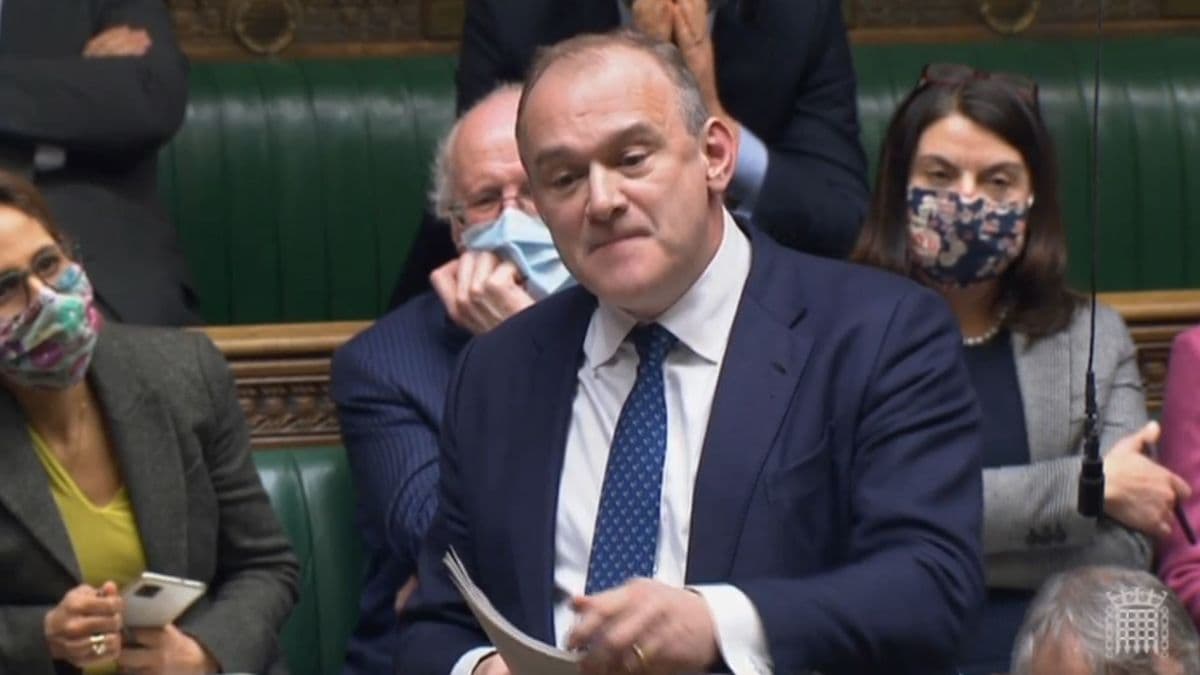
Sir Ed Davey calls for UK to build independent British nuclear deterrent to replace Trident
Key Takeaways
- Ed Davey calls for a fully independent British nuclear deterrent.
- UK currently relies on the US to supply and maintain missiles.
- Britain would have a British-made deterrent, reducing US dependency.
Davey's Independence Call
Sir Ed Davey, leader of the Liberal Democrats, has called on the UK government to build a 'fully independent British nuclear deterrent' to end Britain's reliance on the United States for its nuclear arsenal.
“- Published Liberal Democrats leader Sir Ed Davey is calling on the government to start building a "fully independent British nuclear deterrent" to end the UK's reliance on the US”
In a speech to his party's spring conference in York, Davey argued that the UK's continued dependence on US support for Trident missiles poses an unacceptable risk to national security.

The Liberal Democrat leader emphasized that Britain's nuclear deterrent must be 'genuinely, verifiably ours – not dependent on Trump or whoever his successor may be,' highlighting Trump's presidency as proof that America cannot be relied upon as a dependable ally.
Davey urged the UK to make the decision now to spend billions required over the next two decades domestically rather than in the United States, as the country prepares to replace Trident in the 2040s.
Current Trident System
The UK currently maintains its nuclear capability through a fleet of submarines armed with American-built Trident missiles under a technology-sharing agreement with the United States.
Britain sustains its nuclear deterrent by ensuring one of its four nuclear submarines remains operational at sea continuously, with these vessels operating from Faslane on Scotland's western coastline.
The Vanguard class submarines are currently being succeeded by new Dreadnought class submarines under construction at Barrow-in-Furness, Cumbria.
While the UK possesses operational control of its nuclear arsenal, including British-built warheads, it depends on the US to supply and maintain the Trident missiles that deliver them.
This arrangement means that while the prime minister retains control over when to fire the missiles, Britain's nuclear arsenal is integrated into NATO's defence shield, creating a complex dependency on American technology and support.
Historical Context
Britain has a significant nuclear history, having developed its own atomic weapons during the 1950s and becoming only the third nation to achieve nuclear capability after the USA and the Soviet Union.
“- Published Liberal Democrats leader Sir Ed Davey is calling on the government to start building a "fully independent British nuclear deterrent" to end the UK's reliance on the US”
This historical precedent serves as inspiration for Sir Ed Davey's call to restore full independence in the UK's nuclear deterrent.
The nation can look to its neighbour France, which operates its own completely autonomous nuclear capability, as a model for potential independence.
Davey's proposal suggests returning to Britain's original nuclear strategy of developing indigenous weapons systems rather than relying on foreign technology.
This historical context underscores the technical and political feasibility of an independent British nuclear deterrent, though it also highlights the significant investment and expertise required to rebuild such capability from scratch after decades of technological sharing with the United States.
Cost Challenges
The pursuit of an independent nuclear deterrent presents significant financial and strategic challenges for the UK government.
Trident has previously been calculated to consume roughly 6% of the UK's yearly defence spending, suggesting that developing a completely independent system would prove enormously expensive.
The Chatham House think tank has warned that Britain faces a challenging decision when replacing Trident, noting that pursuing an independent deterrent would be costly while partnering with France would similarly create dependence on another ally.
This financial calculus is complicated by the fact that the UK is already investing heavily in the new Dreadnought class submarines, indicating that any shift toward independence would require substantial additional expenditure and potentially delay the planned replacement timeline.
The economic burden of maintaining both nuclear and conventional defence capabilities continues to be a critical factor in strategic decision-making.
Government Response
The current UK government has defended the existing arrangement with the United States, emphasizing the 'deep and longstanding relationship' between the two nations and Britain's key part in NATO security.
“- Published Liberal Democrats leader Sir Ed Davey is calling on the government to start building a "fully independent British nuclear deterrent" to end the UK's reliance on the US”
The government's position suggests that maintaining the current technology-sharing agreement remains the preferred approach, despite Davey's criticisms about reliance on American support.
This response indicates that the Conservative government likely views the US-UK nuclear partnership as strategically valuable and politically expedient, providing both technological assurance and diplomatic alignment with NATO's collective defence posture.
The government's stance contrasts with Davey's call for independence, reflecting differing assessments of the risks associated with American alliance reliability versus the costs and complications of developing an entirely indigenous nuclear capability.
More on Britain

UK Court Rules Palestine Action Ban Disproportionate, Home Office Plans Appeal
17 sources compared

King Charles III and Camilla Begin U.S. State Visit With Tea at White House
12 sources compared
King Charles III Arrives in Washington, D.C. for Four-Day State Visit With Queen Camilla
28 sources compared

Zohran Mamdani Urges King Charles to Return Koh-i-Noor Diamond to India
15 sources compared