Connaissance des Arts
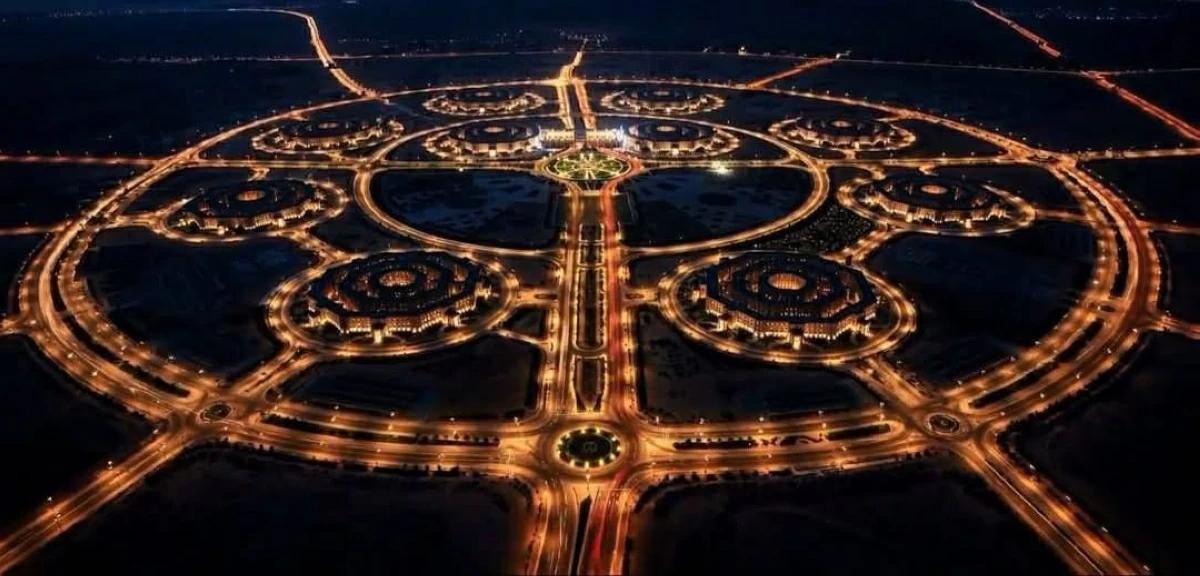
The president’s mega-projects The GEM, as the new spearhead of the tourism industry, sits at the top of the record books of the “New Egyptian Republic,” promoted continuously since 2021 by the strongman with a barrage of posters and advertising spots. The GEM is meant to leave a lasting impression with its gigantism just as the buildings of the new administrative capital, built ex nihilo in the desert about forty kilometers east of Cairo: it houses Africa’s tallest tower and Africa’s largest mosque, the largest cathedral in the Near East, and so on. The museum in Giza also enjoys a special status. Since 2021 it is no longer under the authority of the Ministry of Tourism and Antiquities but reports directly to the Presidency, and its management has been entrusted to a private company, Legacy Development, a subsidiary of Hassan Allam, a colossal Egyptian construction company. One might wonder who, in this public-private partnership, will have to repay in the coming years the loans granted by the Japan Bank for International Cooperation (JBIC) without which the museum would probably not yet have come off the ground. They would amount to $800 million, i.e., two-thirds of the total cost. In January, the board of directors was reshuffled and the arrival of Tahnoon bin Zayed Al Nahyan, the United Arab Emirates’ National Security Advisor and above all an investor with limitless means, sent social media into a frenzy and fed rumors of a possible sale of the museum in the near future, which the government had to issue an official denial. New museum, new district The GEM is at the heart of an urban development project aimed at tourism called Giza Vision 2030. Luxury hotels, upscale residences, an amusement park, and a vast avenue along the axis of the Khufu pyramid are among the dozens of projects funded by foreign investment, especially Saudi and Emirati. And the displaced or expropriated residents could number in the thousands, particularly in the Nazlet al-Samman neighborhood, adjacent to the pyramid plateau. The government is targeting so-called “informal” constructions (built without official authorization), which would house two-thirds of Greater Cairo’s residents, though they are not the only ones affected. As for the transportation network, it has been redesigned to facilitate access to the GEM: a new international airport at the Sphinx, about thirty kilometers away on the Cairo–Alexandria road; a new metro line; new road infrastructures, including on the pyramid plateau, where an intermediate ring road has been laid out “without referring to the World Heritage Centre,” according to a UNESCO document dated 2023. The UNESCO body appears to have little voice left, even though it once managed to block this same highway project in the 1990s. Origins of the GEM The GEM project also dates from the Mubarak era (1981–2011). Back then they sought a site suitable for the tourist onslaught but distant from a congested city center and from an Egyptian Museum that was equally constrained. Wonderfully antiquated to some, terribly outmoded to others, the Tahrir Square building could hardly meet international museography and safety standards, and its operating budget was always meager. According to Egyptologist Wafaa El-Saddik, who was also the first woman to head the Egyptian Museum from 2004 to 2010, the GEM “had to be ‘the largest museum in the world’ since Mubarak wanted to erect a mountain to his own glory” (Protecting Pharaoh’s Treasures, The American University in Cairo Press, 2017). The former leader, a figure reviled since the Arab Spring of 2011, will he receive a discreet homage during the GEM inauguration? Nothing is certain. Two survivors of the old regime, who now sit on the museum’s board, should, however, be warmly welcomed. First, Farouk Hosni, Mubarak’s Minister of Culture for more than twenty years. He is regarded as the project’s architect, formalized in 1992 by presidential decree, with a fifty-hectare military site backing it. Another hero of the celebration, more than ever in command, is the Egyptologist Zahi Hawass, former Minister of Antiquities, now an adventurer of the sands and a media darling thanks to his tireless Stetson. In December 2002, recently named Secretary General of the Supreme Council of Egyptian Antiquities, he is the one who outlines the Giza project to the hundreds of guests gathered at Tahrir Square, in the garden of the Egyptian Museum as it marks its centennial. The Pyramid Triangle The international competition launched the same year drew 1,557 entrants from 82 countries. In 2003 the jury chose, to everyone’s surprise, the Heneghan Peng Architects, beating the Austrian firm Coop Himmelb(l)au. Shih-Fu Peng, American of Taiwanese origin, and his Irish partner Róisín Heneghan had just left New York for Dublin. Their project has much to charm: the museum stands integrated into the landscape, straddling the plateau and the valley, with a slender silhouette and a triangular shape that evokes both a reclining pyramid and a cone of vision directed toward the three Khufu, Khafre, and Menkaure pyramids. Another strong point is the alabaster veil meant to cover the main façade, a long 800-meter cliff where the pyramid motif is endlessly echoed. Also noted are the skylight domes at the top, paired with a cascading reflective roof, which significantly reduce energy costs. The stairs of power The tour de force remains the grand staircase that echoes the constructions and myths of the Old Kingdom. Who could help but think of the Step Pyramid built in the Saqqara necropolis by the architect Imhotep for Pharaoh Djoser? Or of the steps the soul of the deceased sovereign climbs during its celestial ascent, as described in the Pyramid Texts carved on the walls of the tomb chambers? Royal colossi and divine effigies, architectural elements, and sarcophagi—more than 80 rooms adorn the GEM’s grand staircase, lined with moving walkways and a mini-funicular. At the top of the steps, a double panorama awaits visitors: views of the three Giza pyramids through huge glass bays, and of pharaonic civilization from prehistory to the Greco-Roman era, in 12 chronological galleries opened since autumn 2024. About 15,000 pieces, many never exhibited before. Each period is approached from three angles (Egyptian society, royalty, and funerary beliefs) and oriented east–west, guiding us from the living world to the world of the dead. With some visually striking pauses, such as a wall reproducing Amarna reliefs set to the Hymn to Aten, the solar disk worshipped by Akhenaten, or a tomb facsimile with animated walls of the dignitary Khnoumhotep II, who lived in the Middle Kingdom (ca. 2033–1786 BCE). Treasures of the collection This section devoted to the era of Montuhotep III, Amenemhat I, and Senusret I yields the most surprises, along with other marvels tied especially to the early days of pharaonic history: immediately at the entrance, two slender gold figures from the predynastic Tell el-Farkha site in the Nile Delta; further along, the limestone statue of the scribe Nefer or the furnishings of Queen Hetepheres, mother of Khufu. Vincent Rondot, director of the Louvre’s Department of Egyptian Antiquities, says he was impressed by “the considerable number of objects known to specialists only by their photographic reproductions and restored in situ.” The Madness of Grandeur Everything in this building is outsized, billed as the “largest archaeology museum in the world dedicated to a single civilization.” And sometimes for unexpected reasons. The entry esplanade (27,000 m2), occupied by the sole hanging Ramesses II obelisk and bounded along the road by 3-meter-high barriers, primarily serves safety standards. The risk of a car-bomb attack had to be accounted for. The museum proper (92,000 m2) accounts for only a fifth of the site. Several gardens, a dune area, a conference center, a cinema, a shopping gallery, many cafés and restaurants, not to mention a likely hotel zone to come, are added to the 17 conservation laboratories opened first in 2010, to the exhibition galleries (25,000 m2) and the vast stores. The transfer of antiquities—about 100,000 pieces—could also make the Books of Records. High-risk transports, conducted under the watch of Egyptian and Japanese experts, from dozens of site reserves across the country and from several museums, beginning with the Tahrir Square Museum, which, to be precise, has not been stripped of its masterpieces and still houses the world’s largest collection of pharaonic antiquities (50,000 objects on display in about a hundred rooms). A Very Popular Colossus The first transfer occurred overnight in August 2006, triggering a popular fervor the Egyptian authorities had not anticipated. Hundreds of thousands of Cairenes escorted the granite colossus of Ramesses II from the train station square where President Gamal Abdel Nasser had it installed in 1955. A take-back of public space, seen by some observers as a prelude to the Arab Spring. It would be 2018 before Ramses the Great found his final place, in the atrium, after a second transfer of 400 meters, first modeled in 3D, to the sound of a military band and before an invited audience. Despite its 11 meters height and 83 tons, the most famous pharaoh in history struggles to assert itself in the gigantic reception hall whose skylights rise to 38 meters. The statue’s placement was calculated so that twice a year, in February and October, it is struck by the sun’s rays, on the same dates as the other effigy of the pharaoh in Abu Simbel. “A technical tour de force for propaganda purposes but of doubtful relevance,” says one of our Egyptian informants, who shall remain anonymous. The project’s ups and downs This sunlight encounter was orchestrated by Major General Atef Moftah, named in 2016 as the GEM’s general supervisor and its environs by President Sisi. A trained architect, this senior officer reports to the Armed Forces’ Engineering Authority, one of the military institutions most involved in the mega-projects of the “new republic” that has allowed the army to strengthen its economic grip like never before. Undoubtedly, a man of resolve was needed to run a project continually slowed by technical and financial difficulties, internal rivalries, and political upheavals, not to mention the intelligence services “imposing their own financial conditions on foreign contractors,” as revealed by Africa Intelligence. Moftah decided to replace the alabaster slabs that were to cover the façade with much cheaper materials. Some ornaments, a little too conventional, such as the wall of golden cartridges on a black background framing the entrance or the names of Egypt in various languages carved on the pillars at the same spot, would also be his doing. As for the annex building, intended for Khufu’s solar boats, one previously displayed at the foot of its pyramid and the other under restoration, it is not part of the initial project either, as confirmed by architect Róisín Heneghan. Tutankhamun’s Tomb This building will not open its doors until July 3, concurrently with the two galleries housing Tutankhamun’s complete funerary collection. About 5,300 objects instead of the 1,800 previously exhibited at the Egyptian Museum on Tahrir Square. Confined for millennia in a four-room underground space of 100 m2, the young pharaoh will have 7,000 m2 to accommodate the 15,000 daily visitors the authorities hope for in the coming years. High-tech display cases, cutting-edge technologies, digital media, 3D images—these are all the ingredients of a 21st-century museum gathered here as well. Visitors will learn all about Tutankhamun’s brief life, his family and close associates, the royal ritual, funerary beliefs, or the tomb’s discovery. Attempting to show everything is a risky gamble in the age of channel surfing: sandals by the dozens, arrows, bows, or funerary figurines by the hundreds—the bill could be heavy. The red quartzite sarcophagus and the mummy of the young ruler should remain in tomb KV62 in the Valley of the Kings. The mummies of his two stillborn daughters will not be shown, but the results of DNA tests on the fetuses will be detailed. Today, the golden mask and about 200 precious objects are still displayed at Tahrir Square. And the transfer date has not been announced. Will it be done quietly or under camera oversight? Tutankhamun will no doubt enjoy another worldwide surge of attention in early July. The project even promises an opera about the superstar pharaoh, crafted by the Egyptologist and one-man band Zahi Hawass. Can a gold mask take the place of a granite colossus in the heart of Egyptians? An answer is expected soon. Grand Egyptian Museum (GEM), Alexandria Desert Road, Giza, Egypt Tutankhamun’s funerary trousseau galleries from July