Full Analysis Summary
Attack on Greek Tanker Near Somalia
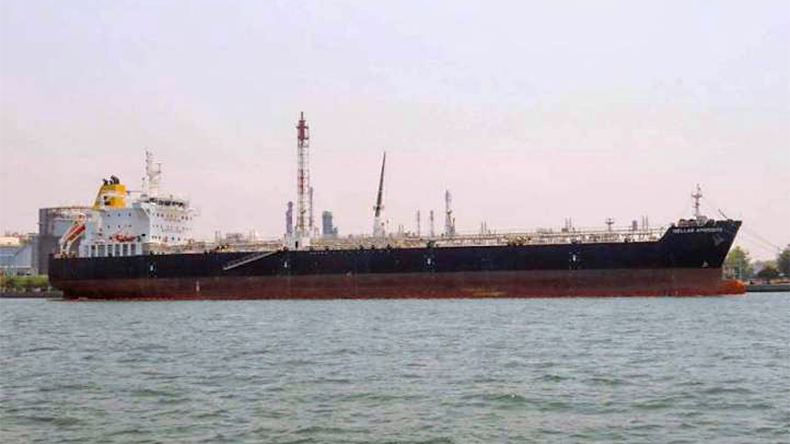
A Greek-owned, Malta-flagged product tanker named Hellas Aphrodite was attacked and boarded off the coast of Somalia.
Different reports describe the incident variously as a hijacking or an illegal boarding.
The assault involved firearms and rocket-propelled grenades launched from or alongside an Iranian-flagged fishing vessel.
The 24-person crew retreated to the ship's citadel, as there was no armed security team on board.
The tanker was carrying gasoline and was en route to South Africa, with one report specifying Durban as the destination.
Following the incident, UK Maritime Trade Operations (UKMTO) issued a regional warning.
Coverage Differences
Narrative/wording difference
BBC (Western Mainstream) uses stronger language, saying the tanker was 'hijacked' and adds UKMTO 'confirmed an illegal boarding', whereas eKathimerini (Other) says it was 'attacked and boarded' and Lloyd's List (Other) states it was 'boarded'. This reflects differing characterizations of the same event.
Missed information
Only Lloyd's List specifies the cargo and destination ('carrying gasoline to Durban'), while eKathimerini notes the route more broadly ('traveling from India to South Africa'); BBC does not mention cargo or destination in its snippet.
Unique detail
Accounts differ on the attack platform: eKathimerini describes a skiff launched from a suspected hijacked Iranian-flagged fishing vessel; BBC says gunfire came from an Iranian-flagged fishing vessel; Lloyd’s List refers to a small craft with guns and RPGs without specifying the mother ship.
Details of Maritime Attack Incident
Key operational details vary by source but collectively indicate the crew sheltered in the citadel, with no armed guards aboard, as shots and RPGs were reported.
One outlet pinpoints the strike far from the traditional high-risk area—roughly 549 nautical miles ESE of Hobyo—while another highlights that the nearest naval support was hours away.
UKMTO issued warnings to ships, yet the attackers’ identities and any demands remain unclear, underscoring the uncertainty around the perpetrators and intent.
Coverage Differences
Unique/off-topic coverage
eKathimerini (Other) uniquely provides precise geospatial context and risk-zone framing, stating the incident occurred about 549 nm ESE of Hobyo and was 'outside the usual high-risk piracy zone', while others do not provide such exact positioning.
Missed information
Lloyd’s List (Other) alone emphasizes response constraints—'the nearest naval support was several hours away'—which is not mentioned by the other sources.
Tone/uncertainty
BBC (Western Mainstream) underscores uncertainty by noting that 'The attackers' identities and demands remain unclear,' a nuance not addressed by eKathimerini or Lloyd's List in their snippets.
Suspected Piracy and Militant Links
Coverage on attribution highlights suspected Somali pirate involvement with differing levels of certainty about external support.
One account ties the attack craft to a suspected hijacked Iranian-flagged fishing vessel linked to Somali pirates.
Another cites a UN Security Council report suggesting possible connections between regional piracy and al-Shabab, potentially collaborating with Yemen’s Houthis for weapons and training.
A third says authorities link piracy groups to al-Shabab and the Houthis for weapons, expertise, and funding—stronger language than a mere possibility.
Coverage Differences
Strength of claims
BBC (Western Mainstream) carefully couches attribution—'suggests possible connections' and 'may be collaborating'—while Lloyd's List (Other) states 'Authorities link' pirates to al‑Shabaab and the Houthis and that they are 'believed to provide' support, a firmer assertion. eKathimerini (Other) focuses on a suspected hijacked Iranian-flagged fishing vessel linked to Somali pirates without naming al‑Shabaab or Houthis.
Maritime Security Threats Update
Analysts warn the incident could signal broader risk dynamics.
Lloyd’s List frames it as part of a resurgence, citing multiple recent attempts including one on a Stolt-Nielsen tanker despite EU naval patrols.
The publication also notes widespread security advisories urging ships to avoid or heighten vigilance in the area.
BBC emphasizes the financial logic behind the attacks, with experts warning that ransom payments could encourage further incidents.
eKathimerini highlights the geographic spread of the threat by noting the strike occurred outside the usual high-risk zone.
The UKMTO issued a warning to ships operating in the region following the incident.
Coverage Differences
Tone/trend framing
Lloyd’s List (Other) explicitly states the attack 'signals a resurgence of Somali piracy' and references recent attempts, while BBC (Western Mainstream) highlights expert warnings that ransom payments may incentivize more attacks. eKathimerini (Other) focuses on geography and warnings rather than trend language.
Unique detail
Lloyd’s List alone mentions EU Operation Atalanta and enumerates specific recent incidents and broad security advisories, details not present in the BBC or eKathimerini snippets.