China06 February, 20263 min read
South Africa Signs Framework Trade Deal With China to Seek Duty‑Free Access for Exports
Trade Minister Parks Tau signed a framework economic partnership agreement with China. Agreement aims to secure duty-free access for South African exports, notably agricultural products.

13 outlets told this the same way.
South Africa China trade pact
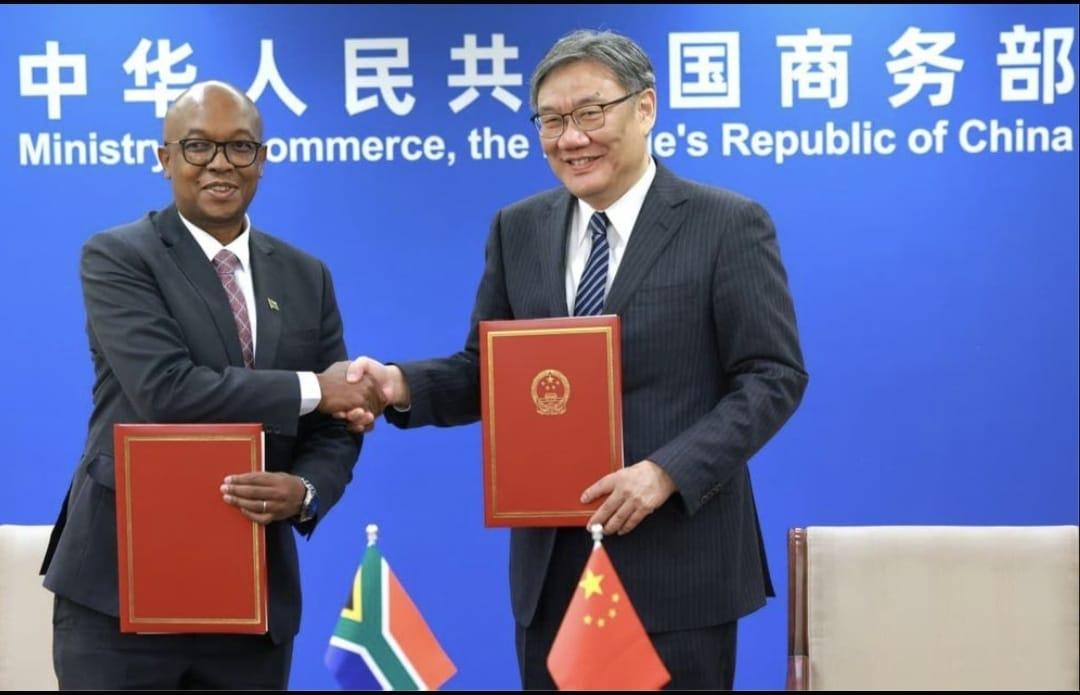
On 6 February 2026 South Africa and China signed the Framework Agreement on Economic Partnership for Shared Prosperity (CAEPA), launching negotiations toward an Early Harvest Agreement to give selected South African goods duty‑free access to China, with officials aiming to conclude the first phase by the end of March 2026. The framework, signed by South Africa's Trade Minister Parks Tau and China's Commerce Minister Wang Wentao, covers trade, investment, new energy and multilateral cooperation and is presented as a pragmatic, WTO‑consistent basis for deeper economic ties rather than an immediate full free‑trade treaty. China has also signalled practical follow‑up actions, including an inward buying mission and an invitation to the China International Import Expo, while Beijing hosted the Joint Economic and Trade Commission where the deal was sealed.
“South Africa and China signed a Framework Agreement on Economic Partnership for Shared Prosperity (CAEPA) on 6 February 2026, by which China will grant duty-free access to certain South African exports.”
South Africa–China trade pact
The agreement is widely presented as part of Pretoria's strategic push to diversify markets after sharply strained ties with the United States, where reciprocal tariffs imposed in 2025 — including duties up to 30% on certain South African exports — damaged exporters and aggravated joblessness in affected sectors. South African officials and many reports link the timing of the China framework to that US pressure.
The new Chinese package aims to open alternative markets for agricultural goods such as citrus and for higher-value manufactured items, while encouraging Chinese investment that could support jobs and factories. At the same time, the deal drew mixed domestic reactions as negotiators said safeguards would be sought to protect local industry and workers.
China-South Africa trade package
The framework highlights specific sectors that could benefit and areas where China has promised practical support, including agricultural exports such as citrus and rooibos, mining, high-value manufactured goods, renewable energy technologies, and automotive-related investment. Reports consistently mention China's pledge to send an inward buying mission and to invite South Africa to the China International Import Expo and a steel investment showcase as concrete steps to boost off-take and investment flows. South African ministers billed the package as potentially bringing skills transfer, factory and farm investment, and billions in extra trade while opening new markets for rural growers and packhouse workers.
“The pact prioritizes expanding bilateral trade in South African agricultural products and high‑value manufactured goods (such as citrus and rooibos) and opens opportunities in mining, renewable energy and technology.”
Trade safeguards and risks
Concerns and calls for safeguards appear repeatedly in coverage. South African officials say they will seek protections to prevent cheaper Chinese imports undermining domestic manufacturers and jobs.
Watchdogs and analysts warn that safeguards will be needed to protect workers' rights and the environment. Coverage of risks ranges from measured calls for negotiated safeguards to warnings that rapid liberalisation could undercut textiles, steel and other local industries, making the safeguard question central to upcoming talks.
South Africa trade geopolitics
The agreement sits in a broader geopolitical and trade-policy context. Reports note Beijing’s outreach, including invitations to a steel-industry investment event and a June 2025 pledge to eliminate tariffs on imports from 53 African states. Observers place the framework within longstanding China–South Africa commercial ties, with China a major investor and trading partner.
“China has invited South Africa to a steel-industry investment promotion event, and Beijing’s June 2025 pledge to eliminate tariffs on imports from all 53 African states it recognizes.”
Coverage also refers to recent U.S. measures and an AGOA extension signed in February 2026 that temporarily restored duty-free access for eligible African exports. This underscores that Pretoria will negotiate with multiple partners as it balances market access, jobs and industrial policy. Media accounts differ on whether the deal primarily deepens long-standing China ties or signals a clearer pivot away from Western markets.