Full Analysis Summary
El Obeid siege signs
In January 2026, Yale's Humanitarian Research Lab reported signs that the Sudanese Armed Forces and allied groups may be preparing to besiege El Obeid, the capital of North Kordofan.
Analysts based their assessment on satellite imagery and observations cited by regional outlets.
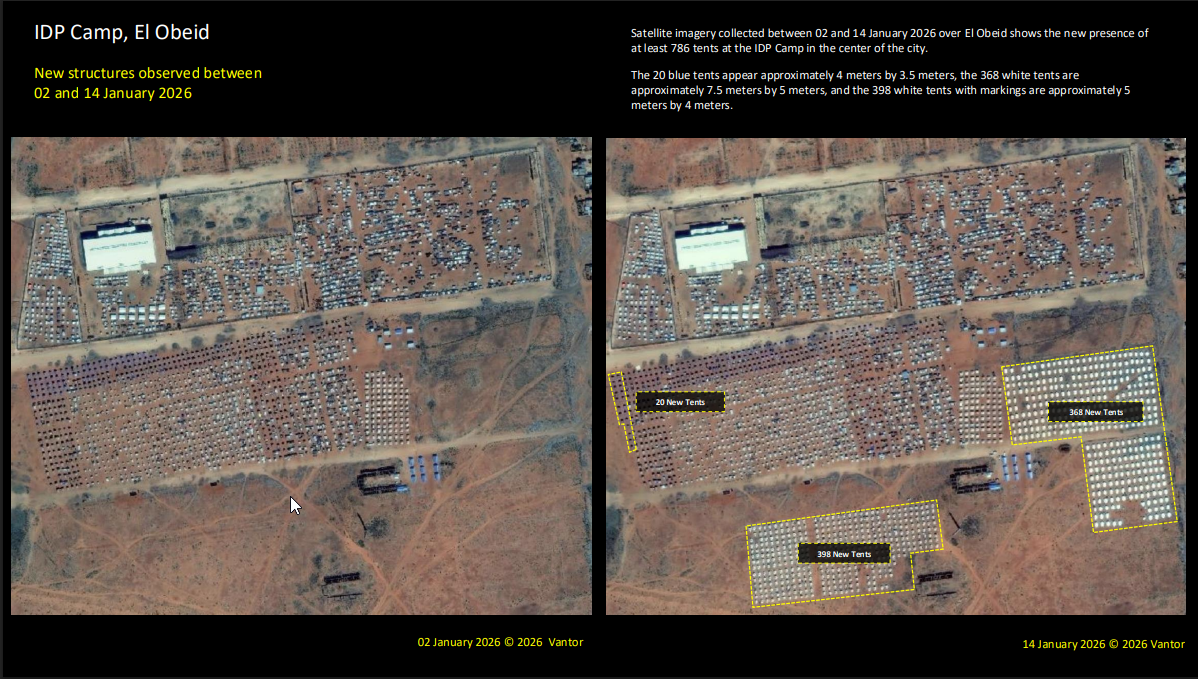
They observed new earthworks and embankments being erected along major exit routes and around critical infrastructure, and noted an increase in tents at city shelters.
Reporters framed these measures as preparations that could restrict movement and either protect or enable targeting of infrastructure around the city.
The findings were reported by Dabanga Radio TV Online and Radio Dabanga, both citing Yale HRL's satellite-analysis claims.
Coverage Differences
Tone/wording difference
Both sources report the same Yale HRL findings but use slightly different phrasing: Dabanga Radio TV Online reports that Yale 'says satellite imagery ... shows signs' that SAF 'may be preparing to besiege El Obeid,' while Radio Dabanga states Yale 'used satellite imagery ... that it says suggests preparations ... for a possible siege.' Both are reporting Yale’s claim rather than asserting it themselves.
Fortifications and humanitarian impact
Reported earthworks and embankments are concentrated along key exit routes and near critical infrastructure.
Analysts interpret this pattern as measures to control movement and fortify positions.
If implemented, these actions would effectively constrain civilian escape and limit humanitarian access.
Both outlets emphasize the physical nature of these preparations, including earthworks, embankments and additional tents at shelters, and flag the humanitarian implications for El Obeid's population and services.
Coverage Differences
Narrative emphasis
Both sources focus on the same physical signs (earthworks, embankments, tents) and potential intent to control movement, but the snippets show Dabanga Radio TV Online frames the measures as possibly intended to 'restrict movement and protect or target infrastructure,' while Radio Dabanga emphasizes they 'could be intended to control movement and fortify positions, raising humanitarian concerns.' Both report Yale HRL’s analysis rather than making independent claims.
Attribution and verification concerns
Both reports explicitly attribute the analysis to Yale's Humanitarian Research Lab rather than presenting the measures as independently verified on the ground, signaling reliance on remote-sensing evidence.
That attribution is repeated in both outlets' wording, as they say or report Yale's satellite-based interpretation.
This wording leaves uncertainty about intent and on-the-ground confirmation because the reporting does not include local eyewitness accounts or official SAF or allied-group statements to corroborate the satellite interpretation.
Coverage Differences
Source attribution and evidence type
Both Dabanga Radio TV Online and Radio Dabanga clearly attribute the observations to Yale HRL satellite analysis ('says' / 'that it says'), indicating the reports are secondary and based on imagery interpretation; neither snippet includes direct local testimony or official responses, which is a shared omission rather than a contradiction between the two sources.
Satellite analysis of El Obeid
Taken together, the two available reports, both labeled 'Other' source_type, provide a consistent account.
Satellite imagery interpreted by Yale HRL suggests the SAF and allied groups may be preparing earthworks and other measures around El Obeid that could facilitate a siege and generate humanitarian risks.
Because the coverage is limited to secondary reporting of satellite analysis and both items derive from similar reporting angles, there is limited diversity of perspective and no contrasting mainstream, regional-government, or opposition-source narratives to corroborate, dispute, or contextualize Yale’s interpretation.
Coverage Differences
Missed information / limited source diversity
Both Dabanga Radio TV Online and Radio Dabanga echo Yale HRL’s satellite findings, but no other types of sources (e.g., government statements, local witnesses, international organizations beyond Yale HRL, or Western mainstream outlets) are present in the supplied material to corroborate or challenge the satellite interpretation — this is an omission shared by both sources rather than a contradiction.