Full Analysis Summary
Aden secession rally
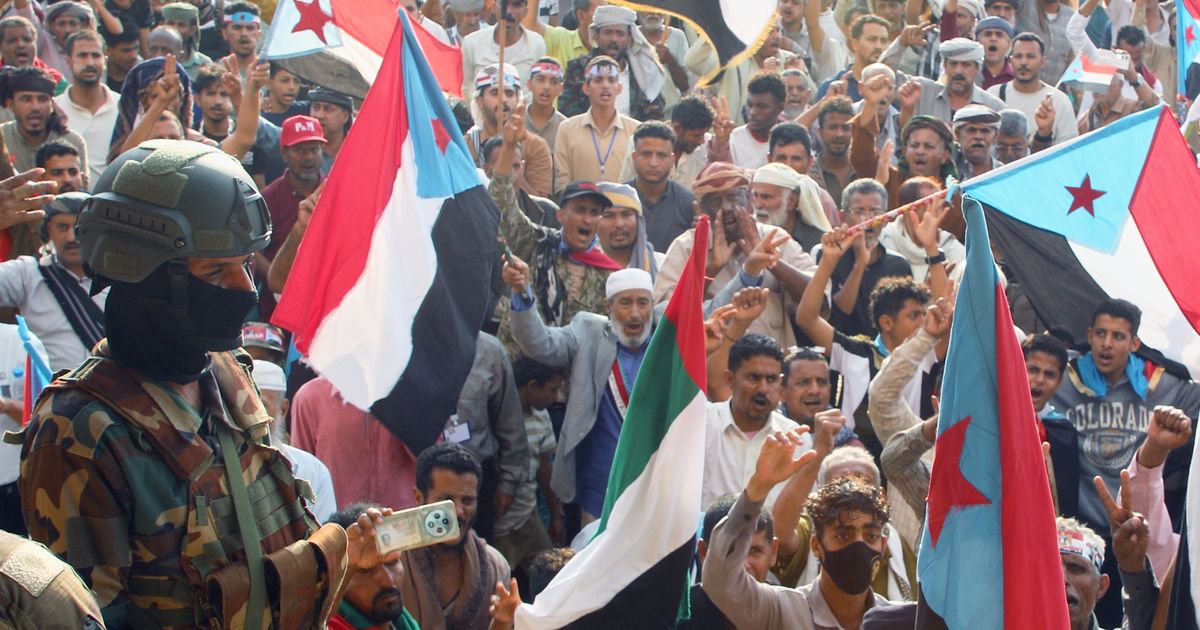
A large crowd gathered in Aden's Khor Maksar district to demand secession of southern Yemen and to show support for the Emirati-backed Southern Transitional Council and its leader, Aidarous al-Zubaidi.
Demonstrators waved South Yemen flags, chanted anti-Saudi slogans, and urged restoration of an independent south to control local oil and gas wealth.
Some accounts said Zubaidi left Aden for the United Arab Emirates.
The demonstration occurred more than a week after the Southern Transitional Council said it would dissolve itself.
Coverage Differences
Tone and detail
Washington Post (Western Mainstream) presents a concise, factual statement that a large crowd rallied and notes the STC "dismantled itself," while WRAL (Local Western) emphasizes visuals and slogans — "STC-linked media showed crowds waving South Yemen flags, chanting anti‑Saudi slogans" — and The Killeen Daily Herald (Other) offers the most granular local detail, noting the numbers as "Hundreds-to-thousands" and that protesters "urged restoration of an independent south to control local oil and gas wealth." The Killeen piece also reports Zubaidi "reportedly fled to the UAE," which the other sources also reference but with less detail.
STC advances and political fallout
The rallies followed recent battlefield moves by the Southern Transitional Council and a political maneuver in which the council said it would dissolve after advances into Hadramout and al-Mahra.
Those advances briefly ousted Saudi-aligned forces before Saudi-backed troops retook key sites after airstrikes.
Media coverage highlighted external patrons, describing the Southern Transitional Council as Emirati-backed and framing the broader conflict as linked to Iran and Saudi Arabia.
In response to the unrest, Yemen's internationally recognized Presidential Leadership Council replaced the prime minister, named Shae'a al-Zandani to form a new cabinet, and Saudi Arabia moved to host talks with southern figures.
Coverage Differences
Narrative emphasis and specifics
The Killeen Daily Herald (Other) gives more granular military and political sequence — "The rallies come after December clashes in which the STC pushed into Hadramout and al‑Mahra, briefly ousting Saudi‑aligned forces before Saudi-backed troops retook key sites following airstrikes" and that "The STC said it would dissolve after those advances, a move some members dispute." WRAL (Local Western) similarly recounts the territorial advances and the Saudi retaking after airstrikes, while Washington Post (Western Mainstream) is brief about timing, only noting the rally came after the STC "dismantled itself." The Killeen piece also explicitly frames the unrest within an "Iran‑ and Saudi‑linked civil war," which provides a wider geopolitical attribution that the other sources summarize more succinctly.
Southern autonomy protests
Protesters articulated economic and political grievances, saying independence would improve living conditions and allow the south to control its oil and gas wealth.
They also chanted against Saudi influence and expressed loyalty to the STC leadership.
Media linked to the STC circulated imagery of the crowds.
Local accounts stressed demands for autonomy and resource control, while national and international coverage framed these demands amid a scramble for influence between the UAE and Saudi Arabia.
Coverage Differences
Focus on motives vs. visuals
WRAL (Local Western) foregrounds protesters’ stated motives: "Protesters said independence would improve living conditions and allow the south to control its oil and gas wealth," and notes STC media coverage of the crowds. The Killeen Daily Herald (Other) likewise highlights demonstrators "carried South Yemen flags, chanted against Saudi Arabia and urged restoration of an independent south to control local oil and gas wealth." Washington Post (Western Mainstream) mentions support for STC but is terser on the protesters’ stated economic motives, focusing on the rally and timing relative to the STC’s dissolution. This shows a divergence where local and other outlets detail popular grievances more than the concise mainstream brief.
Context for Aden rallies
Analysts and coverage place the Aden rallies within Yemen's broader, long-running civil war, noting the STC was formed in 2017 with UAE backing and later allied with a Saudi-led anti-Houthi coalition.
Reports connect December territorial moves and the STC's announced dissolution to heightened tensions between Riyadh and Abu Dhabi, and to Saudi efforts to reassert influence by convening southern figures and reshuffling Yemen's cabinet.
Sources differ in emphasis; some focus on local grievances and public imagery, others on the geopolitical tug-of-war, but all place the demonstrations inside the larger conflict that began with the 2014 Houthi seizure of Sanaa.
Coverage Differences
Geopolitical framing vs. local focus
Washington Post (Western Mainstream) gives a concise account focusing on the rally and the timing of the STC’s self‑dissolution. WRAL (Local Western) and The Killeen Daily Herald (Other) provide more context: WRAL traces the STC’s origins and alliances "formed in 2017 with UAE backing and later allied with a Saudi-led anti-Houthi coalition," while Killeen explicitly frames the unrest as part of "Yemen’s broader, Iran‑ and Saudi‑linked civil war that began in 2014." The Killeen piece therefore offers the most explicit attribution of outside influence to both Iran and Saudi Arabia, whereas WRAL emphasizes tensions between Riyadh and Abu Dhabi and Washington Post remains brief.