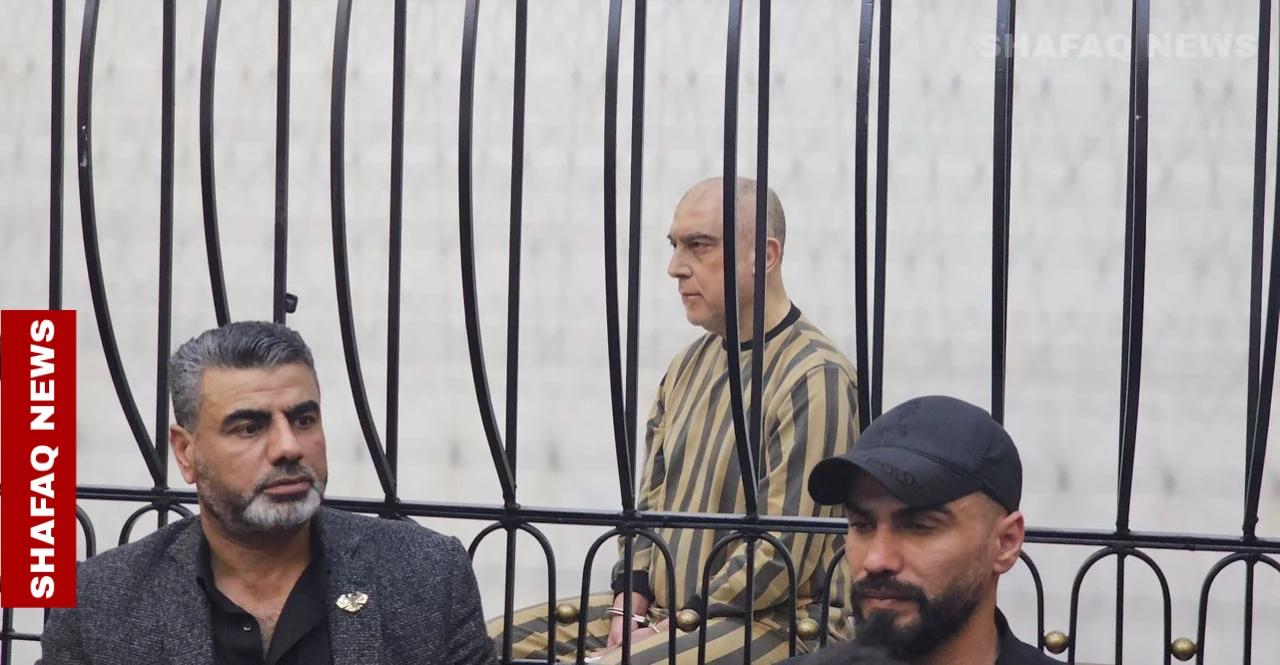
Syria Puts Atef Najib on Trial in Damascus for Crimes Against Daraa Uprising
Key Takeaways
- Atef Najib, Assad-era security official, faces public trial in Damascus for crimes against Daraa civilians.
- Victims’ families attended the first public trial of Atef Najib.
- Crimes against civilians in Daraa during the 2011 crackdown.
Najib trial begins in Damascus
Syria opened a public trial in Damascus on Sunday against Atef Najib, described across multiple reports as a cousin of ousted president Bashar al-Assad and the former head of the Political Security Branch in Daraa.
Crowds gathered outside the Palace of Justice in Damascus as the first trial of a former Assad official got underway, with security forces deployed around the courthouse.
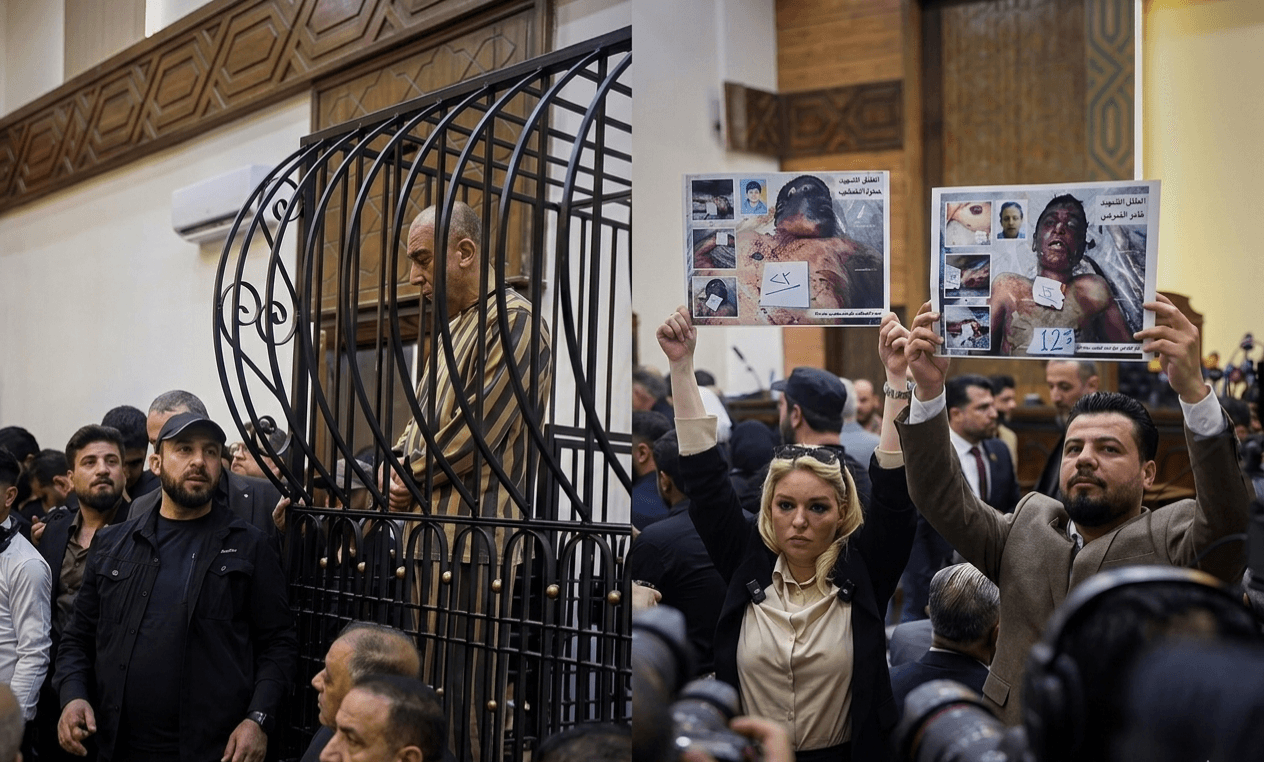
The trial took place at the Palace of Justice in central Damascus, with the courtroom scene featuring a black iron cage and Najib led in shortly before 11 a.m. dressed in a brown, striped prison uniform.
In the courtroom, a placard bearing the face of 13-year-old Hamza al-Khatib was displayed alongside another child, 15-year-old Thamer al-Charai, as families held up photographs and placards tied to the early uprising.
The BBC reported that Najib faced charges of “crimes against the Syrian nation,” and that he was prosecuted for crimes committed against the people of Deraa in the uprising.
The Media Line described the proceeding as “the Criminal Court at the Palace of Justice in Damascus,” and said the court issued in absentia summonses for Bashar Assad and his brother Maher Assad.
Al Jazeera’s account also framed the trial as the opening of a transitional justice process, with the presiding judge Fakhr al-Din al-Aryan announcing the start of “the first transitional justice trial in Syria.”
From 2011 protests to court
The trial is rooted in the early days of the Syrian uprising in Daraa, where Najib was described as head of security in the city when protests erupted in 2011.
Al-Sharq Al-Awsat reported that a 15-year-old woman said she was “fifteen when the protests erupted in Daraa in 2011,” and that she came from the “Sheikh Ahmed al-Siyasan family,” describing relatives who were “detained, hunted down, and killed.”

The same report tied the case to what it called the “Children of Freedom” case, saying that more than 50 people came from Daraa, including six youths arrested by Atef Najib in February 2011 for writing the phrase “Your turn is coming, doctor” on a school wall.
It also said that at the time “more than 20 children were detained” for writing on walls “any writing even if it was a personal name or an innocent childhood memory,” citing Alaa Abu Zaid of Al-Sharq Al-Awsat.
The BBC described the uprising trigger in Daraa as beginning after security forces violently cracked down on protesters who took to the streets after “several boys had been arrested and tortured for writing anti-government graffiti inspired by the ‘Arab Spring’.”
New Lines Magazine similarly described teenagers scrawling antiregime slogans on a school wall, including “Doctor, it’s your turn,” and said several children were arrested and detained with torture.
Al Jazeera’s account added that the presiding judge Fakhr al-Din al-Aryan opened the session and read out the names of absent defendants, including Bashar al-Assad and Maher al-Assad.
Voices inside and outside court
Reactions to the trial were intense and varied, with plaintiffs, lawyers, and rights figures describing both hope for accountability and concerns about fairness.
Al-Sharq Al-Awsat captured plaintiffs confronting the courtroom’s security and media presence, including one person shouting: “Are the journalists more entitled to be here than the plaintiffs?”
It also quoted Alaa Abu Zaid saying Najib denies the arrest and torture of the children, noting that “everyone who entered Assad’s prisons did not escape horrific torture.”
In the BBC’s account, a crowd chanted “People want to hang Atef Najib!” and families chanted slogans including “death and no humiliation” and “Syria for us and not for the Assad regime.”
Nuha al-Masri, a 54-year-old lawyer from Deraa, told the BBC: “I felt that today we started to get justice. It tells everyone that no-one is exempt from justice.”
But Anwar al-Bunni, a Syrian human rights lawyer and head of the Syrian Centre for Legal Studies and Research, criticized the legal framework, telling the BBC: “Syrian law has no legislation [for prosecuting] war crimes and crimes against humanity,” and adding, “They are ridiculing his [Najib's] crimes and ridiculing the victims with this trial.”
Zahra Barazi, vice-president of the National Commission for Transitional Justice set up in 2025, said they were working with the ministry of justice and described drafting a Transitional Justice law, telling the BBC: “We drafted a Transitional Justice law to ensure that in the future once the law is passed by the parliament, new charges of crimes against humanity and war crimes will be added to the charges.”
Different outlets, different emphases
While all the reports describe a first transitional justice trial in Damascus involving Atef Najib, they diverge in what they foreground: courtroom symbolism, legal process, or the political stakes of absent defendants.
New Lines Magazine emphasized the courtroom’s dramatic imagery, describing the black iron cage, the placard of Hamza al-Khatib, and a chant that called Najib “the dog,” while also quoting a Quran verse displayed in the courtroom: “Today every soul will be recompensed for what it has earned. No injustice today. God is swift in reckoning.”

The BBC focused more on the charged atmosphere and the legal framing, reporting that Najib faced charges of “crimes against the Syrian nation” and including the reported statement attributed to Najib about “Forget your children.”
Al Jazeera’s account centered on the presiding judge’s background and the symbolism of a judge returning to the bench, quoting Fadel Abdulghany’s assessment that “This reversal of power dynamics reflects the promise of the rule of law so rarely fulfilled in post-authoritarian transitions.”
France 24’s segment, by contrast, presented the trial through a broader transitional justice argument, quoting Nanar Hawach: “transitional justice is integral for Syria to move on past the civil war and past atrocities.”
JusticeInfo.net described the physical setting in detail, calling the courthouse “the ‘Palace of Justice’” and describing security forces outside the “four-story building” near the Citadel of Damascus and the historic Souq al-Hamidiyya, while also quoting Om Eyhab screaming “My son is not a terrorist!”
The Media Line highlighted the day as “Exceptional and Historic,” quoting Damascus Attorney General Hossam Khattab calling it “exceptional and historic,” and describing the judiciary as “championing their pain and suffering.”
What comes next for Syria
The trial’s immediate next steps involve the continuation of transitional justice proceedings and the handling of absent defendants, while rights groups and legal observers debate whether the process will deliver accountability beyond symbolism.
Al Jazeera reported that Judge Fakhr al-Din al-Aryan announced “a list of 10 suspects set to be tried,” with the first name cited as Bashar al-Assad and others including Maher al-Assad, described as commanding the 4th Armored Division, and additional officials, while Assad would be tried in absentia.

JusticeInfo.net similarly described the judge opening the session and reading out the names of absent defendants, including Bashar Hafez al-Assad and Major General Maher Hafez al-Assad, and it said the judge explained that plaintiffs were the only ones the court had been able to locate and that “any party with a stake in the case has the right to appear in future hearings.”
The BBC reported that Zahra Barazi said the transitional justice law would add new charges once parliament passes it, and it also noted that Syria’s Islamist government had arrested several members of the Assad regime, including Amjad Youssef, a key suspect in the Tadamon massacre in 2013 where “41 civilians were blindfolded, shot dead and thrown into a pit.”
France 24’s Nanar Hawach framed the broader purpose as moving “past the civil war and past atrocities,” while the Foundation for Defense of Democracies argued that the trial signals progress but that accountability “still falls short,” describing it as “only an initial step toward accountability.”
The Media Line described the “road ahead” as long and said the test would be “judicial independence, transparency, and whether future trials reach beyond symbolism.”
Al-Sharq Al-Awsat added that the courtroom moment was described as “a rare, historic moment” when the defendant confronts his victims, and it quoted a plaintiff who said Najib should be punished in a way that would satisfy the victims’ demand for accountability.
More on Syria
Syrian Authorities Arrest Amjad Yousef, Main Suspect in 2013 Tadamon Massacre
58 sources compared

FBI, House Oversight Committee Probe Deaths and Disappearances of U.S. Nuclear, Aerospace Scientists
13 sources compared

Damascus And SDF Hold Consultations To Implement January Agreement In Hasakeh
11 sources compared

Chemical Leak Kills Two at Catalyst Refiners Plant in Institute, West Virginia
10 sources compared