Syria24 December, 20252 min read
Syrian Ministers Press Putin to Expand Russian Military Presence and Bases in Syria
This article is an automated aggregation of coverage from news outlets. Our editorials offer in-depth analysis curated by the NewsCord team.
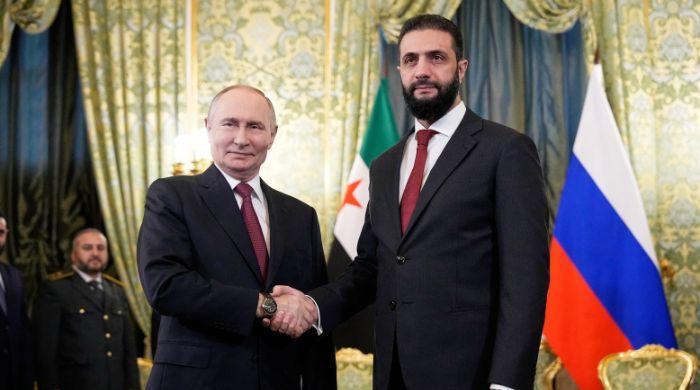
Syrian foreign minister Asaad al‑Shaibani and defense minister Murhaf Abu Qasra met Putin in Moscow They sought expanded Russian military cooperation, emphasizing strategic defense industries and military-technical partnership

11 outlets told this the same way.
Outlets did split on France Suspends Police Stun Grenades at High School Protests After 15-Year-Old Loses Hand →
Syria-Russia strategic cooperation
Syria's foreign minister Asaad al-Shaibani and defence minister Murhaf Abu Qasra travelled to Moscow to press President Vladimir Putin for deeper political, military and economic ties. State media SANA reported the talks focused particularly on 'strategic cooperation in the military industries sector' and broader military cooperation. Multiple accounts described the visit as centred on boosting defence capabilities and diplomatic coordination between Damascus and Moscow.
“Syria’s foreign minister Asaad Hassan Al‑Shaibani and defence minister Murhaf Abu Qasra met Russian President Vladimir Putin in Moscow to discuss expanding ‘strategic cooperation in the military industries sector,’ Syrian state media (SANA) reported.”
Observers framed the meeting as part of Russia's continuing effort to build ties with Syria's new authorities after last year's political changes. Coverage consistently cited SANA as the immediate source for the meeting and its agenda.
Defence-industrial cooperation aims
A major focus reported across outlets was defence-industrial cooperation, including modernizing Syrian equipment, transferring technical and military-technical know-how, and pursuing joint research and development to strengthen the national defence system. Several sources explicitly tied these aims to boosting the Syrian army's capabilities and to strengthening cooperation within the military-industrial complex. They also noted Moscow's interest in securing its operational presence, specifically access to the Khmeimim (Hmeimim) airbase and the Tartus (Tartous) naval facility.
Syria-Russia talks overview
Beyond defence, coverage stresses political coordination and economic reconstruction as pillars of the talks. Outlets report discussions of diplomatic coordination in international forums and efforts to expand bilateral trade.
“The talks emphasized defence matters — boosting the Syrian army’s capabilities, modernising equipment, transferring expertise and joint research and development — alongside political and economic issues such as diplomatic coordination in international forums and cooperation on reconstruction, infrastructure and investment.”
Reports also highlight reconstruction and infrastructure projects and efforts to attract Russian investment to spur Syria's economy and improve living conditions. SANA-based reports present a comprehensive agenda pairing military support with reconstruction incentives intended to stabilise the country and deepen bilateral ties.
Moscow's role in Syria
Several outlets place the meeting in the recent political context. They note Syrian President Ahmed al‑Sharaa’s October visit to Moscow.
Reports say Russia has previously backed Bashar al‑Assad, even granting him asylum after his removal, which underscores Moscow’s continued influence and the transactional character of the relationship. Reports vary in how they phrase that history and who is now in power, but the consistent throughline is Moscow’s central role in the post‑conflict landscape and Syria’s need for external military and reconstruction support.

Syrian-Russian military cooperation
Taken together, the sources depict a push by Syrian ministers to expand and formalise Russian military presence and cooperation in Syria. They describe defence-industrial cooperation paired with economic and diplomatic incentives.
“Russia is keen to secure continued access to its Khmeimim airbase and Tartous naval base.”
However, coverage shows notable gaps and tonal differences, especially regarding Kremlin confirmation and the framing of leadership changes. These issues mean the full scope and legal terms of any expanded basing agreements remain unclear from these reports alone.