Business14 July, 20263 min read
T. Rex Skeleton Gus Sells for $50.1 Million at Sotheby’s New York Auction
This article is an automated aggregation of coverage from news outlets. Our editorials offer in-depth analysis curated by the NewsCord team.
Gus, a 67-million-year-old Tyrannosaurus rex skeleton, sold for $50.1 million. It set a world record for the most expensive dinosaur sold at auction.

Gus smashes auction record
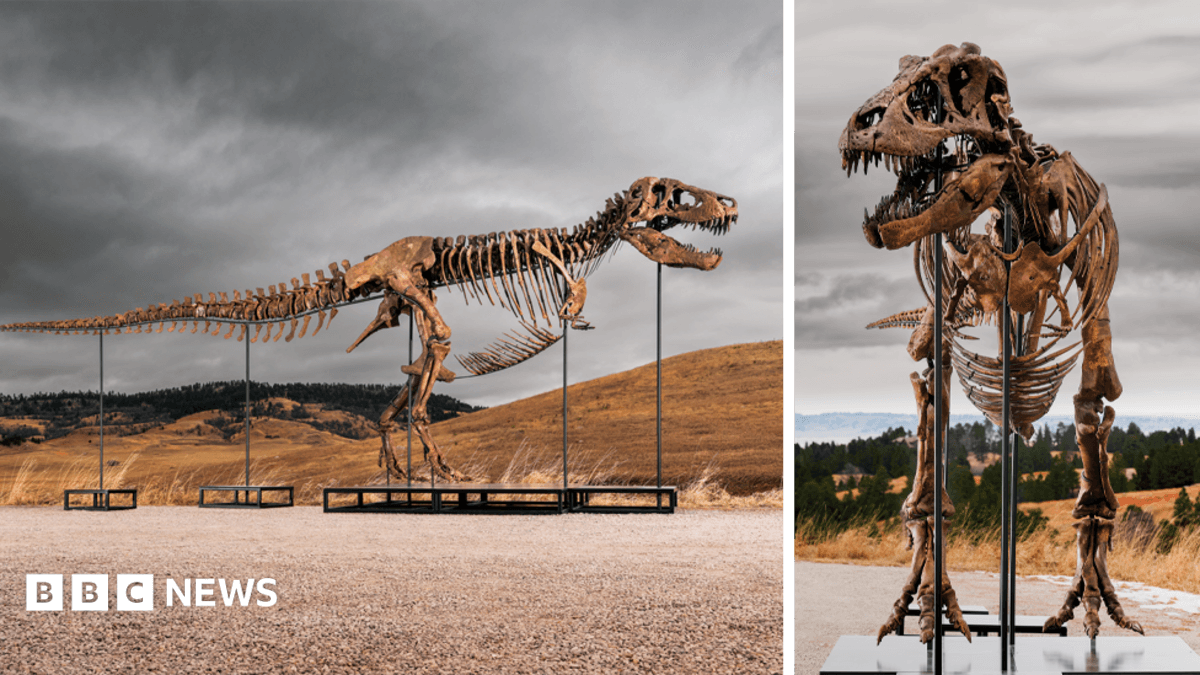
A 67-million-year-old Tyrannosaurus rex skeleton nicknamed Gus sold for $50.1 million at Sotheby’s in New York on Tuesday, becoming the most expensive dinosaur fossil ever auctioned. Sotheby’s said the fossil is now the most expensive set of dinosaur bones ever auctioned off, besting the almost $45-million US price tag for a nearly complete stegosaurus sold by the same New York auction house in 2024. The sale followed a 10-minute bidding battle among seven bidders, with the hammer price reported as $43 million before premiums, pushing the final figure to $50.1 million.
Gus was discovered in 2021 on a ranch in South Dakota, and Sotheby’s described it as about 61% complete by bone count, with 183 fossil bone elements and an “exceptionally preserved” skull. Cassandra Hatton, Sotheby’s vice chair, said after the sale was completed, “Gus is not only an exceptional find, but a specimen that's been excavated, documented, prepared and cared for with real excellence.”

Science vs private ownership
Scientists and advocacy groups raised concerns that privately owned fossils can become unavailable for study, with the Society of Vertebrate Paleontology saying scientifically significant fossils such as Gus should be publicly displayed in museums and other research institutions. Kristi Curry Rogers, the society's president-elect, said in a statement Tuesday, “Our hope is that the new owner recognizes the extraordinary scientific and educational value of Gus the T. rex and that they aim to keep it in the public trust by immediately donating it to an accredited natural history museum.” The Guardian reported that palaeontologists worried that selling dinosaur skeletons into private hands could limit palaeontological research by placing specimens out of the reach of academic institutions.
Professor Richard Butler of the University of Birmingham told the Guardian, “A fossil not in a recognised museum collection cannot be studied and is therefore lost to research.” Sotheby’s vice chairman Cassandra Hatton argued that the market responds when specimens are cared for, saying “The market responds when great specimens are taken care of in the right way.”
What happens next
The auction house said the winning bidder participated by phone and wants to remain anonymous, and Sotheby’s described Gus as a “monumental item” that would, “in our opinion, require special handling or shipping services due to size or other physical considerations.” Sotheby’s said Gus was excavated on a ranch in South Dakota between 2021 and 2023, and it took a further three years in the lab to piece the T. rex back together, with the skull showing bite marks and previously broken ribs that had healed in its lifetime. The BBC reported that the winning bid has not yet been disclosed, while noting that Apex, the stegosaurus that held the previous record, was loaned to the American Natural History Museum for four years by its billionaire owner Kenneth Griffin.
In the same context of record-setting fossil sales, the Guardian said Gus was presented as “an outstanding exhibition-ready mounted skeleton” and listed it as lot 20 in Tuesday’s auction. Whether Gus ends up in a museum or remains private is now the central question, because the BBC said some scientists told it the auction may herald a new era in fossil collecting by the ultra-rich.