Protests18 October, 20253 min read
Thousands Rally Across US to Demand End to Trump’s Authoritarianism and Repression
Nearly 7 million people participated in over 2,500 'No Kings' protests nationwide. Protesters condemned Trump’s authoritarian policies, including immigration and police repression.

22 outlets told this the same way.
Outlets did split on France Suspends Police Stun Grenades at High School Protests After 15-Year-Old Loses Hand →
Protests Against Trump Policies
Thousands joined coordinated “No Kings” demonstrations across the United States and abroad to oppose what organizers and participants described as authoritarian moves by Donald Trump’s administration. More than 2,600 rallies were planned nationwide. The actions unfolded amid a government shutdown as Trump spent the weekend at Mar-a-Lago denying he is acting like a king.
“Thousands of people across the US are participating in ‘No Kings’ demonstrations... Organizers expect over 2,600 events nationwide... Trump... dismissed claims that he is acting like a king.”
Meanwhile, Republicans attacked the events as “Hate America” rallies. Organizers cast the mobilization as a defense of constitutional rights and civil liberties.
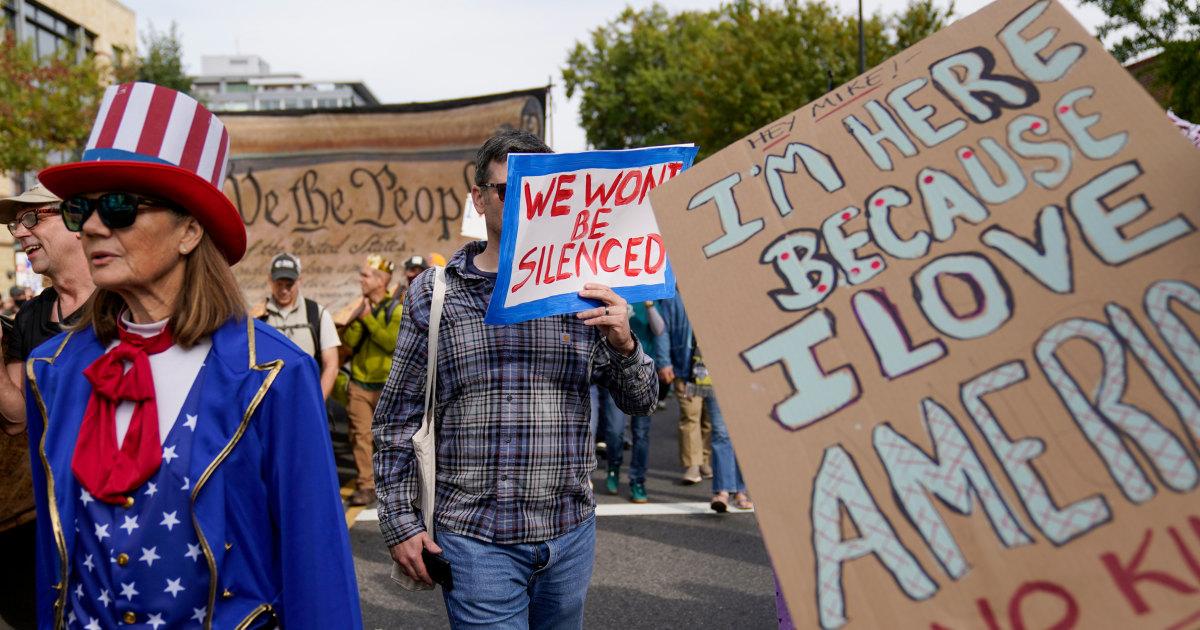
This was the largest wave of protests since Trump’s return to the White House. Solidarity actions were also reported outside the U.S.
Crowd Estimates of Demonstrations
Reports converged on broad, peaceful turnout—especially in New York—yet diverged sharply on the scale. BBC detailed that over 100,000 people peacefully gathered in New York City, with around 20,000 in Times Square, and said no arrests were reported. CNN echoed that police praised the demonstrators for maintaining order, with no arrests or incidents reported across several cities.
NBC News likewise noted over 100,000 people across New York City, with the NYPD reporting no arrests. By contrast, World Socialist Web Site claimed millions participated nationwide, citing over 100,000 in New York City and 250,000 in Chicago. The Independent also reported up to 250,000 in Chicago, illustrating significant variance in crowd estimates and emphasis.

Protests Against Authoritarian Actions
Across outlets, protesters’ grievances centered on what they described as authoritarian measures, including expanded executive powers, National Guard deployments, prosecutions of political opponents, aggressive immigration raids, and attacks on free speech. BBC reported fears of a shift toward fascism, while CommonWealth Beacon detailed opposition to indictments of critics, troop deployments to Democratic cities, and mass immigration enforcement deportations. Local and public media focused on community-level impacts, with NBC chronicling fears over immigration enforcement near schools.
“Protesters expressed concerns about what they see as authoritarian moves by Trump, including expanded executive powers, deployment of national guard troops, and efforts to prosecute political opponents.”
Connecticut Public highlighted family separations, raids, and alleged attempts to bypass Congress. ABC10 added concerns about armed forces in cities and health-care fallout from the shutdown. World Socialist Web Site underscored signs calling for a general strike and abolition of immigration enforcement, linking anti-dictatorship struggles to broader social inequality.
Political Responses to Rallies
Political reactions broke along familiar lines. Democrats—including Senate leaders and prominent progressives—joined or endorsed the rallies, while Republicans condemned them. Metro.co.uk and AZ Family report GOP leaders denouncing the events as “Hate America” or “radicals.”
France 24 notes Trump “denied being a ‘king’” from Mar-a-Lago. NBC News adds that the administration mocked Democratic leaders on social media, raising Hatch Act questions. Figures like Kamala Harris and Doug Emhoff publicly backed the demonstrations, and Governor Gavin Newsom called for peace.

Coverage also diverged around a simultaneous military event in California. CNN described a “large military celebration at Camp Pendleton,” while The Independent reported Newsom blasted a live-fire exercise near I‑5 as a “dangerous and reckless show of force intended to intimidate dissenters.”
Global and Local Solidarity Actions
Coverage also traced the movement’s breadth from global solidarity to local flashpoints. CBC noted solidarity rallies abroad, including Montreal, while World Socialist Web Site reported simultaneous actions in London, Madrid, Berlin, and Paris. Regionally, CommonWealth Beacon documented Boston’s coalition of unions, faith leaders, the ACLU, and state leaders.
“Solidarity rallies also took place in cities abroad, such as Montreal, where participants voiced support for American democracy and Canadian sovereignty.”
AZ Family and The Boston Globe described Birmingham’s large turnout rooted in civil rights history. ABC10 reported Sacramento protesters linking immigration raids to state health-care issues.

The Independent highlighted the unresolved investigation into a fatal shooting at a previous Salt Lake City rally. These local and international angles underscore how outlets balanced democracy-and-rights themes with community-specific concerns and, in some cases, tragic consequences.