China14 November, 20252 min read
Three Chinese Astronauts Return After Space Debris Damages Their Shenzhou Capsule
Space debris likely cracked a window on the crew's Shenzhou-20 return capsule. Chen Dong, Chen Zhongrui, and Wang Jie returned aboard a replacement Shenzhou capsule.

13 outlets told this the same way.
Shenzhou crew return
Three Chinese astronauts, Chen Dong, Chen Zhongrui and Wang Jie, returned to Earth after their planned Shenzhou-20 return was postponed when that capsule suffered damage likely caused by orbital debris.
The crew ultimately came home in a different spacecraft, touching down at the Dongfeng landing site in Inner Mongolia after more than a week aboard the Tiangong space station.
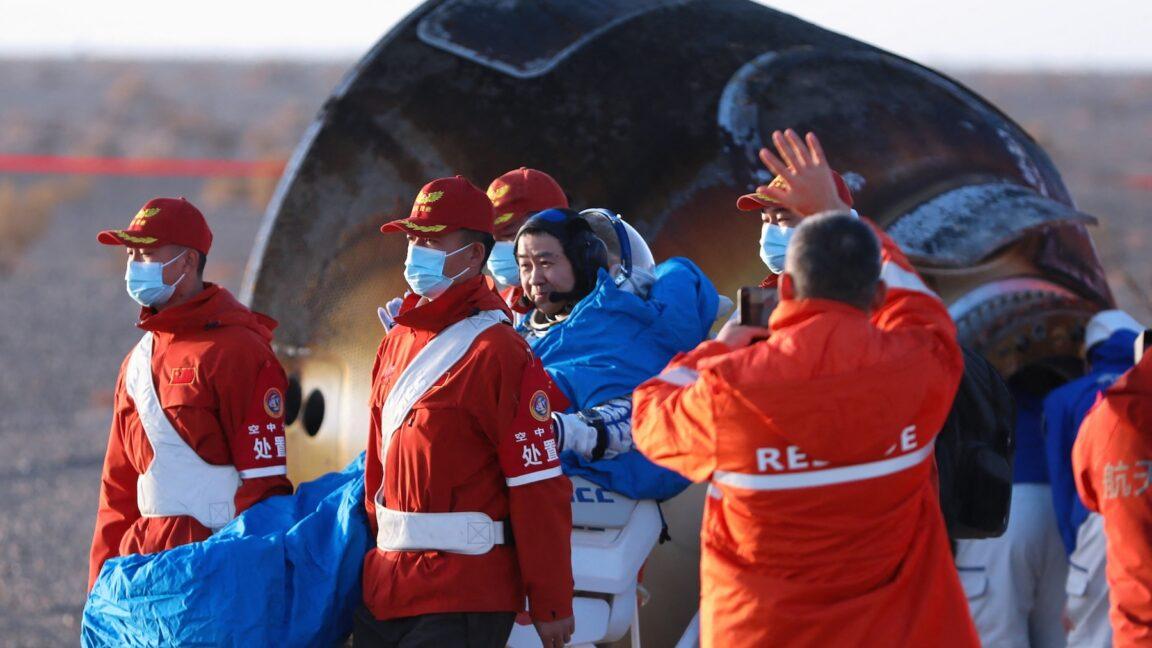
Reports place their touchdown on Nov. 14, with slightly different timestamps across outlets.
Sources agree that switching to the docked Shenzhou-21 vehicle enabled the safe return of the three taikonauts.
Shenzhou-20 reentry damage
Multiple outlets report that officials found a crack in Shenzhou-20's return-window glass. The crack was likely caused by a small piece of space debris. China Manned Space Agency judged the capsule unsafe for reentry, and coverage consistently frames the damage as originating from high-speed orbital fragments and as the proximate reason for switching the crew to the docked Shenzhou-21 spacecraft.
Tiangong crew and vehicle
Officials and reporters emphasize that the crew remained in good health. They used the docked Shenzhou-21 vehicle as a lifeboat. Station operations continued with other personnel aboard Tiangong while the damaged craft stayed docked.
“The crew finally undocked from Tiangong on Nov. 13 (0314 GMT/11:14 a.m. Beijing time) and made a parachute-assisted descent; they exited the return vehicle in good health.”
CMSA and Chinese state media reported the procedural swap. Outlets note plans for an uncrewed Shenzhou launch to restore the standard return options.
Orbital debris policy debate
Reporters and analysts used the episode to underline the broader hazard posed by orbital debris. They called for better tracking, increased sustainability measures and possible international treaties. Outlets such as WebProNews and India Today explicitly linked the incident to policy calls—WebProNews said the outcome 'strengthens calls for treaties and technologies to make orbital traffic more sustainable'—while Zoom Bangla and the Daily Mail stressed the scale of the debris problem and the danger posed even by tiny fragments.
Coverage and editorial differences
Coverage gaps and editorial differences are evident across the set of outlets. Some outlets, such as Editorji and Moree Champion, did not provide full text in the available snippets and instead requested the article or user input.
“Please paste the full article (or a link) and tell me how short or detailed you want the summary (one-sentence, 3–5 bullets, paragraph, etc.), and I’ll summarize it.”
Other outlets varied in tone and emphasis, ranging from technical, safety-protocol reporting in Ars Technica and Space to more sensational wording in the Daily Mail. Readers should note which outlets supply detailed technical quotes from the CMSA and which emphasize human drama or policy implications.
