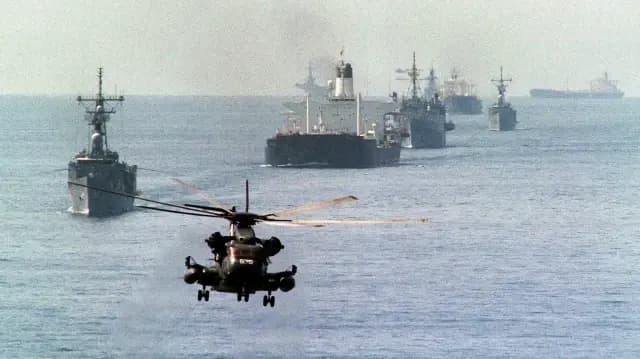
Trump Administration Plans Coalition to Escort Ships Through Strait of Hormuz
Key Takeaways
- US plans to announce a multinational coalition to escort ships through the Strait of Hormuz.
- Trump demanded seven countries join the coalition to escort Hormuz vessels.
- Timing remains undecided; discussions continue on whether missions begin before or after hostilities end.
Coalition Announcement Plans
The Trump administration is preparing to announce a multinational coalition to escort commercial vessels through the strategically vital Strait of Hormuz.
“ISTANBUL, March 16 (Bernama-Anadolu) -- US President Donald Trump’s administration could announce as early as this week that several countries have agreed to form a coalition to escort ships through the Strait of Hormuz along Iran’s coast, Anadolu Ajansi reported, citing The Wall Street Journal”
Reports indicate the announcement could come as early as this week, according to multiple sources.
US officials have confirmed that several countries have agreed to form a coalition to ensure safe passage through the narrow waterway.
Iran has effectively blocked the strait since early March in response to ongoing US-Israeli military strikes.
Discussions are still underway regarding whether the escort operations would begin before or after hostilities end.
The White House declined to comment on the potential announcement.
Trump has publicly demanded that countries dependent on Middle Eastern crude take responsibility for protecting the strategic passage.
The strait normally carries roughly one-fifth of the world's traded oil.
International Response
International responses to Trump's coalition proposal have been mixed, with several countries appearing evasive about committing naval forces.
Trump specifically named China, France, Japan, South Korea, and the UK as countries that should send warships.

The president stated on social media that he hoped these nations would participate in keeping the Strait 'open and safe.'
Responses from these countries have been cautious and non-committal.
China's embassy stated that 'all parties have the responsibility to ensure stable and unimpeded energy supply' but stopped short of promising naval deployment.
South Korea's Foreign Ministry indicated it would 'closely coordinate and carefully review' the situation with Washington.
France mentioned working with partners on a possible international mission but emphasized it must be when 'the circumstances permit.'
Germany's Foreign Minister Johann Wadephul directly expressed reluctance, questioning 'Will we soon be an active part of this conflict?'
Strategic Importance
The strategic importance of the Strait of Hormuz cannot be overstated.
“WASHINGTON/TEHRAN/ABU DHABI/PARIS/BANGKOK - US President Donald Trump said Sunday that he has "demanded" about seven countries heavily reliant on Middle East oil join a coalition to escort vessels through the Strait of Hormuz, a key waterway through which about 20 percent of the world's oil passes”
It serves as a critical chokepoint through which approximately 20 percent of the world's daily oil supply flows.
The strait is just 21-33 km wide at its narrowest point.
The disruption of shipping has sent global crude prices soaring beyond $100 per barrel.
US gas prices have risen by more than 70 cents per gallon.
The closure has created turmoil across global energy markets.
Several countries have been pushed to the brink of energy crisis.
Trump emphasized that China gets around 90 percent of its oil from the strait.
Oil industry executives have warned the energy crisis is likely to get worse.
Operational Details
The operational details of the proposed escort mission reveal complex military considerations and significant risks.
US military officials have indicated that the Navy would escort vessels 'when it is militarily possible.'
&w=3840&q=75)
The US has already struck around 6,000 Iranian targets over the last two weeks.
These include anti-ship missile sites, drone manufacturing facilities, and approximately 30 Iranian minelayers.
Experts caution that Iran could still pose serious threats through naval mines, anti-ship cruise missiles, drones, and fast-attack boats.
The operation could involve staging areas at either end of the contested area.
US Navy ships would escort several commercial vessels at a time, supported by air cover and surveillance.
Military analysts note that the first few ships might be targeted.
The strategy would be to observe where they shoot from and then hit them once they reveal themselves.
Iranian Perspective
Iran has maintained a defiant stance regarding the Strait of Hormuz.
“Trump says he demands seven countries escort ships through Strait of Hormuz U”
Iran insists that the waterway remains open to all shipping except vessels belonging to the United States and its allies.

Iranian Foreign Minister Abbas Araghchi told CBS that Tehran has been 'approached by a number of countries' seeking safe passage.
Decisions on passage are left 'up to our military to decide.'
Araghchi added that a group of vessels from 'different countries' had already been allowed through.
He emphasized that 'the Straits of Hormuz is open.'
According to Iran, the strait is 'only closed to the tankers and ships belonging to our enemies.'
This contradicts US assertions that Iran is attempting to close the strait.
Iran frames its actions as defensive measures against hostile US and Israeli aggression.
More on Iran

Israel Attacks Dubai International Airport, Triggers Drone Fire and Flight Disruptions
29 sources compared

Trump Demands About Seven Countries Join Coalition to Police Strait of Hormuz
30 sources compared

Epstein network plots 9/11-style attack to blame Iran, Ali Larijani says
11 sources compared

Iran Drone Attack Hits UAE Fujairah Port, Halting Oil Loading
11 sources compared