
Trump Demands About Seven Countries Join Coalition to Police Strait of Hormuz
Key Takeaways
- Trump demanded about seven countries join coalition to escort Hormuz shipping.
- Allied governments have shown reluctance and offered no commitments.
- Trump framed effort as protecting allies' own territory and energy interests.
Trump Coalition Demand
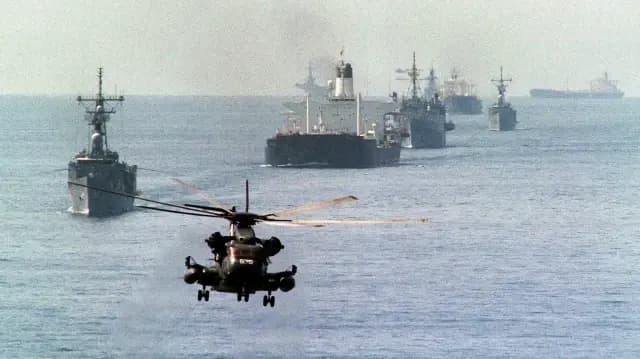
President Donald Trump has demanded about seven countries heavily reliant on Middle Eastern oil join a coalition to help police the Strait of Hormuz.
“Australia will not send navy ship to Strait of Hormuz, official says Australia will not send navy ships to protect oil tankers in the Strait of Hormuz, a senior government minister said on Monday”
Speaking to reporters aboard Air Force One on Sunday, Trump stated, 'I'm demanding that these countries come in and protect their own territory, because it is their own territory.'

The president emphasized that the shipping channel is not something the United States needs due to its minimal oil dependency.
Trump has previously appealed to China, France, Japan, South Korea and Britain, noting China gets about 90% of its oil from the strait while the U.S. gets only about 1-2%.
The Trump administration is planning to announce the multinational coalition as early as this week, with multiple countries reportedly agreeing to join.
Countries are still deciding on operational timelines for the proposed maritime security mission.
International Response
Despite Trump's demands and appeals, no countries have yet formally committed to joining the proposed maritime security mission.
China has been notably non-committal, with a spokesperson stating that 'all parties have the responsibility to ensure stable and unimpeded energy supply' while calling for de-escalation.

Japan has indicated that any decision to dispatch naval vessels would face 'high hurdles,' requiring 'in-depth assessments' and stating that 'the bar is very high.'
Australia has explicitly refused to send a ship to the Strait of Hormuz, with Transport Minister Catherine King telling ABC that 'we won't be sending a ship to the Strait of Hormuz.'
Britain has maintained a cautious stance, with Prime Minister Keir Starmer discussing the issue with Trump while emphasizing the government is 'in contact with allies, including the US'.
South Korea has been the most responsive, stating it 'takes note' of Trump's call and will 'closely coordinate and carefully review' the situation.
Iran's Position
Iran has maintained a defiant stance toward international pressure, with Foreign Minister Abbas Araghchi stating that the Strait of Hormuz remains open to all vessels except those from the United States and its allies.
“CGTN is not responsible for any of the translations”
In an interview with CBS, Araghchi revealed that Tehran has been 'approached by a number of countries' seeking safe passage for their vessels, noting that 'this is up to our military to decide.'
He confirmed that vessels from 'different countries' have already been allowed to pass through the strait without providing further details.
The Iranian foreign minister rejected suggestions that Tehran was seeking negotiations with Washington, stating, 'We have never asked for a cease-fire, and we have never asked even for negotiations.'
This position comes as Iran has effectively blocked the strategic waterway through attacks targeting at least 16 vessels and tankers since the start of joint US-Israeli strikes.
The closure of the strait, through which about 20% of the world's traded oil normally flows, has caused global oil prices to surge.
Energy Crisis Response
The closure of the Strait of Hormuz has triggered significant energy market disruptions and global response measures.
The International Energy Agency announced a massive release of emergency oil reserves, revising its initial announcement of 400 million barrels upward to nearly 412 million barrels.

Asian member countries plan to release stocks 'immediately,' while reserves from Europe and the Americas will begin flowing to markets from the end of March.
Major oil executives have warned Trump administration officials that disruption to flows would 'continue to create volatility in global energy markets.'
Lloyd's List estimates that even with naval escorts, no more than about 10 percent of lost volumes could realistically be restored.
The IEA reported that disruptions have cut global supply by about 8 million barrels a day of crude and another 2 million barrels of condensates and natural gas liquids.
More on Iran

Israel Attacks Dubai International Airport, Triggers Drone Fire and Flight Disruptions
29 sources compared
Trump Administration Plans Coalition to Escort Ships Through Strait of Hormuz
22 sources compared

Epstein network plots 9/11-style attack to blame Iran, Ali Larijani says
11 sources compared

Iran Drone Attack Hits UAE Fujairah Port, Halting Oil Loading
11 sources compared