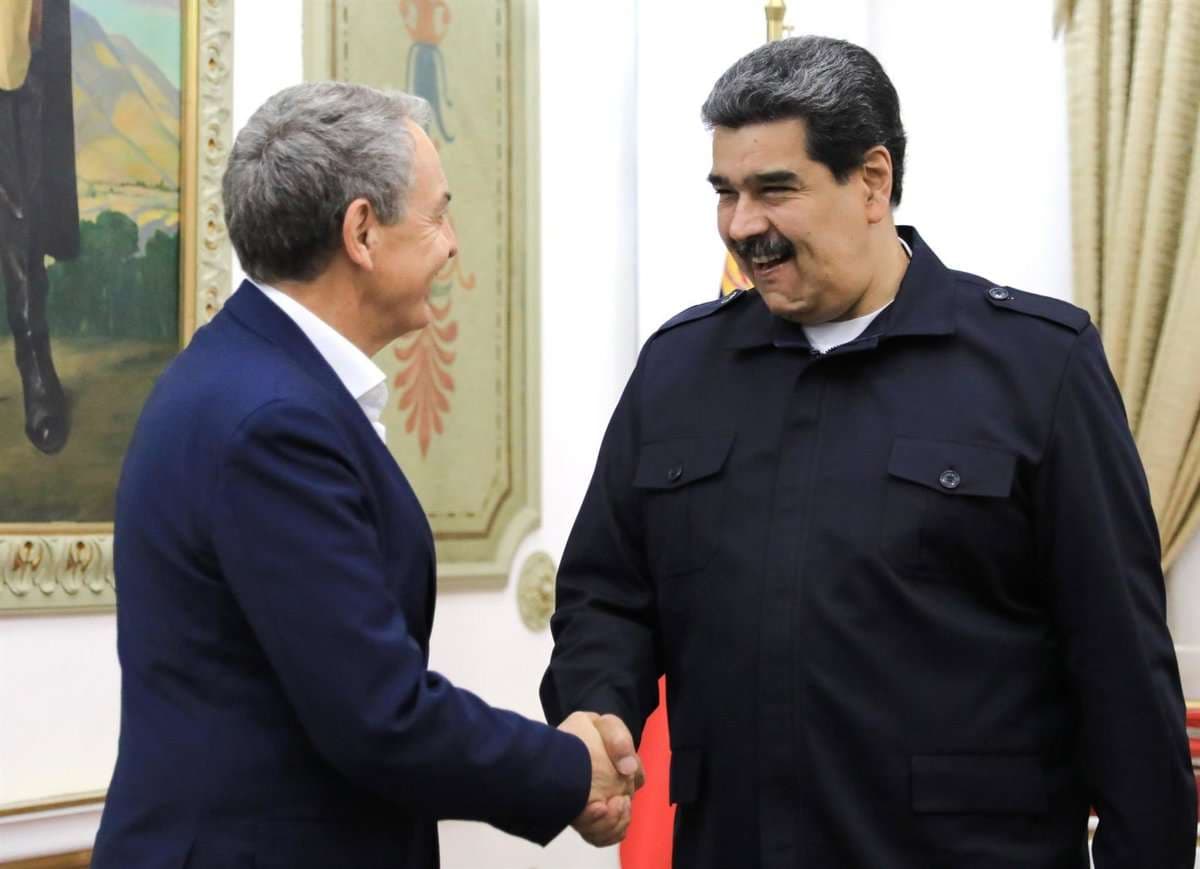
Trump blocks Zapatero's participation in any negotiations about Maduro's future.
Key Takeaways
- Trump barred the former Spanish president Zapatero from any negotiations over Maduro's future.
- Move follows December rumors of Venezuela's power reconfiguration involving Miguel Rodríguez Torres and Spain.
- ABC newspaper reported the information underpinning the Maduro exit rumors.
Trump blocks Zapatero talks
Trump has barred the former Spanish president José Luis Rodríguez Zapatero from entering any kind of negotiations about Maduro's future.
“Trump has barred the former Spanish president José Luis Rodríguez Zapatero from entering any kind of negotiations about Maduro's future”
This December, information and persistent rumors have emerged pointing to a possible reconfiguration of power in Venezuela, with General Miguel Rodríguez Torres and Spain as central elements of a negotiated exit for Nicolás Maduro.
Information published by ABC newspaper and other international media indicate that Maduro would be trying to negotiate with Trump a 'golden retirement' outside Venezuela.
The destination chosen for this exile would be 'Ayuso's Madrid,' where numerous former chavista officials and opposition leaders already reside.
Maduro's objective would be to obtain guarantees of not being pursued legally by the US judiciary in exchange for stepping down from power.
Zapatero's role and Rodríguez Torres
Rodríguez Torres, who currently resides in Madrid after his release in 2023, is seen by some circles as a figure capable of uniting dissident chavismo and maintaining a certain institutional stability without Maduro's direct presence.
His name has been mentioned in informal contacts between Caracas and Washington as an alternative for a negotiated exit that would avoid a total collapse of the regime.
The former president José Luis Rodríguez Zapatero is attributed with a fundamental role in this possible scheme.
Zapatero was the one who managed Rodríguez Torres' departure to Madrid, and it is believed that he is using his network of contacts to build this alternative that guarantees Maduro's exit without immediate accountability before international tribunals.
This prominence puts Zapatero even more under the lens of US intelligence agencies, which suspect that these efforts aim to protect the economic interests and the impunity of the chavista leadership.
Zapatero as unofficial mediator
Rodríguez Torres was one of the figures closest to Hugo Chávez and led SEBIN.
“Trump has barred the former Spanish president José Luis Rodríguez Zapatero from entering any kind of negotiations about Maduro's future”
After distancing himself from Maduro, he spent five years in prison in Venezuela.
He was released and exiled to Spain after an international mediation led by former Spanish president José Luis Rodríguez Zapatero.
Zapatero continues acting as the main unofficial diplomatic channel between Caracas and Moncloa, using his network of contacts to manage humanitarian cases, releases of political prisoners, and the reception of figures from both sides on Spanish soil.
According to sources close to the US government, Zapatero's status with the United States is marked by extreme diplomatic and judicial tension, shaped by a drastic shift in stance under the administration of Donald Trump.
Sanctions, findings, and implications
Although there is not yet a current international arrest warrant against Zapatero, critical advances have been reported.
For example, the US Attorney's Office and agencies such as the DEA have intensified monitoring of his activities.
The extradition of General Hugo Carvajal has been key.
His testimony before the Southern District of New York would have provided evidence of alleged payments to Zapatero through financial structures linked to PDVSA.
Media outlets such as Vozpópuli and The Objective have indicated that the Department of Justice is studying opening a criminal case against the former president for his alleged ties to the chavista economic structure.
The US administration has moved from political criticism to the threat of direct sanctions.
In September 2025, senior officials of US diplomacy publicly suggested the possibility of revoking his visa to enter the United States.
In the US Congress, a bloc of Republican senators and representatives leads a political offensive against Zapatero.
They have formally requested the State Department to cease any engagement with him, accusing him of undermining international efforts for a real democratic transition.
According to these same sources, he is included in the finding, which allows the CIA to carry out lethal and covert operations inside Venezuela to destabilize the chavista command structure.
A presidential finding functions like a 'green light' for agencies such as the DEA, the CIA, and the Department of Justice to proceed with investigations that were previously limited by diplomacy.
There has been intensified use of testimony from Hugo Carvajal, who has provided documentation about alleged payments from chavismo to Zapatero through PDVSA.
This legal framework facilitates the US Prosecutor's Office considering Zapatero as a 'necessary link' in the chavista financial network, allowing progress toward a possible criminal indictment.
Visa withdrawal? In 2025, the Undersecretary of State, Christopher Landau, has publicly suggested the withdrawal of his visa to enter the United States.
There is a possibility that this finding could lead to the issuance of an international arrest warrant if the DOJ formalizes charges for money laundering or collaboration with sanctioned regimes.
Additionally, the finding allows the Department of the Treasury to apply Magnitsky Law, which entails blocking any bank accounts or property that the former president might have under US jurisdiction and inclusion on sanctions lists, which would hinder his international banking operations.
On a political level, the finding places Zapatero outside the circle of valid mediators for Washington.
The US sees his efforts not as neutral mediation, but as an attempt to guarantee impunity for Maduro's leadership, which has strained bilateral relations between the United States and Spain.
The Trump administration is eager to find information about former president Zapatero that would allow it to isolate Sánchez in the NATO and EU environment, declare the Puebla Group dead, and present itself with this backing in the November 2026 elections.
More on South America

Acting President Delcy Rodriguez Replaces Vladimir Padrino Lopez as Defense Minister.
45 sources compared
Colombia’s Petro Accuses Ecuador of Bombing Near Border
11 sources compared
President Trump Offers Missiles to Latin America to Destroy Cartels
54 sources compared

US Restores Diplomatic Relations With Venezuela Months After Trump-Ordered Raid Captured Maduro
68 sources compared