Full Analysis Summary
US influence in Honduran vote
As Hondurans went to the polls, international and domestic actors warned that U.S. President Donald Trump's public involvement risked swaying the tight race.
Multiple outlets reported that Trump openly backed conservative candidate Nasry Asfura and suggested U.S. assistance could be conditional.
Al Jazeera cited Trump saying the U.S. 'will not be throwing good money after bad' if Asfura loses, while Folha de S.Paulo reported his pledge to pardon former president Juan Orlando Hernández.
The Straits Times highlighted broad international concern about the integrity of the vote as polls opened in the impoverished country.
Coverage Differences
Tone / Emphasis
Al Jazeera (West Asian) foregrounds explicit U.S. statements and warnings including Trump’s quoted line and the U.S. Deputy Secretary’s threat to act “swiftly and decisively,” presenting U.S. intervention as a high-stakes external pressure. Folha de S.Paulo (Latin American) highlights the political consequence of Trump’s endorsement including a promise to pardon a convicted former president, focusing on domestic legal-political links. The Straits Times (Asian) emphasizes international concern and the close race but is more concise on U.S. rhetoric. Each source reports the same facts but emphasizes different implications: Al Jazeera on U.S. pressure, Folha on ramifications for Honduran politics and legal ties, and The Straits Times on the international alarm around a close contest.
Honduras election polls
Polling indicated a razor-thin contest among three front-runners, intensifying fears the result could be widely contested.
Folha reports a "three‑way technical tie" at roughly 25% among ruling-party figure Rixi Moncada (LIBRE), conservative Nasry Asfura (National Party), and centrist Salvador Nasralla (Liberal Party).
Folha says each frontrunner had preemptively suggested that a loss would be due to fraud.
The Straits Times likewise notes polls showing a near tie among the three candidates, underscoring the competitive dynamic as Hondurans voted.
Al Jazeera frames this close contest within broader institutional concerns, noting the OAS’s extraordinary session urging elections free of intimidation, fraud and political interference.
Coverage Differences
Narrative / Focus
Folha de S.Paulo (Latin American) gives detailed polling figures and stresses the candidates’ preemptive claims of fraud and the domestic institutional tensions that raises contestation risks. The Straits Times (Asian) concurs on the tight race but summarizes the situation more succinctly. Al Jazeera (West Asian) links the tight race to international institutional oversight by highlighting the OAS’s extraordinary session; it places the contest within the context of external norms and calls for a fair process.
Honduran election integrity concerns
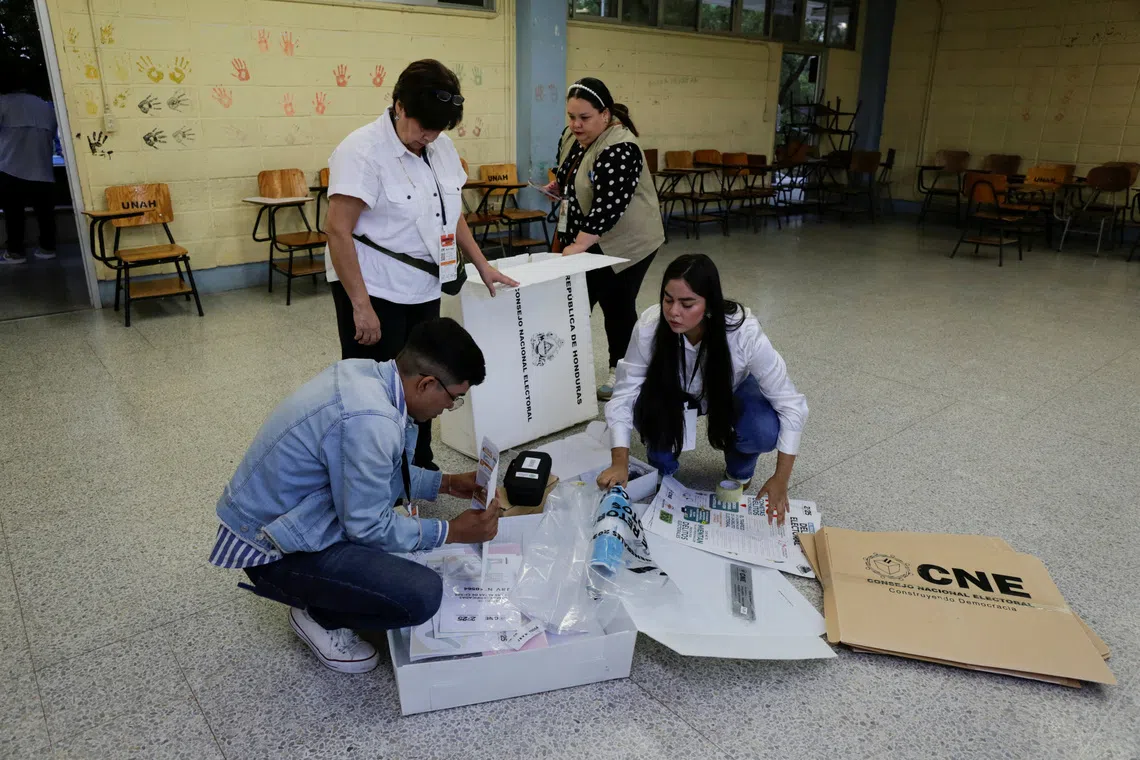
International observers and Honduran institutions expressed acute concern about electoral integrity as voting began.
Folha reports that the EU and OAS sent observation missions and that members of the U.S. Congress planned to monitor the vote.
Al Jazeera highlights the OAS's extraordinary session and U.S. diplomatic warnings, including Deputy Secretary Christopher Landau's remark that the United States would act "swiftly and decisively" against anyone undermining Honduran democracy.
The Straits Times also reports that the OAS raised alarms, reflecting broad multilateral attention even as monitoring missions assembled.
Coverage Differences
Emphasis on international vs. U.S. action
Folha de S.Paulo (Latin American) catalogs international monitoring (EU, OAS, U.S. Congress) as a response to fears over electoral integrity. Al Jazeera (West Asian) foregrounds specific U.S. diplomatic language and threats of action from named U.S. officials, casting U.S. engagement as direct pressure. The Straits Times (Asian) emphasizes the OAS alarm and international concern but gives less space to U.S. diplomatic specifics, focusing instead on multilateral observation.
Honduras election context
The domestic backdrop heightening the stakes for the vote is clear and varies in how sources frame it.
Al Jazeera highlights socioeconomic and historical context, noting that about 60% of Hondurans live in poverty.
It also notes that the homicide rate has fallen to its lowest recent level, though violence persists.
Al Jazeera recalls the 2009 coup that ousted Manuel Zelaya and the 2021 landslide that brought Xiomara Castro to power.
Folha adds immediate political constraints, citing a state of emergency since 2022 that expanded military powers.
It also reports probes by an attorney general aligned with the ruling party.
Folha mentions allegations around recordings that the National Party says were AI-generated.
The Straits Times refers to the country as impoverished while focusing primarily on the electoral contest.
Coverage Differences
Missed Information / Emphasis
Al Jazeera (West Asian) provides socioeconomic and historical detail (poverty rate, homicide trends, 2009 coup, Castro’s 2021 win) that situates the vote within longer-term governance dynamics. Folha de S.Paulo (Latin American) details recent security and institutional measures that shape the immediate electoral environment (state of emergency, attorney general probes, contested recordings). The Straits Times (Asian) stresses the impoverished setting and the close race but omits the specific legal probes and the 2022 state of emergency, making its coverage more narrowly focused on the contest itself.
Contested election coverage
Multiple sources together depict a volatile election: a near‑tie race, mutual pre‑emptive fraud claims, and international observers on alert.
A U.S. president’s public backing of one candidate adds geopolitical and political risk.
The three outlets agree the vote is highly contested and internationally monitored, but they emphasize different details.
Al Jazeera emphasizes U.S. diplomatic pressure and the socioeconomic context.
Folha offers detailed reporting on domestic probes, alleged AI‑tape claims and potential legal ramifications.
The Straits Times concisely highlights the close race and the OAS’s alarm.
Given these variances, the immediate post‑vote period carried a clear risk of widely contested results and heightened international scrutiny.
Coverage Differences
Synthesis / Tone across source types
All three sources report the contested nature of the election and international attention, but their framing differs by source_type: Al Jazeera (West Asian) ties U.S. pressure and historical context together; Folha de S.Paulo (Latin American) emphasizes domestic institutional conflict and concrete allegations and probes; The Straits Times (Asian) focuses on the tight three‑way race and OAS concerns without deep dive into domestic legal controversies. These differences reflect editorial choices and regional perspectives on what elements are most consequential.