Full Analysis Summary
Trump tariff dividend proposal
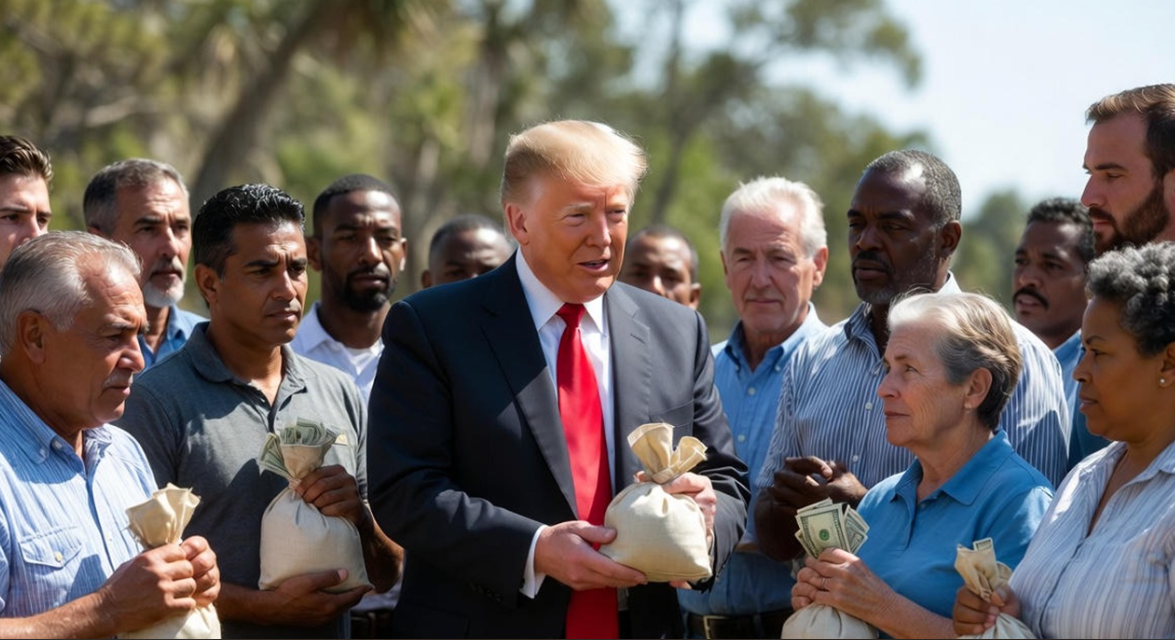
President Trump proposed a “tariff dividend” — at least $2,000 per person paid from tariff revenue — in a post on Truth Social.
The administration has released few specifics about eligibility, whether children would qualify, or whether payments would be checks or tax cuts.
Sources describe the announcement as a direct return of import-tariff revenue to Americans, while noting crucial details remain missing.
Treasury Secretary Scott Bessent said he had not been briefed and suggested the payout might take the form of tax relief rather than cash.
The proposal is therefore framed as an ambitious political offer with many unanswered operational questions.
Coverage Differences
Tone and emphasis
Zoom Bangla News (Asian) frames the plan as a politically bold proposal but emphasizes missing details and skepticism from budget analysts; Associated Press (Western Mainstream) situates the announcement in a political context (coming after Republican losses) and highlights officials’ and analysts’ doubt, including a quote that Scott Bessent hadn’t discussed the plan; Live 5 News (Other) similarly stresses the lack of details and Bessent’s comment, but focuses more on the practical question of checks versus tax cuts. Each source reports the same core facts but differs in which context they emphasize — political timing (AP), political boldness and legal concerns (Zoom Bangla), or operational mechanics (Live 5).
Reporting vs. quoted claims
AP explicitly links the announcement to recent Republican electoral setbacks and quotes administrators and analysts (e.g., Scott Bessent, Erica York), while Zoom Bangla and Live 5 primarily report the proposal and note analysts’ skepticism; thus AP attributes motive and political context more directly through quotes, whereas the other outlets emphasize the mechanics and fiscal questions.
Tariff revenues and $2,000 payout
All three outlets cite the same recent tariff-receipt figures but draw different conclusions about the arithmetic and feasibility.
Tariff receipts jumped to $195 billion in the year ending Sept. 30, up 153% from $77 billion.
That still falls far short of the roughly $600 billion that would be needed to pay $2,000 to every American, assuming children are included.
Analysts quoted or summarized across the sources question the math and say a universal $2,000 payout would be unlikely without offsets or new revenue sources.
Coverage Differences
Narrative emphasis
Zoom Bangla News (Asian) highlights Reuters’ calculation that $195 billion is far short of the roughly $600 billion needed, stressing the shortfall. Associated Press (Western Mainstream) presents the same numbers but emphasizes that tariffs remain under 4% of federal revenue and have not meaningfully reduced the fiscal 2025 deficit, framing the proposal as fiscally implausible without offsets. Live 5 News (Other) adds an alternative estimate from Yale’s John Ricco (tariffs $200–300 billion annually) and explicitly computes that a universal payment including children would cost about $600 billion, making the shortfall clear. These differences are mostly in emphasis and additional context rather than contradiction.
Source of numerical framing
AP uses the percent-of-revenue framing to show systemic insignificance (under 4% of federal revenue), while Zoom Bangla foregrounds the raw dollar shortfall as reported from Reuters, and Live 5 supplies an academic estimate to show the recurring annual revenue likely won’t bridge the gap. Each framing supports the conclusion that receipts are insufficient, but they guide readers by different metrics (percentage, absolute gap, or academic forecast).
Legal obstacles to tariff dividend
All three sources note legal and procedural obstacles.
The plan would require new Congressional legislation to authorize a payout.
The tariffs themselves face legal challenges that could eliminate the revenue stream.
Coverage highlights that the Supreme Court has been asked to weigh the administration's use of emergency powers to impose tariffs.
Outlets report justices have expressed skepticism.
If the court strikes down the tariffs, the government might have to refund importers, which would undo the revenue the dividend depends on.
Coverage Differences
Focus on legal risk vs. legislative need
Zoom Bangla News stresses that “the program would require new Congressional legislation, and the Supreme Court is weighing legal challenges,” framing the issue as both legislative and judicial. Live 5 News (Other) underscores the likely Supreme Court challenge over emergency powers and the potential practical consequence that the government could be forced to refund importers if tariffs are struck down. Associated Press highlights the legislative hurdle and notes that Treasury Secretary Bessent hadn’t discussed the plan, implying administrative uncertainty. Together the outlets cover both judicial risk and legislative/process uncertainty but vary in which consequence they foreground.
Reported practical consequences
Live 5 News explicitly reports the refund risk (refund importers) if the Court overturns the tariff authority, while Zoom Bangla notes the revenue would ‘disappear’ if tariffs are struck down — substantially the same practical consequence phrased differently. AP’s reporting adds the policy alternative (tax cuts) as reported from Bessent, signaling a different procedural route if the tariffs aren’t a viable revenue source.
Analysis of tariff impacts
Economists and budget experts cited across the pieces argue that importers and consumers ultimately bear tariffs through higher prices, meaning the measure may not deliver the intended relief and could have a regressive effect.
Sources suggest eliminating tariffs would more directly lower consumer costs, and analysts including Erica York of the Tax Foundation say the numbers 'just don't check out'.
That skepticism about both the arithmetic and the distributional effects runs consistently through the reporting.
Coverage Differences
Framing of economic critique
Zoom Bangla News and Live 5 News both state that “economists also note tariffs are effectively paid by U.S. importers and consumers through higher prices” (Zoom Bangla) and that critics argue eliminating the tariffs would be a more direct way to ease costs (Live 5). Associated Press provides a broader listing of Trump’s defenses of tariffs (protecting U.S. industry, attracting factories, raising revenue) alongside the quote from Erica York that “the numbers just don’t check out,” so AP contrasts administration claims and analyst rebuttals more explicitly. The difference is that AP sets up an explicit debate between administration rationale and expert skepticism, while the others focus on the economists’ practical critique.
Tariffs and $2,000 Payout
Taken together, the three outlets present a consistent bottom line: while tariffs have raised extra revenue, the amounts observed so far and the legal and legislative hazards make a universal $2,000 payout unlikely without additional funding or statutory changes.
Each source emphasizes different facets: political timing and administration rhetoric in AP, the headline shortfall and political boldness in Zoom Bangla, and detailed arithmetic and court-risk scenarios in Live 5.
All three record experts' skepticism that tariffs alone can reliably fund a broad, unconditional dividend.
Coverage Differences
Overall narrative convergence with varied emphasis
All three outlets converge on skepticism about feasibility but emphasize different angles: Associated Press (Western Mainstream) connects the proposal to political signaling after Republican losses and contrasts administration claims with deficit figures; Zoom Bangla News (Asian) calls the move politically bold and stresses the raw shortfall reported via Reuters; Live 5 News (Other) supplies granular cost estimates and the legal consequence (refunds) if the courts strike down tariff authority. These variations reflect each source’s editorial focus — political framing (AP), concise big-picture framing (Zoom Bangla), and operational/legal detail (Live 5) — while not contradicting the core conclusion.