
Trump Says U.S. War On Iran Could Last Five Weeks; U.S. Death Toll Reaches Six
Key Takeaways
- Trump said the U.S. military campaign against Iran could last five weeks
- U.S. military reported six Americans killed after recovering two previously unaccounted-for remains
- Article called the war the 'last best chance' to address Iran's missile and nuclear threats
Administration framing
CBS News reports that President Trump framed the U.S. operation against Iran as limited in scope, saying no U.S. ground forces were used and that the mission was designed to minimize civilian casualties, deter future attacks and neutralize Iran's malign activities.
The president also told interviewers "you'll be finding out very soon" when asked who now controls Iran, and his letter to Congress said he directed the action "pursuant to his constitutional authority as commander in chief" while submitting a report "consistent with the War Powers Resolution."
The administration acknowledged uncertainty about how long operations may continue, stating "it is not possible at this time to know the full scope and duration of military operations that may be necessary," while also saying U.S. forces remain postured to take further action as needed.
U.S. casualties and damage
CBS reports the U.S. death toll from the exchange reached six service members, and that recovery at at least one targeted site was hampered by fire after the strike.
Military sources described a makeshift tactical operations center — a triple-wide trailer used as office space — that lacked robust fortifications beyond 12-foot T-walls, and preliminary assessments suggested a one-way unmanned aerial system was used to attack the facility.
The scale of casualties included both fatalities and dozens of wounded: CBS cited U.S. Central Command saying "Six American service members and 18 service members had been seriously wounded in Operation Epic Fury as of Monday morning," and noted Defense Secretary Pete Hegseth acknowledged vulnerabilities in air defenses when he said sometimes "you might have one, unfortunately, we call it a squirter, that makes its way through."
Military objectives
CBS describes the military rationale and objectives voiced by U.S. officials: Defense Secretary Pete Hegseth said U.S. goals included destroying Iranian missiles and missile production, degrading Iran's navy and other infrastructure, and preventing Iran from obtaining nuclear weapons, with Hegseth stating the intent that "they will never have nuclear weapons."
The administration emphasised that no U.S. ground forces were used and that forces are prepared to take further action as necessary, while warning that what constitutes an end state or exit plan remained unclear in public statements.
The president's public comments also oscillated in tone and aims, with Sen. Mark Warner noting administration officials have voiced multiple different goals over the prior days.
Regional impact
CBS details the wider regional fallout: the U.S. Embassy in Riyadh was hit by two drones, causing a small fire and limited damage according to Saudi officials and prompting the embassy to urge U.S. citizens to shelter in place and close the mission for the day.
Gulf states reported mass missile and drone activity: Qatar said it intercepted 90 ballistic missiles along with dozens of drones and cruise missiles, while Kuwait reported detecting 178 missiles and 384 drones and warned of injuries among its troops.
CBS also mapped attacks across Iran — including Tehran, Isfahan, Qom and other cities — and cited the Iranian Red Crescent reporting at least 555 killed; CBS further reported Iranian strikes have killed at least 11 people in Israel.
Political reaction
CBS records immediate political responses: Key Senate Democrat Sen. Mark Warner called the strikes a "war of choice," saying "there was no imminent threat to the United States of America by the Iranians" and raising concerns about an unclear exit plan and shifting rationales from the administration.
House Speaker Mike Johnson defended the strikes, arguing "Israel was determined to act with or without the U.S.," and stressing that American strikes were needed to deter Iranian retaliation against U.S. forces.
Warner also raised questions about what obligations the U.S. might face if Iran's internal situation changed, and warned that multiple shifting goals made an endgame unclear.
More on Iran
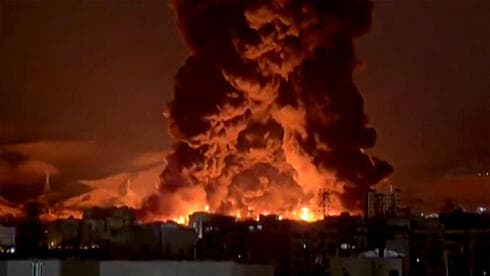
US obliterates military targets on Iran’s Kharg Island, Trump warns
13 sources compared

US Deploys About 2,500 Marines to Middle East After Iran Attacks Gulf Shipping
33 sources compared
FBI Warns of Iranian Drone Plot Based on Unverified Tip; California Says No Credible Threat
10 sources compared

White House Demands ABC Retract Report Claiming Iran Sought To Launch Drone Attacks On California
11 sources compared