Trump Signs Executive Order Expanding Cuba Sanctions, Targeting Foreign Banks And Companies
Key Takeaways
- Trump signed an executive order expanding sanctions on Cuban officials and security sectors worldwide.
- Allows penalties on foreign banks and firms doing business with Cuba's security apparatus.
- Cuba denounces the measures as illegal, abusive, and collective punishment.
Trump’s Cuba Sanctions
President Donald Trump signed an executive order on Friday expanding U.S. sanctions on Cuba, authorizing penalties that reach beyond the island to foreign companies and banks that do business with the Cuban government.
“US expands sanctions on Cuban government U”
Reuters reported that the new measure threatens “secondary” sanctions, meaning foreign banks worldwide that conduct or facilitate transactions for the Cuban government and other sanctioned individuals and entities risk losing access to U.S. dollars.

The Miami Herald described how the order authorizes the Secretary of the Treasury to restrict or block foreign banks’ access by allowing Treasury to “restrict or block their bank accounts in the United States.”
The Hill similarly said the order seeks to curtail Cuba’s access to the global banking system by imposing secondary sanctions on “people, entities and financial institutions that conduct financial transactions with those already sanctioned because of their ties to Cuba.”
The South China Morning Post framed the same step as expanding Washington’s ability to target “third-country actors deemed to support the Cuban government,” with implications for global firms “including those in China and Europe.”
The order’s scope, as described by the Miami Herald, also includes broad authority to block property in the United States belonging to foreign entities or persons found to have “materially assisted, sponsored, or provided financial, material, or technological support for, or goods or services to or in support of, the Government of Cuba.”
In parallel, the BBC reported that the executive order targets officials in the energy, defence, financial or security sectors of Cuba’s economy, as well as those accused of “human rights abuses” or corruption.
How the Order Works
Multiple outlets described the executive order’s mechanics as a combination of asset blocking, sector-based targeting, and secondary penalties aimed at the international financial system.
The Miami Herald said the order authorizes the Secretary of the Treasury to restrict or block foreign banks’ access to U.S. dollars, noting that “for the first time, the new executive order threatens sanctions on foreign companies and banks from other countries found to be helping the Cuban government.”
It also said Treasury can block property in the United States belonging to foreign entities or persons found to have “materially assisted, sponsored, or provided financial, material, or technological support for, or goods or services to or in support of, the Government of Cuba.”
The Hill described the order as expanding sanctions to target “agents, officials, or material supporters of the Cuban government,” including those who support Cuba’s security apparatus and those complicit in “government corruption or serious human rights violations.”
The South China Morning Post added that the measure allows the U.S. to block the assets of any foreign individual or entity operating in key Cuban sectors “including energy, financial services, mining and defence,” or providing material, financial or technological support to the government.
The BBC reported that Cuba’s foreign minister Bruno Rodriguez condemned the new sanctions as “illegal and abusive,” while the order itself targets people in energy, defence, financial or security sectors and those accused of “human rights abuses” or corruption.
CBS News emphasized that the order “does not name any specific sanctioned individuals,” while still increasing pressure on foreign financial institutions by threatening their access if they continue working with Cuban government entities.
Havana’s Rebuttal
Cuba’s government responded with sharp condemnation, arguing the sanctions amount to collective punishment and violate international law.
“Cuba condemns new US sanctions as 'illegal' and 'abusive' Cuban Foreign Minister Bruno Rodriguez has condemned a new wave of US sanctions on the country as "illegal and abusive"”
The BBC reported that Cuban Foreign Minister Bruno Rodriguez condemned the new U.S. sanctions as “illegal and abusive,” saying in a post on X that the “unilateral coercive measures” violated the United Nations Charter and aimed to impose “collective punishment against the Cuban people.”
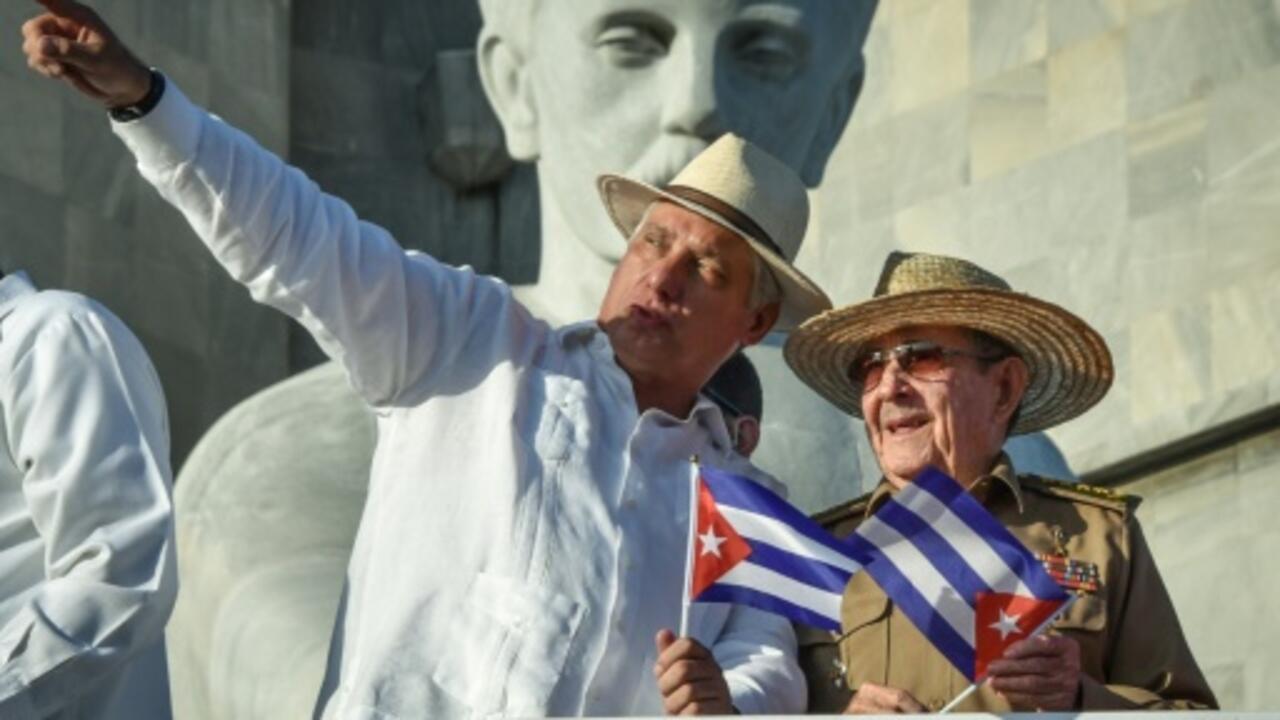
The Guardian similarly said Cuba’s foreign minister Bruno Rodriguez called the sanctions “collective punishment,” and described an “enormous 1 May procession outside the American embassy in Havana” that vowed to “defend the homeland.”
The 巴士的報 (Bus de Shi Bao) account quoted Rodriguez saying, “We firmly reject the recent unilateral coercive measures adopted” by the U.S. government, adding that the actions demonstrate an intention to impose “collective punishment on the Cuban people.”
It also quoted Rodriguez saying, “These measures are extraterritorial in nature and violate the United Nations Charter,” and that the United States has “no right whatsoever to impose measures against Cuba or against third countries or entities.”
The Guardian reported that Trump used a speech in Florida to suggest the U.S. could launch operations against Cuba, quoting him saying, “On the way back from Iran, we’ll have one of our big – maybe the USS Abraham Lincoln aircraft carrier, the biggest in the world, we’ll have that come in, stop about 100 yards offshore and they’ll say, ‘Thank you very much. We give up.’”
The BBC also reported Trump told an audience in Florida the U.S. would be “taking over” the Caribbean island “almost immediately,” and that the island lies 145km (90 miles) from the U.S. state of Florida.
Diplomacy, Threats, and Context
The sanctions were placed in a broader context of U.S. pressure on Havana, including diplomatic efforts and escalating rhetoric about Cuba’s future.
The Miami Herald said the new sanctions came after “a recent round of negotiations in Havana” in which senior State Department officials told Cuban counterparts that the island had “a small window of time to act on key U.S. demands,” including “the release of political prisoners and implementing significant economic and political reforms.”

It quoted Brian Fonseca, Vice Provost for Defense and National Security Research and Director of the Jack D. Gordon Institute for Public Policy at Florida International University, saying, “This is a clear escalation,” and adding that “Washington is doubling down on economic pressure by raising legal and financial risk for anyone helping sustain the Cuban regime’s economy.”
CBS News described the executive order as a warning to other countries and said experts viewed it as signaling that Cuba “remains a for the administration,” while Andy Gómez, a professor of Cuban studies at the University of Miami, said it carries “broader geopolitical implications” and is “a warning to countries like Russia and China to keep their distance.”
The Hill said the sanctions come amid a renewed diplomatic effort to pressure Havana to address the humanitarian crisis, noting that the State Department reportedly sent a delegation to Cuba in April to discuss a deal.
The Hill also reported that Trump has previously floated toppling the Cuban government, quoting him saying in March, “Whether I free it, take it, I think I can do anything I want with it.”
The CBC account added that the order contains an implicit warning accusing Havana of aligning itself with Iran and militant groups like Hezbollah, including that “Cuba provides a permissive environment for hostile foreign intelligence, military, and terrorist operations less than 100 miles from the American homeland.”
Reactions and Stakes
The reporting also highlighted how different U.S. and international voices interpreted the sanctions’ likely impact, particularly on foreign banks and on Cuba’s humanitarian and economic conditions.
The Miami Herald quoted Fonseca describing the sanctions as “Secondary sanctions are the centerpiece here. They’re designed to reach beyond Cuba and force global banks and companies to stop enabling the regime’s economic survival.”

The Guardian quoted Jeremy Paner, a former sanctions investigator at the U.S. Treasury’s office of foreign assets control, who said the move was “the most significant one for non-American companies since the U.S. embargo against Cuba began decades ago.”
Paner added, “Oil and gas, mining companies and banks that have carefully segregated their Cuba operations from the United States are no longer protected,” underscoring the shift from U.S.-only exposure to broader enforcement.
CBS News quoted South Florida Rep. Carlos Giménez praising the sanctions, saying, “The newly implemented sanctions against the Cuban regime are necessary to target its security apparatus—the machine that jails political prisoners and oppresses its people,” and warning that “Anyone who props up this tyranny will face serious consequences.”
The BBC described the humanitarian stakes by reporting that a U.S. blockade on oil to Cuba has led to “fuel shortages and widespread blackouts,” impacting “hospital wards, public transport and education.”
The CBC and The Hill both described uncertainty about who exactly would be sanctioned, with CBC saying “It was not immediately clear who exactly had been hit with sanctions under the order.”
More on USA
Spirit Airlines Shuts Down After Trump Bailout Talks Fail, Cancels All Flights
16 sources compared

U.S. Rebuilds Logistics Supply Chain After Ceasefire, Boosts CENTCOM Airlift From Ramstein
12 sources compared

Donald Trump Tells Congress Iran Hostilities Have Terminated After War Powers Deadline
30 sources compared
Pentagon Plans To Withdraw 5,000 U.S. Troops From Germany Over Trump-Merz Iran Dispute
59 sources compared