USA20 December, 20252 min read
Trump's Hand-Picked Board Orders Workers to Install Trump's Name on Kennedy Center Facade
Trump‑appointed Kennedy Center board voted to add his name to the institution Workers installed Trump's name on the Kennedy Center facade the day after the vote
29 outlets told this the same way.
Outlets did split on Trump Interrupted by Protesters at San Antonio Rally for Ken Paxton →
Kennedy Center renaming
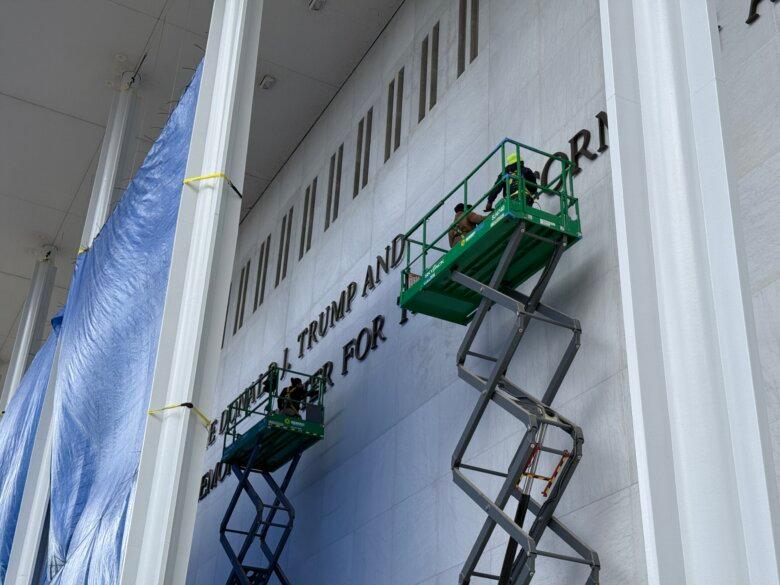
Workers installed new metal lettering and affixed the word Donald to the facade of the John F. Kennedy Center for the Performing Arts after a board dominated by President Trump's appointees voted to add his name, renaming the building as The Donald J. Trump and The John F. Kennedy Memorial Center for the Performing Arts.
“A MAGA-friendly Kennedy Center board voted Dec. 19 to add ‘The Donald Trump and’ above ‘The John F. Kennedy Memorial Center for the Performing Arts,’ sparking sharp criticism and legal questions.”
Multiple outlets reported crews working behind tarps and in cherry-picker lifts to place the new signage the day after the board vote, drawing onlookers and immediate controversy.

Kennedy Center renaming dispute
The renaming followed a rapid reshaping of the Kennedy Center's board earlier in the year: outlets report President Trump removed Biden and Obama appointees, filled the board with his own picks, and made himself chair - moves critics say enabled the swift vote and signage change.
The White House initially characterized the board's action as unanimous; several ex-officio Democratic members, most prominently Rep. Joyce Beatty, disputed that account, saying she was muted during the meeting and that the decision wasn't on the agenda.

The center's leadership and the White House defended the vote as legitimate, while opponents said the procedure and speed were designed to evade congressional authority.
Kennedy Center renaming debate
Legal experts and historians told reporters the board likely lacks authority under the center's founding statute to rename the living memorial or to add plaques or memorials, meaning Congress would probably have to act to make the change lawful. Several outlets cited statutes and legal scholars who say the 1964 law establishing the Kennedy Center fixes its name (with narrow exceptions) and forbids post-1983 memorial additions in public areas.
“Congress designated the center in 1964 as a living memorial to John F. Kennedy, and critics (including former House historian Ray Smock) say the statute forbids renaming or adding another person without revising the law.”
Others noted uncertainty about who has standing to sue or whether courts would enforce the statute. Some news pieces reported that lawmakers are considering legislative responses.
Reaction to renaming
The reaction was swift and bipartisan. Members of the Kennedy family publicly condemned the change. Performers and cultural figures expressed outrage and some canceled engagements.
Protesters gathered outside the center. Kennedy family members told reporters they view the center as a congressionally established memorial that only Congress can rename. At the same time, President Trump said he was 'honored' and praised his role in funding renovations.

Coverage varied in tone—from outraged and moralistic to matter‑of‑fact reporting of statements and cancellations. Most outlets recorded the same pattern of denunciation from the family and pushback from artists and lawmakers.
Renaming of cultural institutions
Reporters framed the Kennedy Center renaming as part of a broader pattern of the administration reshaping cultural institutions.
“The renaming is part of a broader, controversial overhaul by Trump: he replaced the Biden-appointed board with his own picks, had himself named chair, ordered major aesthetic renovations, and directed that programming be purged of what he calls ‘woke’ material.”
Many outlets linked the Kennedy Center action to an earlier rebranding at the U.S. Institute of Peace and to a wider strategy of installing allies and attaching the president’s name to government‑adjacent institutions.
Some outlets emphasized precedent and relayed the center’s defense that the move followed prior additions.
Others argued the change represents a politicized imprint on national cultural sites and warned of long‑term reputational and operational fallout.
Observers are debating whether Congress, the courts, or public pressure will ultimately reverse or validate the decision.