Protests16 December, 20252 min read
UK Authorities Keep Palestine Action Prisoners on Remand Without Bail, Hunger Strikers Near Death
This article is an automated aggregation of coverage from news outlets. Our editorials offer in-depth analysis curated by the NewsCord team.
Eight Palestine Action activists are on hunger strike while held on remand in UK prisons Several detainees have been held over a year without bail or imminent trial dates
8 outlets told this the same way.
Hunger strike and remand crisis
Eight Palestine Action activists held on remand in UK prisons have staged a prolonged hunger strike and are reported to be at acute risk of dying. Supporters and legal teams call the situation a medical and human-rights emergency.
“Lawyers say eight Palestine Action activists held in UK prisons are on hunger strike and at risk of dying.”
Lawyers say the detainees have been refusing food for weeks to protest long pre-trial detention linked to direct-action protests against Elbit Systems and RAF Brize Norton. Human-rights organisations including Amnesty and UN experts have criticised extended remand as misuse of counter-terrorism laws, and a doctor assisting families warned there is a very high risk of death.

Allegations of prison mistreatment
Prisoners and campaigners allege harsh conditions and medical neglect, including reported restrictions on mail, visits and legal correspondence, solitary measures and non-association orders, and claims of Islamophobic treatment. Detainees report systematic abuse such as solitary confinement, denial of letters, books and calls, and being ordered to remove a keffiyeh hijab. Campaigners say paramedics were not called promptly when remand prisoner Qesser Zuhrah lost consciousness, a nurse reportedly told her "you don’t decide if you go to hospital, I do," and activists say vitals and ECG results were not followed up by timely hospital care.
Strike demands and response
The strikers' stated demands are consistent across reports: immediate bail; an end to the proscription and ban on Palestine Action; removal of communication and censorship restrictions on prisoners; fair trials; and closure of Elbit Systems' UK sites. Campaigners and some MPs have sought government engagement on these demands.
“The strikers’ demands include immediate bail, an end to the ban on Palestine Action, and an end to restrictions on communications.”
More than 50 MPs and peers urged Justice Secretary David Lammy to meet representatives. A Commons request for such a meeting was declined, and campaigners say the justice secretary has not met them.
Hunger strike reporting overview
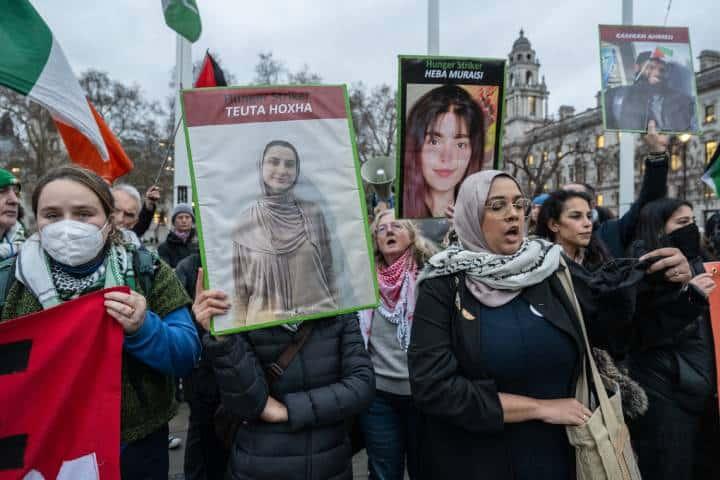
Names, current statuses and hospitalisations are reported with some variation across outlets. Several sources list eight people reported as hunger striking: Qesser Zuhrah, Amu Gib, Heba Muraisi, Jon Cink, Teuta 'T' Hoxha, Kamran Ahmed, Muhammad Umer Khalid, and Lewie Chiaramello. The Guardian records that two, Jon Cink and Umer Khalid, are understood to have ended their protests and provides day counts for the remaining strikers.
Dazed and the World Socialist Web Site report multiple hospitalisations, citing five cases. Middle East Eye gives a detailed account of Zuhrah's collapse and a disputed medical response, saying paramedics were not called until she lost consciousness and she was discharged without a diagnosis that evening.

Media coverage of hunger strike
Coverage diverges on political framing and institutional response. Alternative and activist outlets situate the hunger strike within wider criticism of UK policy toward Israel and use charged language.
“More than 50 MPs and peers, including John McDonnell and former Labour leader Jeremy Corbyn, have urged justice secretary David Lammy to meet representatives of the strikers; a Commons request for such a meeting was declined.”
Socialist Worker compares the action to the 1981 Irish hunger strikes, and critics in the World Socialist Web Site denounce what they call an unprecedented crackdown and link the protests to opposition to genocide. Mainstream reporting highlights legal, medical, and parliamentary elements and notes limited official engagement, and some accounts say Ministry and contractor bodies declined or offered only limited comment.