
Gaza Genocide · 30 April, 2026 · 7 min read
UK Court Finds Palestine Action Ban Illegal as Shabana Mahmood Appeals
High Court ruled the Palestine Action ban unlawful. Home Secretary Shabana Mahmood's government appeals the ruling to the Court of Appeal.
Legality/outcome framing.
6 of 7 outlets skipped it: "Stammheim is a highly symbolic choice of venue, not least because in the crackdown on pro-Palestine speech and activism of recent years, many Germans of the repressive climate surrounding the so-called Radikalenerlass (Radicals Decree) of the RAF era — a West German policy targeting the left, in which public sector applicants and employees were screened for constitutional loyalty and often lost the right to practice their jobs.".
24outlets compared
Same story, two versions
tap a side to read it in full
L'Humanité
“Listed as a 'terrorist organization' by the Starmer government, Palestine Action won, on Friday, February 13, a major victory: the court ruled that the movement's ban was illegal.”Read the original ↗
Al Jazeera
“London, United Kingdom – The United Kingdom is appealing the High Court’s landmark ruling that the government’s ban on Palestine Action was illegal.”Read the original ↗
Shows a dramatic framing split: some outlets present the court finding as a victory and an illegal ban, while others stress the ongoing appeal and that the outcome remains contested.
Ban Ruled Illegal
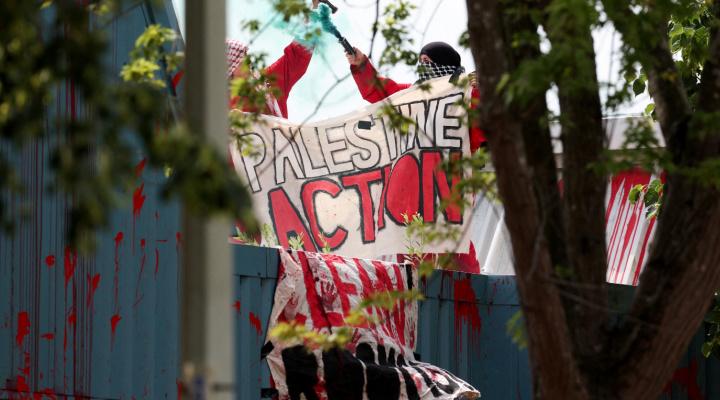
A British court ruled that the ban on the Palestine Action movement was illegal, a decision that came as the United Kingdom government had listed Palestine Action as a 'terrorist organization' and as the authorities’ crackdown had led to hundreds of arrests at solidarity demonstrations.
“Listed as a 'terrorist organization' by the Starmer government, Palestine Action won, on Friday, February 13, a major victory: the court ruled that the movement's ban was illegal.”
L'Humanité says the victory arrived on Friday, February 13, when “Three judges, under the leadership of Victoria Sharp, president of the King's Bench Division” found the ban “illegal.”L

The same article quotes Victoria Sharp describing Palestine Action as an organization “that promotes its political cause through crime and incitement to crime,” while also stating that “the court found the ban on Palestine Action to be disproportionate.”
L'Humanité adds that the judges said “a very small number of Palestine Action's activities constituted acts of terrorism within the meaning of Section 1 of the Terrorism Act 2000.”L
It also reports that British Home Secretary Shabana Mahmood announced she would appeal the decision on Friday, February 13.
In parallel, Al Jazeera reports that the United Kingdom is appealing the High Court’s ruling that the government’s ban on Palestine Action was illegal, with a two-day hearing beginning on Tuesday at the Court of Appeal in London.A
Al Jazeera also frames the proscription as still in force during the appeals process, stating it is “still illegal to show support for the group.”A
Crackdown and Arrests
The legal fight over Palestine Action is intertwined with a broader enforcement campaign that multiple outlets describe as sweeping up supporters and demonstrators.
L'Humanité says the crackdown “had led to hundreds of arrests at solidarity demonstrations” and describes detained activists as having been “on hunger strike for several months.”L
It also reports that the Labour leader Keir Starmer’s government decided on June 23, 2025, to place Palestine Action on its list of 'terrorist organizations,' “on par with groups like the Islamic State.”
The Guardian adds that the ban came into effect on 5 July and that, by the time of the high court’s judgment, “according to DOJ, more than 2,700 people had been arrested for alleged support of a terrorist group under section 13 of the Terrorism Act.”
The Guardian further states that the arrest campaign included a record-breaking civil disobedience effort coordinated by Defend Our Juries, where protesters held placards reading: “I oppose genocide, I support Palestine Action.”
Al Jazeera similarly reports that “thousands of Britons have participated in a coordinated campaign of civil disobedience,” with “more than 2,700 people arrested under terror laws for holding up signs reading, “I oppose genocide. AI support Palestine Action.””
The Times of Israël quotes rights lawyer Raza Husain telling the court that the ban had a “colossal impact on individuals, a colossal impact on rights,” and says the ban had a “risk of over-broad police action.”
Courtroom Arguments
As the appeal proceeds, the dispute centers on how counterterrorism law is being applied to protest activity and what that means for free speech and assembly.
“the watchdog said using such powers against activist groups could blur the line between protests and national security threats.”
The Times of Israël reports that Britain’s terrorism watchdog said the government risked stretching counterterrorism laws beyond their original purpose as the government appealed to uphold its ban, and it quotes independent reviewer Jonathan Hall warning that “using such powers against activist groups could blur the line between protests and national security threats.”
Hall’s report, as described by The Times of Israël, says the banning of Palestine Action exposed “real uncertainty” over whether “serious damage to property alone should qualify as terrorism,” and it adds: “There is no legal authority on what ‘serious damage to property’ means.”
The same outlet quotes Raza Husain arguing that the ban had “very serious consequences for free speech on a matter of the most acute public interest,” and that there is a “risk of over-broad police action.”
The Guardian describes the high court’s ruling as finding the ban unlawful on two grounds, including that proscription was a “very significant interference” with freedom of speech and freedom of assembly, and that it breached the home secretary’s own policy on proscription.
The Guardian also says that after allowing the home secretary permission to appeal, “the judges said that the ban should remain in place pending the appeal.”
Al Jazeera adds that the government’s case suffered a blow at the High Court but that “the proscription remained in place amid the appeals process,” and it notes that the Home Office said: “There are many lawful ways to support the Palestinian cause without being a member or supporter of this harmful organisation.”A
Trials and Defendants
Beyond the ban itself, the sources describe ongoing criminal proceedings against Palestine Action defendants and the way those cases are being argued in court.
BBC reports that Zoe Rogers, 22, is accused of breaking into the Elbit Systems factory near Bristol in August 2024 before destroying property and clashing with security guards and police, and it says she told a jury at Woolwich Crown Court that taking part in the raid was the “best thing I've ever done.”
BBC quotes Rogers telling jurors: “The prosecution know full well that we are right that this factory is supplying weapons to Israel,” and it adds her closing statement: “I can say with absolute certainty that this is the best thing I've ever done because there's a good chance that because of our action that night, innocent lives were saved.”
The BBC account lists other defendants as Samuel Corner, 23, Charlotte Head, 30, Leona Kamio, 30, Fatema Rajwani, 21, and Jordan Devlin, 31, and it says Corner faces a further charge of causing grievous bodily harm with intent to police sergeant Kate Evans, which he denies.
In parallel, The Grayzone describes a retrial of six Palestine Action activists beginning on April 13 and says a presiding judge forbade defendants from referring to the principle of jury equity in their closing speeches.
The Grayzone also claims that the defendants have been barred under court order from using terms like “genocide” or discussing the target of their direction action protests, and it says supporters were arrested outside the court for holding signs advising jurors of their right to acquit based on conscience.
Meanwhile, The Times of Israël reports that in 2025 two activists broke into the Royal Air Force Brize Norton base in southern England and sprayed two planes with red paint, and it says in the previous year six Palestine Action members raided Israeli defense firm Elbit’s UK factory, where “one member of the group hit a police officer with a sledgehammer,” leaving the officer with a fractured spine.
Germany Trial and Stakes
The Palestine Action legal battle is not confined to the United Kingdom, with outlets describing related prosecutions in Germany and the potential consequences for defendants and for political dissent.
“In the early hours of Sept. 8, 2025, a group of activists wearing black hoodies that bore the red and white logo of Palestine Action broke into the offices of Israeli arms manufacturer Elbit Systems in Ulm, southern Germany.”
+972 Magazine reports that in the early hours of Sept. 8, 2025, activists wearing black hoodies with the red and white logo of Palestine Action broke into the offices of Israeli arms manufacturer Elbit Systems in Ulm, southern Germany, and it says prosecutors allege they damaged and partly destroyed furniture, windows, and technical equipment with axes, sprayed slogans, lit pyrotechnics, and chanted “Free, free Palestine” and “Germany finances, Israel bombs.”

+972 Magazine says the five activists held in pre-trial detention are Daniel Tatlow-Devally, Leandra Rollo, Crow Tricks, Zo Hailu, and Vi Kovarbasic, and it adds that four of the five are held in their cells for up to 23 hours a day.
It also reports that lawyers raised concerns about “highly problematic” conditions, including strict monitoring of phone calls, visits, and correspondence, and it says the trial against the activists known as the “Ulm 5” began this Monday at Stammheim, the high-security prison complex outside Stuttgart.
+972 Magazine quotes Benjamin Düsberg saying: “This is about sending a signal: that direct action — especially when it targets the military-industrial complex — will be met with the full force of the state,” and it adds that “In a normal case, you wouldn’t see months of pre-trial detention for property damage and trespassing.”
In a separate Reuters-based report carried by Al-Monitor, five people appeared in court in Stuttgart on charges of causing about 1 million euros ($1.17 million) of damage at the German site of an Israeli defence company, and prosecutors say the defendants trespassed and shouted pro-Palestinian statements as they smashed office equipment, measuring devices and windows in Ulm.
Al-Monitor says the Stuttgart court has previously said that more than a dozen hearings have been scheduled in the case until the end of July.