Africa13 November, 20253 min read
UN General Assembly and Security Council Elect Kenyan Professor Phoebe Okowa, Who Accused Israel of Apartheid, to International Court of Justice
This article is an automated aggregation of coverage from news outlets. Our editorials offer in-depth analysis curated by the NewsCord team.
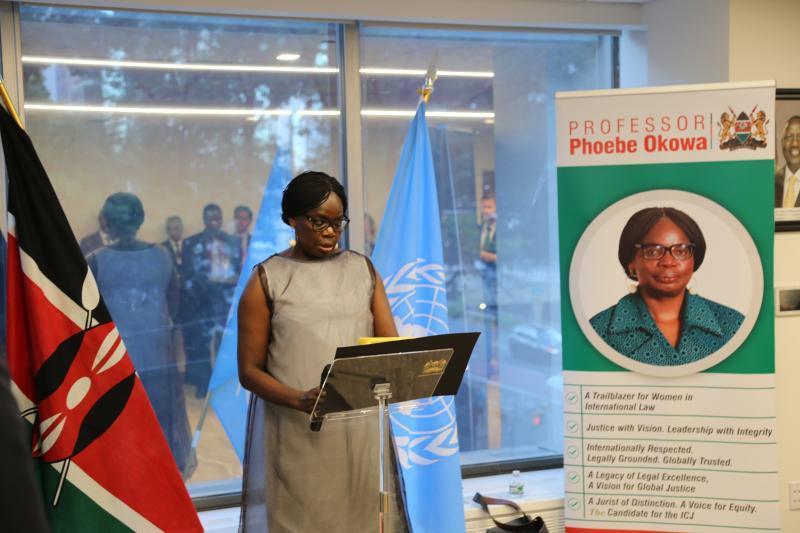
UN General Assembly and Security Council elected Phoebe Okowa to the International Court of Justice. Election announced on 12–13 November 2025 with immediate effect.
7 outlets told this the same way.
Kenyan judge elected to ICJ
The UN General Assembly and Security Council elected Kenyan Professor Phoebe Okowa to the International Court of Justice in The Hague. ChimpReports said she was elected a Member of the International Court of Justice, the UN’s principal judicial organ, and that both bodies voted with the required two‑thirds majorities. K47 Digital News reported she won the required absolute majority in both the UN General Assembly and Security Council to secure her seat at the ICJ in The Hague.
“Prof. Phoebe Okowa of Kenya has been elected a Member of the International Court of Justice (ICJ), the UN’s principal judicial organ, the Court announced.”
Nairobi Leo said she was elected after four rounds of voting on November 12, defeating three other candidates. Middle East Eye described the outcome as a historic first for Kenya, noting her election by the UN General Assembly and Security Council.

Academic and legal profile
Profiles across sources emphasize Okowa’s scholarly standing and expertise in international law. Middle East Eye describes her as a leading public international law scholar and notes her roles as Professor of Public International Law and Director of Graduate Studies at Queen Mary University of London. Middle East Eye also lists degrees including an LLB (first-class) from the University of Nairobi and BCL and DPhil degrees from Oxford.
ChimpReports similarly calls her a distinguished scholar of public international law and records an LLB (First Class) from the University of Nairobi and an LLM and PhD from King’s College London. K47 describes her as a distinguished scholar and practitioner of international law with extensive experience advising governments, participating in international tribunals, and contributing to legal scholarship. Nairobi Leo confirms her academic appointment and her role as Director of Graduate Studies.

Media tone and reactions
Coverage of reactions and tone differs markedly across the sources. K47 Digital News and Nairobi Leo convey a strongly celebratory, national tone. K47 quotes the Kenyan Ministry and government officials hailing the election as strengthening diversity and 'a win for Kenya, Africa, women in leadership and the global pursuit of justice', while Nairobi Leo records the Foreign Affairs Principal Secretary praising her 'judicial competence' and crediting Kenyan diplomatic teams.
“The ministry described Okowa as a ‘distinguished scholar and practitioner of international law’ with extensive experience advising governments, participating in international tribunals, and contributing to legal scholarship.”
ChimpReports notes official welcomes too, saying 'Kenyan President William Ruto and Foreign Affairs Principal Secretary Korir Sing'oei welcomed the appointment as a national and multilateral milestone.' By contrast, Middle East Eye's reporting includes controversy in the wider ICJ context and reports that a comment by Judge Sebutinde - 'the Lord is counting on me to stand on the side of Israel' - has drawn criticism from legal experts and calls for her disqualification over alleged bias, a tone that foregrounds institutional contention rather than unalloyed celebration.
Allegation verification
The specific claim in your prompt that Okowa accused Israel of apartheid is not supported by the provided sources. None of the supplied snippets report Okowa making such an accusation. Instead, the pieces focus on her election, qualifications, and the political and procedural context.
Middle East Eye profiles her scholarly record and reports on a separate Judge Sebutinde controversy. ChimpReports and K47 outline her election and experience, and K47 highlights expected contributions to climate change, maritime disputes, human rights, and peacekeeping.

Nairobi Leo concentrates on the voting rounds and Kenya's diplomatic effort. Because the provided sources do not include any quote or report that Okowa accused Israel of apartheid, that allegation cannot be confirmed from these texts and remains unsupported by the material provided.
Okowa at the ICJ
Looking ahead, sources suggest different framings of Okowa's anticipated impact at the ICJ. K47 and Nairobi Leo project a symbolic and practical win for Kenya and African representation, with K47 saying the election 'underscores African representation in key international institutions' and that it will 'inspire young Kenyans - especially women.' ChimpReports underscores the immediate procedural consequence - filling a vacancy under Article 15 and serving out the remainder of an existing term.
“Kenya thanked UN member states, the African Union and regional partners for their support, saying the election underscores African representation in key international institutions and the country’s diplomatic alliances.”
Middle East Eye's inclusion of broader ICJ controversy signals that some coverage will continue to interrogate impartiality and contestation within the Court. Readers should therefore expect a mix of narratives: national celebration and diplomatic pride (K47, Nairobi Leo), neutral procedural reporting (ChimpReports), and scrutiny of institutional controversies (Middle East Eye).