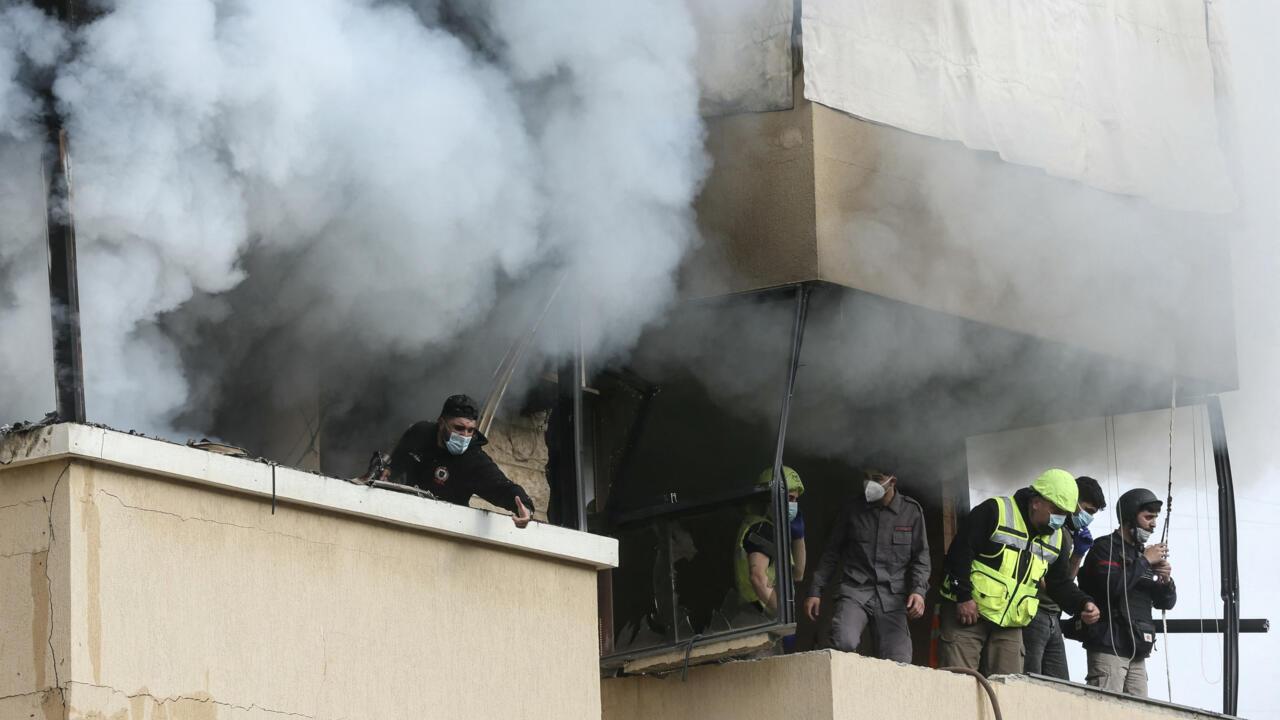
UN Human Rights Report Says Israel Killed Families and Imposed Yellow Buffer Zone in Southern Lebanon
Key Takeaways
- Destruction of villages and towns in southern Lebanon by Israeli strikes.
- Civilian and rescue worker casualties reported in Lebanon.
- Israel's plan for a Yellow Zone south of the Litani.
OHCHR: Lebanon demolitions
The United Nations High Commissioner for Human Rights (OHCHR) published a report on Friday, April 24, titled 'Deaths and Displacement in Lebanon,' documenting the first three weeks of the war in Lebanon between Israel and Hezbollah.
“The scenes of destruction in Gaza and southern Lebanon are no longer merely a visual record documenting the outcomes of Israeli military operations since 2023; they have been turned into recyclable material within rapidly spreading narrative templates, led by the technique of 'before and after'”
The report documents “several Israeli strikes during which entire families were killed,” and OHCHR says such attacks are “likely to constitute grave violations of international humanitarian law.”

Mazen Shaqoura, the UN’s representative for the Middle East and North Africa for OHCHR, recalls principles tied to Israel’s conduct in the border region.
Shaqoura says “The Israeli army is carrying out massive destruction of buildings in villages in the Lebanese border region,” and that Israel intends to transform the area into a “sterile” zone, “i.e., a zone no longer able to host any Hezbollah infrastructure.”
The report also says Israel “has unilaterally imposed a buffer zone in southern Lebanon, bordered by a 'yellow line.'”
It adds that this perimeter “accounts for about 6% of the total area of the Cedar country,” and that “all the villages located there are off-limits to civilians.”
The OHCHR account frames the destruction and displacement as part of a broader strategy for the border area, rather than isolated incidents.
Gaza and Lebanon narrative
A separate thread in the reporting focuses on how Israel justifies destruction across Gaza and southern Lebanon through a recurring narrative format.
Al-Jazeera Net describes scenes of destruction in Gaza and southern Lebanon as “no longer merely a visual record” but “recyclable material within rapidly spreading narrative templates.”

The outlet says Israel’s campaign relies on the technique of “before and after,” where “Israeli activists and accounts known for ties to the Israeli government publish two adjacent images of Lebanon and Gaza; the first shows everyday life” and “the second shows widespread destruction or ruins.”
Al-Jazeera Net says the images are paired with a one-line caption such as “This is what Hamas's victories look like,” or “Hezbollah destroyed Lebanon,” which it describes as reducing complex events into a “ready-made propaganda equation.”
In this account, the caption assigns responsibility by sequencing, with destruction framed as the “logical” outcome of Hamas or Hezbollah rather than “a direct result of Israeli military operations.”
Al-Jazeera Net adds that its Open Source Intelligence unit tracked “an organized Israeli campaign aimed at reusing images of destruction in Gaza and Lebanon within a justificatory narrative that places the victim responsible for what happened.”
The analysis also claims the same template was moved “literally” to border villages in southern Lebanon, including “Ayta al-Shab and Ramya,” with “the site name and the target entity” changed while “the wording” remained.
Netanyahu’s Christ remark
Israeli Prime Minister Benjamin Netanyahu’s remarks about Jesus and Genghis Khan became a focal point for criticism tied to the wider war.
“The United Nations High Commissioner for Human Rights (OHCHR) published on Friday, April 24, a report on the first three weeks of the war in Lebanon between Israel and Hezbollah”
In a televised address, Netanyahu said, “In this world, it is not enough to be ethical, nor is it enough to be fair, nor is it enough to be right,” and he argued that “evil can prevail over good.”
The statement, as reproduced in the reporting, cites a historian who says that “Christ does not have superiority over Genghis Khan,” and Netanyahu adds, “Because if you are powerful enough, ruthless enough, and influential, evil can prevail over good, and aggression can prevail over moderation.”
The controversy is framed as occurring while Israel faces “international isolation and global anger” over “the war of extermination in Gaza” and “continuing aggression against Lebanon and Iran.”
Anadolu Ajansı reports that Pastor Manzar Ishaq of Bethlehem’s Evangelical Lutheran Church of the Nativity condemned the “insult” and called it an attempt to justify Israel’s aggression “under the pretext of triumph over an alleged evil.”
Anadolu Ajansı quotes Ishaq saying, “Netanyahu, and his Christian Zionist allies, mock the ethics of Jesus, and this is the real and deep insult to religion.”
The same Anadolu report says Ishaq argued Netanyahu’s comparison labels the Christian message as “naive” and seeks to entrench “might is right” to justify “ongoing aggression and military brutality.”
Yellow zone and engineering
Reporting in Arabic-language outlets ties the “yellow zone” concept in southern Lebanon to a broader plan described as involving systematic destruction and engineering activity.
Al-Mudon says Israeli security propaganda is intensifying to present the image of Hezbollah rockets fired toward deep inside Israeli territory as a pretext “to build a narrative to justify the destruction and massacre of a large number of Lebanese towns south of the Litani.”

The outlet claims that Israeli occupation statements and leaks “hinted at the nature of the plan prepared to invade Lebanon,” describing discussions about “a scheme to establish a yellow zone south of the Litani, similar to the security zone imposed by the occupying army in the Gaza Strip.”
Al-Mudon says the Hebrew site Walla claimed the Lebanese army lied to Israel when it said “southern Litani had become disarmed,” and it quotes Walla’s account of Israeli officers in the northern command describing “the engineering activity in the Lebanese village of Khiam” as revealing “a fault” inside the town.
The outlet states that Walla’s report says Israeli forces found “evidence that the party had rearmed itself in the area and succeeded in smuggling weapons,” and it adds that a new Walla report suggests “an Israeli intention to implement what it described as a drastic measure in the village of Khiam.”
Al-Mudon interprets the phrasing as implying “a systematic destruction will be carried out of all infrastructure through broad engineering activity,” and it describes a method involving specialized forces entering buildings with “demolition bulldozers,” then “rigging them with explosives and blowing them up.”
It further claims that because systematic destruction “will take a long time,” it provided “another motive for the occupation to finally approve a framework to recruit more than 450,000 reservists.”
Medics killed and warnings
As the war between Israel and Hezbollah continues, Mont Carlo Internationale reports that Lebanese authorities say Israeli airstrikes have killed health workers and that the conflict is raising fears of a “Gaza-style scenario.”
“Israeli Prime Minister Benjamin Netanyahu sparked controversy with a statement that contradicted a justification for marginalizing values and prioritizing force, in which he said that 'evil can prevail over good,' citing a quote from a historian who says that 'Christ has no superiority over Genghis Khan”
The outlet says the Lebanese Ministry of Health reported “the killing of 26 health workers as a result of Israeli airstrikes since the start of the war,” and it specifies that the ministry said “the total death toll among rescuers since March 2 to today, 26 dead and 51 injured, constitutes the clearest evidence of the enemy's violent practices.”
The report links the toll to a specific incident at a health center in “the town of Burj Qalouiya in the south,” where it says another statement reported “the killing of 12 health workers” in an unofficial toll.
It also describes Israeli army spokesperson Avichai Adraei accusing Hezbollah of using ambulances “for broad military use,” while Lebanese saw this as a pretext for wider strikes.
Mont Carlo Internationale quotes the Israeli army spokesperson’s accusation and says Lebanese Ministry of Health responded that “the claim by the enemy army that ambulances are used for military purposes is merely a pretext for the crimes this army commits against humanity.”
The report further says Adraei issued a warning that “all civilian trucks that they expose themselves to danger if they travel along the coastal route he defined from the Damour area south of Beirut to Lebanon's southern border.”
It adds that the Israeli army accused Hezbollah of using civilian trucks “to camouflage the launching and transfer of rockets.”
More on Gaza Genocide
Israel’s Defense Ministry Approves F-35 And F-15I Deal With The United States
15 sources compared
Israel’s War On Gaza Leaves Thousands With Untreated Fractures As Healthcare System Collapses
16 sources compared

Middle East War Triggers Canceled Flights and Tourism Collapse in Jordan, Dubai, and Egypt
13 sources compared

Israeli Police Arrest 36-Year-Old Man After French Nun Attacked Near Jerusalem’s Old City
26 sources compared